October Housing Starts Show Ottawa Still Owes the Ledger
The October housing data are a scoreboard, not a talking point: starts momentum fell, pending starts softened, and the promised affordability ledger is still missing.
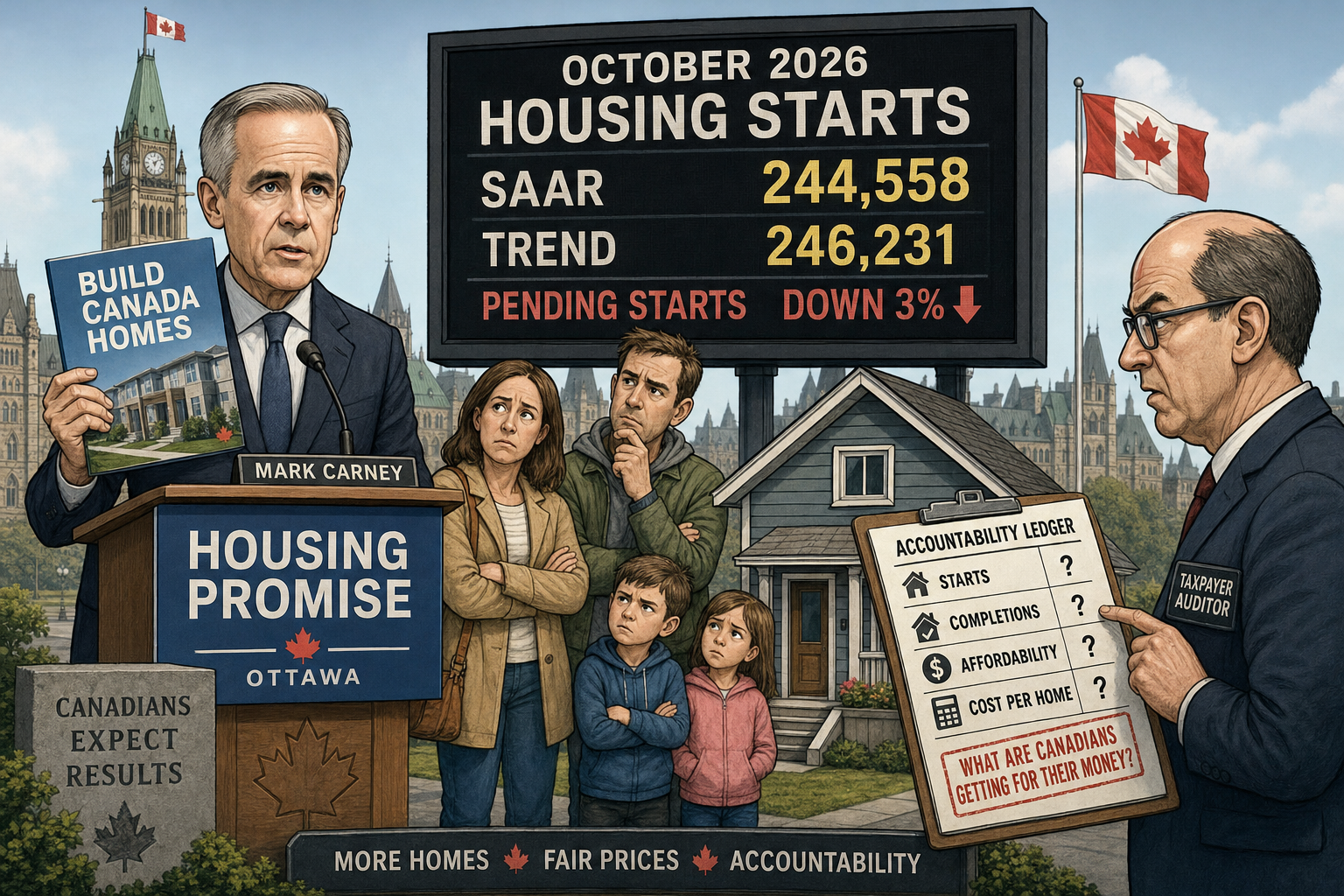
Ottawa does not need another housing slogan. It needs a scoreboard. CMHC’s October 2026 housing-starts release gives Canadians exactly the kind of monthly receipt that should be attached to every Liberal housing announcement.
The headline number moved the wrong way. CMHC says the six-month housing-starts trend declined 1.7 per cent in October to 246,231 units. The total monthly seasonally adjusted annual rate for all areas also fell 2 per cent, to 244,558 units from 250,072 in September. Canadian Press reported the same national drop on November 17.
There was one positive line: actual monthly starts in centres of 10,000 people or more rose 6 per cent year over year, to 21,059 units in October. But the year-to-date ledger is still not flattering. CMHC says actual starts in those centres reached 192,023 from January to October, down 3 per cent from the same period in 2025.
The pipeline warning matters even more. In larger centres, units under construction were flat month over month at 369,569. Completions rose 24 per cent in October, with 21,621 units finished. But approved units not yet started — CMHC’s “pending starts” measure — fell 3 per cent month over month to 139,592. That is not proof of collapse. It is a warning light Ottawa should not spin away.
CMHC deputy chief economist Kevin Hughes said October signalled reduced momentum, driven by declines in Ontario, British Columbia and Atlantic Canada. He also warned that the drop in pending starts suggests softness in the near-term construction pipeline and should be watched carefully.
This is why the Carney government’s housing accountability problem remains unresolved. Four days ago, this site noted that Budget 2026 had shifted the public emphasis away from the earlier broad homebuilding promise and toward a narrower non-market housing target. Today’s CMHC data are not a duplicate argument; they are the next monthly scoreboard showing why the missing target matters.
If Ottawa says it is building homes at crisis scale, it should publish crisis-scale reporting. Canadians should see the target number, baseline year, required monthly starts, actual starts, completions, pending starts, province-by-province misses, affordability level, subsidy per completed unit and delivery date for every federally backed program, including Build Canada Homes.
A conservative housing policy can support construction while still demanding receipts. Federal land, financing, infrastructure money and tax tools should be judged by completed homes people can afford, not by ministerial backdrops. The October numbers show reduced momentum. Now the government should release the starts-to-affordability ledger before asking taxpayers to trust the next announcement.
- CMHC: Housing starts and construction data for October 2026
- Canadian Press via CityNews Halifax: CMHC’s annual pace of housing starts in October down two per cent from September
- iVoteLiberal.com: Budget 2026’s Missing Housing Target Needs a Starts Ledger
This article is a November 17 monthly data update to the existing housing-target ledger issue. It relies on CMHC data and Canadian Press reporting, and does not allege criminal wrongdoing.