Budget 2026’s Missing Housing Target Needs a Starts Ledger
If Ottawa changes the benchmark after the promise gets hard, Canadians should get the before-and-after receipts.
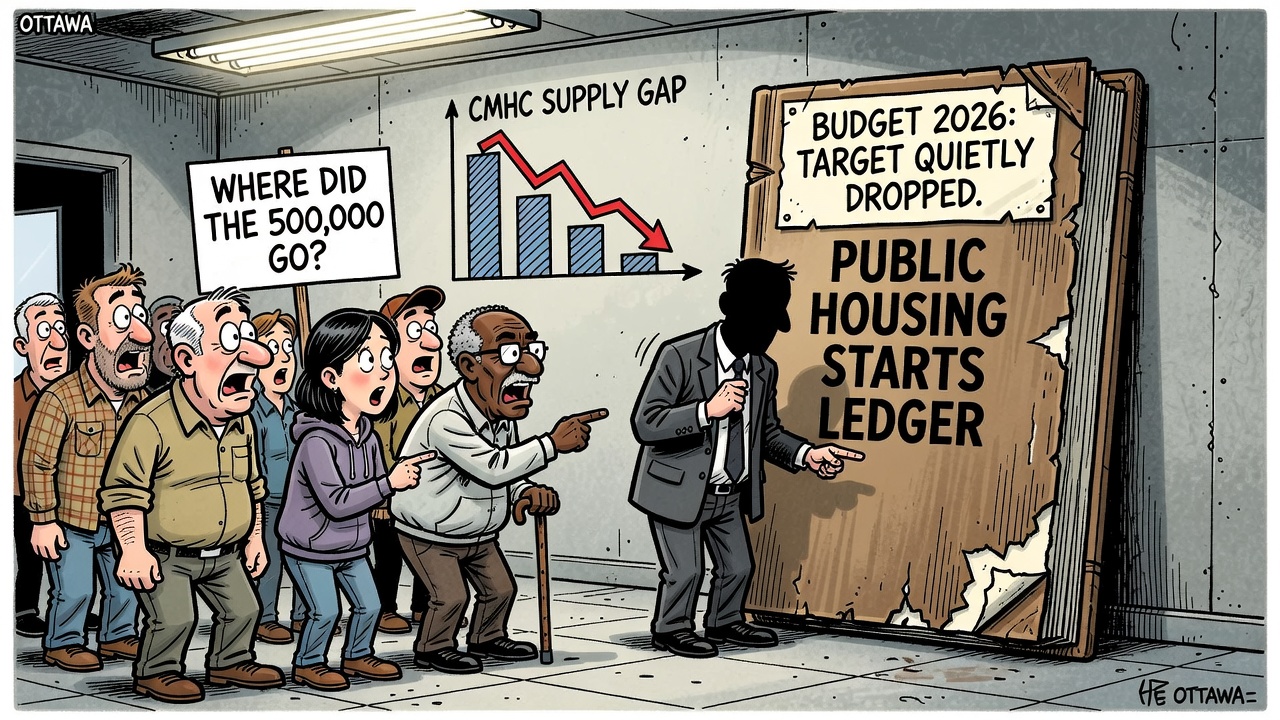
The Carney Liberals did not solve the housing crisis by changing the wording. They made the accountability problem clearer. Canadian Press reports that Budget 2026 drops the Liberals’ earlier language about doubling the pace of overall home construction, a promise tied to the 2025 campaign and Budget 2025.
In its place, Budget 2026 highlights a narrower target: tripling non-market housing construction to 24,000 starts per year over the next decade. Non-market homes matter. Co-ops, supportive housing and deeply affordable units should be built faster. But that is not the same thing as a transparent national plan to close Canada’s full housing supply gap.
The distinction matters because Canadians were sold scale. Families priced out of starter homes were not told the federal target would quietly migrate from an overall homebuilding benchmark to a smaller public-and-non-profit lane. If the original doubling goal still exists, Ottawa should say so plainly. If it does not, the government should admit the promise changed.
Canadian Press says Housing Minister Gregor Robertson’s office, after repeated requests, pointed back to an older statement that Ottawa was still “working toward doubling homebuilding over the next decade.” That is not a metric. It is a sentence. A government serious about affordability should be able to publish the target number, the baseline year, the annual starts required, and the province-by-province progress table.
The official housing math is not comforting. CMHC’s Fall 2026 Housing Supply Report says business-as-usual construction is roughly 231,000 homes per year. To restore pre-pandemic affordability by 2036, CMHC estimates Canada would need about 417,000 to 469,000 homes annually. That leaves a yearly supply gap of roughly 187,000 to 238,000 homes.
Budget 2026 also pledges $13 billion over 10 years for Build Canada Homes and related housing and homelessness measures. Taxpayers deserve to know what that money buys in actual starts, not just announcements, ribbon cuttings and federal logos on construction hoarding. Spending more while reporting less is how Ottawa turns crisis policy into branding.
Conservatives should not dismiss every federal housing role. Ottawa controls immigration levels, infrastructure dollars, federal land, financing tools and tax rules. But federal intervention should come with measurable deliverables. The standard is simple: if ministers claim a program will build homes, publish the starts, completions, unit type, affordability term, subsidy per door and delivery date.
The Liberals should release a housing target-to-results ledger: the original 2025 promise, Budget 2025 wording, spring update language, Budget 2026 wording, current national-starts target, market and non-market targets, CMHC affordability requirement, and quarterly results by province. Canadians do not need another slogan about “building Canada.” They need to know where the missing housing target went.
- Canadian Press via National Newswatch: Budget 2026 shifts Liberal government’s language on home construction targets
- Canadian Press via Ottawa CityNews: Budget 2026 shifts Liberal government’s language on home construction targets
- Government of Canada: Budget 2026, Chapter 3: Build Canada Strong
- CMHC: Fall 2026 Housing Supply Report
- CMHC: Slowing home construction threatens recent affordability gains
This article distinguishes between Budget 2026’s non-market housing target and broader housing-supply targets reported by Canadian Press and CMHC.