Carney Promised Parliament a Vote. Publish the EU Mandate Before Montreal.
A deeper Canada-EU alliance may be defensible. Hiding the mandate until after momentum hardens is not.
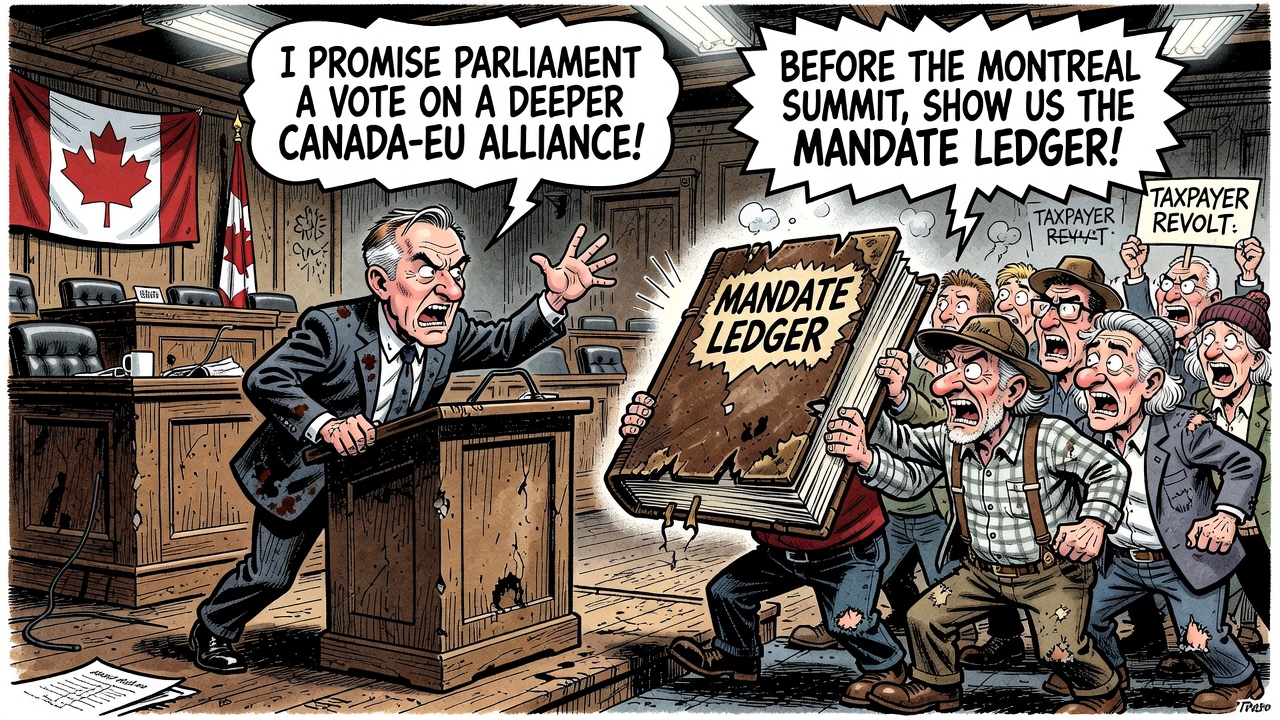
Prime Minister Mark Carney gave Canadians one important receipt in Strasbourg: he said the final structure of his proposed deeper Canada-EU alliance would go through debates, relevant committees and, ultimately, a vote in the Canadian Parliament.
Good. Now make that promise useful before the train leaves the station.
The government is not merely refreshing a friendship speech. The PMO says Carney proposed a Canada-EU partnership that is “far deeper and more integrated.” Its own release points to critical minerals, defence industries, energy, artificial intelligence and compute, youth mobility, financial services, space, payments, research and strategic autonomy. CityNews and The Canadian Press reported that Carney also pointed to the next major checkpoint: the Canada-EU summit in Montreal on October 29 and 30, 2026.
That deadline matters. A parliamentary vote after negotiators and leaders have already framed the package is not the same as parliamentary control. If the government has a mandate, Canadians should see the public version now: objectives, red lines, legal authority, provincial consultation, cost exposure, labour-mobility terms, procurement implications, data and financial-services rules, dispute-settlement options and opt-outs.
This is not an anti-Europe argument. Conservatives should welcome more trade with democratic allies, stronger defence supply chains, reliable critical-mineral customers, and less dependence on hostile regimes. But good alliances are not built by asking citizens to applaud labels they have not been allowed to read. “Associate member,” “unique alliance,” “different framework” — the name matters less than the obligations.
Carney’s speech, published by Global News, welcomed Ursula von der Leyen’s ambition to move beyond CETA and open the door to Canada becoming the EU’s first associate member. He also sketched out possible cooperation on youth mobility, Erasmus+, Horizon, LNG and hydrogen, AI standards, critical raw materials and an integrated market for financial services. Each item may have benefits. Each item also has a receipt Canadians deserve to inspect.
Will provinces have a veto where energy, credentials, labour markets, procurement or natural resources are touched? Will Canadian firms face European content rules or standards alignment? Will defence contracts favour Canadian workers or pull Canadian procurement into Brussels’ priorities? Will youth mobility change immigration pressures or public-service obligations? Will financial-services integration affect Canadian regulators, privacy rules, capital requirements or consumer protection?
If the answers are reassuring, publish them. If confidentiality is needed for tactical bargaining, brief committees in camera and release public summaries. What Ottawa cannot do is sell sovereignty as “resilience,” promise a vote later, and then treat every practical detail as premature until it is politically too late.
Parliament should not be a ceremonial rubber stamp after the Montreal summit. It should be the place where the mandate is tested before Canada signs onto anything deeper, broader or more binding.
- CityNews / The Canadian Press: Carney says new EU partnership will go to debate, vote in Parliament
- Global News: Read a transcript of Carney’s speech to the European Parliament
- Prime Minister of Canada: Prime Minister Carney deepens ties with trusted allies in visit to France and the United Kingdom
- iVoteLiberal.com: Before Carney Rewires Canada Toward Brussels, Publish the Mandate
This follow-up focuses on the September 17 parliamentary-vote promise and the October 29-30 Montreal summit deadline. It argues for disclosure before decisions harden, not against co-operation with democratic allies.