Before Carney Rewires Canada Toward Brussels, Publish the Mandate
If Ottawa is exploring a deeper Canada-EU arrangement that stops short of full membership, Canadians should see the sovereignty, labour-mobility, procurement and cost ledger now.
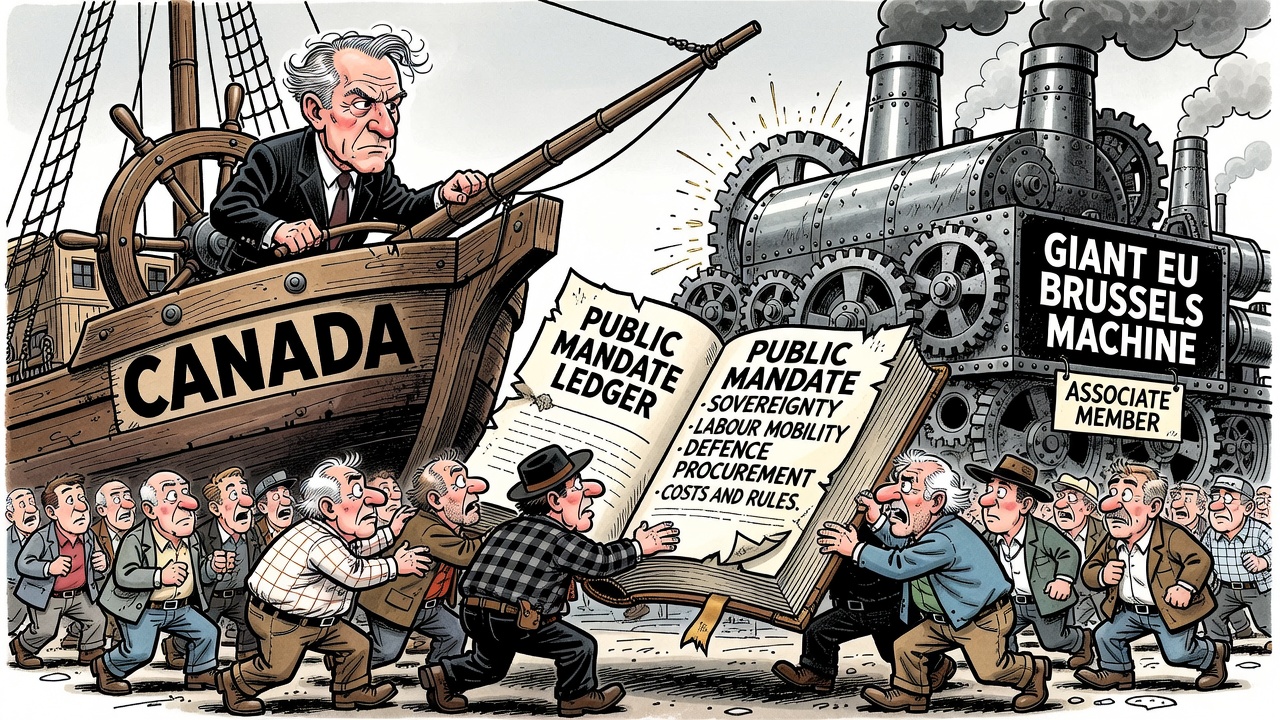
Prime Minister Mark Carney is again asking Canadians to accept a major international turn on trust. Reports this weekend said his government is exploring whether Canada could move toward an EU “associate member” style arrangement. Other reporting has described the emerging Canada-EU package as a unique partnership that would stop short of membership but still deepen ties across trade, defence, critical minerals, technology and supply chains.
That may sound tidy in a summit communiqué. It is not tidy for a country that still has provinces, Parliament, courts, workers, taxpayers and exporters who deserve to know what Ottawa is bargaining away, what it is seeking, and what lines it will not cross.
The issue is not whether Canada should talk to Europe. Conservatives should support freer trade with democratic allies, stronger defence industrial capacity, critical-mineral partnerships and less dependence on hostile regimes. The issue is mandate before momentum. Once governments wrap a negotiation in “strategic partnership” language, the hard questions often arrive too late, after officials have already narrowed the options and leaders have already shaken hands.
Carney’s own record shows why a ledger is needed. In June, the PMO said Canada and the EU had forged a new strategic partnership across trade, energy, climate and technology, and that Canada had joined the EU’s Security Action for Europe initiative as the first non-European nation in the program. The same readout highlighted a Canadian tactical-radio contract for Polish Cyber Command under SAFE, with more defence opportunities expected.
Defence exports and allied procurement can be good for Canadian workers. But if Canada is becoming more deeply plugged into European defence, industrial and regulatory systems, the public should see the terms. Will Canadian firms face EU-content preferences, subsidy rules or standards alignment demands? Will provinces be consulted before critical-mineral, energy or procurement commitments are made? Would any arrangement affect labour mobility, immigration processing, credentials, public benefits, data rules, agriculture or environmental regulation?
Supporters will say this is not EU membership. Fine. Then publish the document that proves where it begins and ends. “Not membership” is not the same as “no sovereignty risk,” “no fiscal exposure,” or “no rule-taking.” Canada can co-operate with Brussels without copying Brussels’ habit of making ordinary voters feel decisions were made somewhere else.
A conservative accountability test is simple: publish the negotiating objectives, legal basis, provincial consultation record, parliamentary briefing plan, expected labour-mobility implications, procurement obligations, regulatory-alignment requests, cost estimates, dispute-settlement options, opt-outs and red lines. If officials need confidential space for tactics, provide classified committee briefings and public summaries.
If Carney can secure better market access and defence opportunities on Canadian terms, disclosure will help prove it. If this is an elite rebrand of sovereignty-by-communiqué, Canadians should know before the mandate hardens in Brussels.
- Reuters: Carney pushes idea of making Canada associate member of EU, WSJ reports
- Associated Press: Canada PM seeks ‘associate member’ ties with EU that would stop short of joining the bloc
- Yahoo Finance / The Canadian Press: EU envoy says unique partnership with Canada won’t look like other countries’ deals
- Prime Minister of Canada: Prime Minister Carney meets with European Council President António Costa and European Commission President Ursula von der Leyen
- Prime Minister of Canada: Prime Minister Carney announces first-ever Canada Investment Summit
This article argues for disclosure around international negotiations. It does not allege unlawful conduct by Canadian officials, EU officials, companies, investors or partner governments.