Carney’s China EV Deal Is Now a CUSMA Back-Door Test
Washington is saying the quiet part out loud: Canada’s China reset is now a trade-security problem.
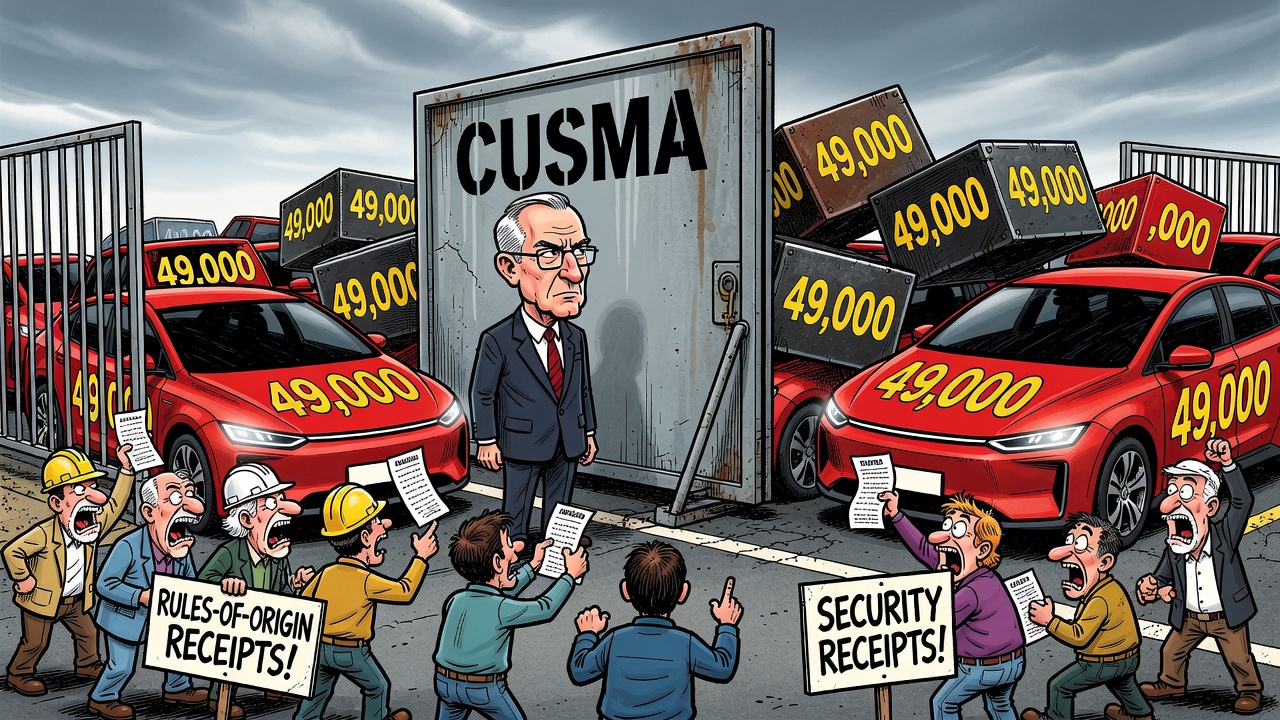
The CUSMA fight is no longer only about tariffs, sunset clauses and Donald Trump’s negotiating style. It is now about whether Mark Carney’s China strategy is creating a back-door risk for Canada’s most important trade relationship.
On July 1, the United States declined to renew USMCA/CUSMA in its current form. The agreement remains in force, but without a clean extension the three countries move into annual reviews unless they later agree to renew. Canada’s official response, from Minister Dominic LeBlanc, was to reaffirm “unwavering support” for CUSMA and its renewal after the trilateral review meeting.
That is the diplomatic line. The accountability problem is what U.S. Trade Representative Jamieson Greer told Global News afterward. Greer pointed to Canada’s deepening ties with China and said Washington does not want Canada bringing in Chinese investment and Chinese cars, then sending them into America. He called that approach “totally at odds” with the U.S. position.
This is not an abstract worry. Global connected Greer’s comments to Carney’s January rapprochement with Beijing, including a deal allowing up to 49,000 Chinese-made electric vehicles into Canada at a 6.1% tariff while China dropped tariffs on Canadian agricultural goods. The first shipments reportedly began arriving in May. Ottawa may see that as diversification. Washington plainly sees a potential hole in the North American trade wall.
Carney cannot sell himself as the sober economic manager while asking workers to accept secret trade-offs. If the Chinese EV quota is harmless to CUSMA, publish the proof. Show the exact quota terms. Show how rules of origin stop Chinese vehicles, batteries or subsidized components from being re-labelled through Canada. Show the forced-labour screening process. Show what Investment Canada is doing with Chinese capital in sensitive supply chains. Show what Ottawa told U.S. negotiators before the July 1 review.
A conservative accountability standard does not require pretending China trade should never exist. It requires protecting Canadian jobs, Canadian sovereignty and Canadian leverage. If Beijing wins easier access, farmers get short-term tariff relief, and auto workers inherit CUSMA uncertainty, Canadians deserve to know who made that bargain and on what terms.
The Prime Minister wanted credit for moving beyond U.S. dependence. Fine. But independence is not the same thing as drifting into Beijing’s orbit while the United States writes the risk into CUSMA talks. Carney’s China EV deal now needs public receipts before Canadians are asked to believe it did not weaken the trade deal their paycheques depend on.
- Global News: U.S. flags concerns over Canada’s ties to China as CUSMA renewal talks continue
- Global Affairs Canada: Statement by Minister LeBlanc following trilateral CUSMA joint review meeting
- CBS News: U.S. says it won’t extend key trade deal with Canada and Mexico
- iVoteLiberal.com: CUSMA sunset-clock accountability context
This article does not claim CUSMA has ended or that Chinese vehicles are currently entering the United States through Canada in violation of CUSMA. It argues that Ottawa must publish the safeguards and negotiating receipts now that U.S. officials have raised the risk publicly.