CUSMA’s Sunset Clock Is Carney’s Trade Receipt Test
The agreement is not dead. But the certainty Canada was promised is now on a clock — and Carney owes workers the receipts.
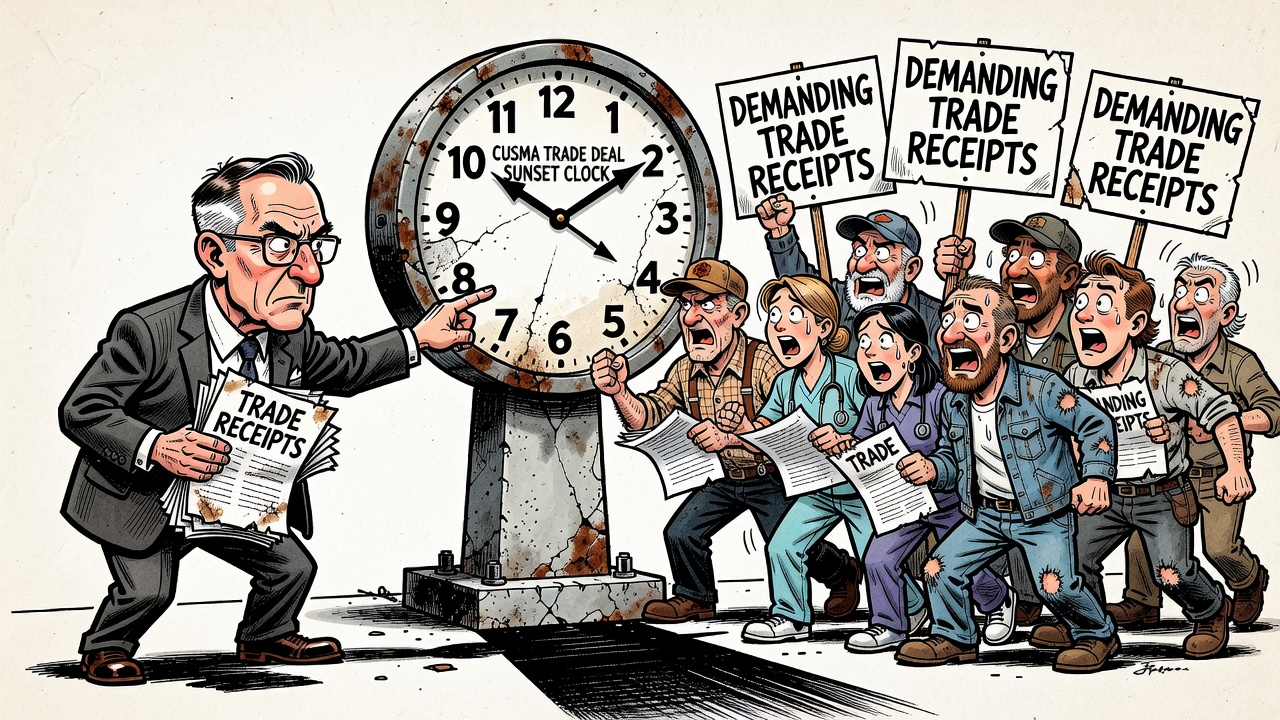
The U.S. decision not to extend CUSMA should end one Liberal talking point immediately: competence is not a slogan. It is a result. Prime Minister Mark Carney sold himself as the steady economic manager for a dangerous U.S. trade environment. On the first major CUSMA deadline, Canada did not get the clean 16-year extension it wanted.
That does not mean the deal vanished overnight. Global Affairs Canada says CUSMA remains fully in force until 2036 and can still be renewed at any time for another 16-year period. The Congressional Research Service explained the mechanism months ago: the agreement was due for its first joint review on July 1, 2026, and if all three parties did not confirm extension, annual reviews would continue until an extension is agreed or the agreement terminates.
That is why Carney and Trade Minister Dominic LeBlanc should stop congratulating themselves and publish the negotiating ledger. CBS and ABC both reported that the Trump administration would not renew the agreement by the July 1 deadline. Canada’s own statement says LeBlanc met U.S. Trade Representative Jamieson Greer and Mexico’s Marcelo Ebrard, reaffirmed Canada’s support for renewal, and raised sectoral tariffs on Canadian steel, aluminum, autos and lumber. Fine. Now show Canadians what was actually on the table.
A conservative accountability standard is simple: no panic, no bluffing, no secret handshake politics. Publish Canada’s written extension position. Publish the U.S. demand list, with necessary national-security redactions. Publish a sector-by-sector risk table for autos, parts, steel, aluminum, lumber, agriculture, energy and small exporters. Publish which Canadian concessions were ruled out, which were negotiable, and which provinces and industry groups were consulted before the deadline.
This matters because CUSMA is not an abstract diplomatic trophy. The Government of Canada calls it the framework for one of the world’s largest free-trade regions and says Canada-U.S. goods and services trade reached C$3.5 billion crossing the border each day in 2025. When that framework is pushed onto an annual review track, factories, farmers, ports, truckers and investors face a different risk calculation.
Carney cannot control Washington. He can control transparency in Ottawa. If Canada is truly negotiating from strength, the government should prove it with documents, timelines and measurable fallback plans — not just ministerial quotes after the deadline passed.
The receipt test is now public. What did Canada ask for, what did Washington refuse, what did Mexico support, and how will Ottawa protect Canadian workers if CUSMA remains stuck on the sunset clock?
- Global Affairs Canada: Statement by Minister LeBlanc following trilateral CUSMA joint review meeting
- Congressional Research Service: USMCA Joint Review: Process and Role of Congress
- CBS News: U.S. says it won't extend key trade deal with Canada and Mexico
- ABC News: U.S. won’t renew trade deal with Mexico and Canada
- Government of Canada: The Canada-United States-Mexico Agreement (CUSMA)
This article does not claim CUSMA has ended. It argues that the failure to secure a July 1 extension increases uncertainty and requires public negotiating receipts.