Leaked CAF Report Confirms the Recruitment Crisis Is Now a Training Crisis
The Liberal government wanted a recruitment headline. The leaked CFLRS report points to the harder question: are new recruits being screened, supported and trained to become ready soldiers, sailors and aviators?
There is a real story here — and it is stronger than the viral clips because the underlying document is now public and CBC says defence officials verified its authenticity.
The document is a 15-page internal Canadian Forces Leadership and Recruit School report titled “Initial Observations — Impact of Changes to CAF Recruiting Policies at Basic Training Over 2025.” It is dated January 27, 2026 and signed by LCol M.R. Kieley, commandant of CFLRS. Some social posts have said “Kelly”; the document and CBC identify the officer as Kieley.
- CBC reported that defence officials verified the leaked report’s authenticity.
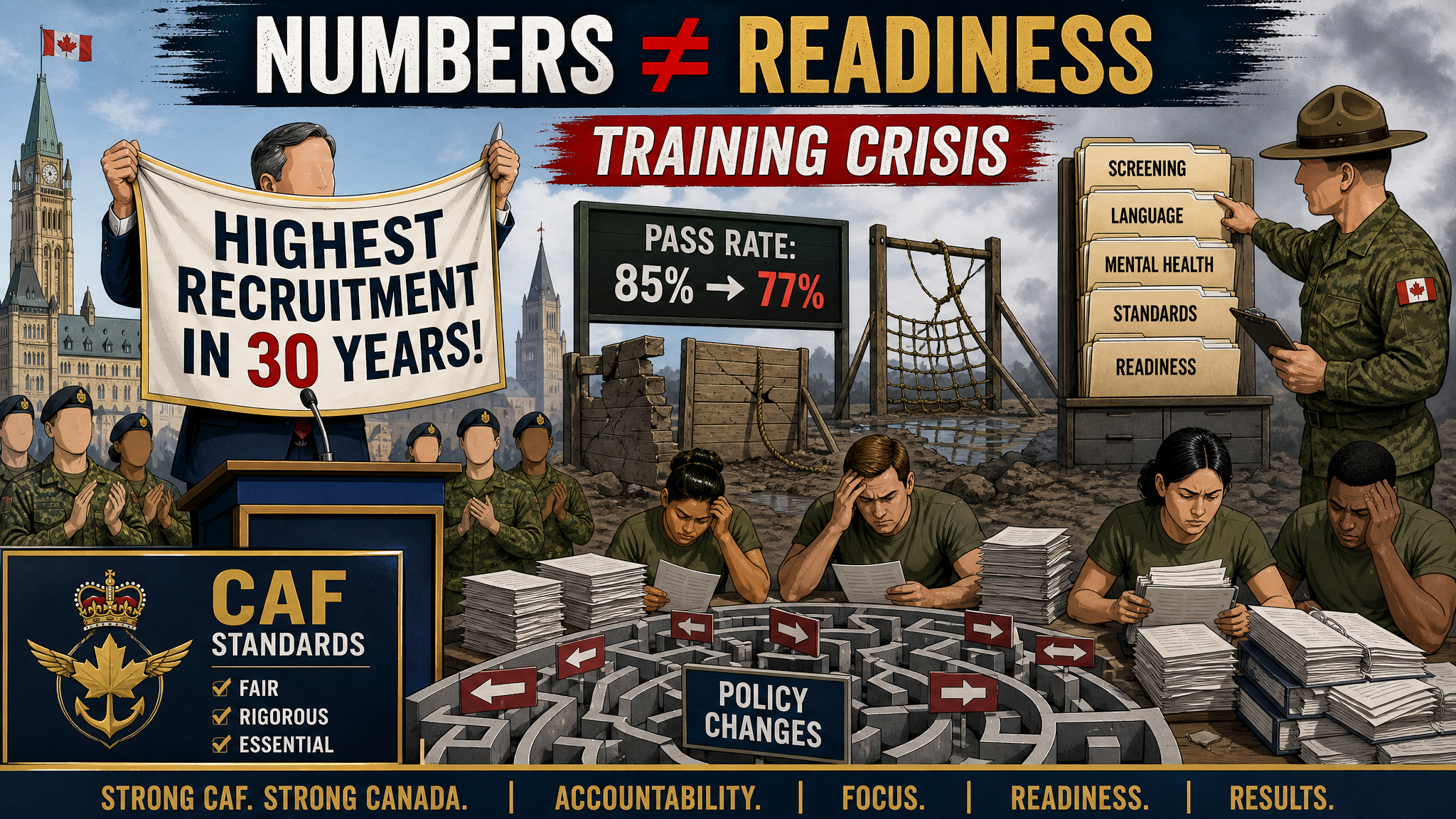
- The report says the basic-training success rate fell from 85% in 2024 to 77% in 2025.
- The share of candidates needing multiple attempts rose to 14.89%, compared with 8.44% in 2024.
- The report flags mental-health concerns, culture shock, language/cultural integration problems and friction inside the training system.
National Defence announced in April that the CAF had reached its highest Regular Force recruitment in more than 30 years, enrolling 7,310 Regular Force members in fiscal year 2025/26. The government also said the CAF enrolled 1,400 permanent residents, up sharply from 823 the year before and 109 in 2023/24.
Those numbers sound good in a press release. But the CFLRS report shows why recruitment volume is not the same thing as military readiness. A bigger intake can become a training crisis if screening, language capacity, mental-health supports, standards and course design do not keep up.
The wrong lesson would be to attack immigrants or permanent residents who want to serve Canada honourably. Many do, and Canada should respect that service. The right lesson is that the military is not a social-program dashboard. It is a fighting institution, and basic training exists to test whether recruits can become effective members of that institution.
CBC’s report says Kieley flagged candidates with as little as three months’ residency in Canada, culture shock, higher failure in certain units, conflict among some recruits and cases where some officer candidates struggled with expectations around treating women as peers. Those are not reasons for bigotry. They are reasons for better screening, clearer eligibility, stronger language and cultural preparation, and honesty from Ottawa.
The Liberals cannot rebuild the Canadian Armed Forces with press-release metrics. They need to prove that the people entering the system are being prepared to succeed, that standards are not being quietly softened to meet targets, and that training schools are not being asked to absorb policy changes without enough support.
That means Parliament should ask direct questions:
- Which recruiting policies changed before the 2025 drop in basic-training success?
- How many recruits arrived with language, literacy or employability barriers that should have been caught earlier?
- Were medical and mental-health screening standards changed, and what were the downstream effects?
- How many permanent-resident recruits were fully employable in their intended occupations at enrolment?
- What support was given to CFLRS before the intake surge?
- Will the government publish a redacted version of the report and its corrective-action plan?
This is the same question raised by our earlier CAF recruitment piece, but now with a clearer document trail: are Canadians getting a stronger military, or just better recruitment optics?
The bottom line: Canada needs more people in uniform. But Canada also needs a military that can train, integrate and deploy them. If the pass rate falls and training friction rises, the Liberal government cannot call that a success simply because enrolment numbers went up.
- CFLRS report PDF — “Initial Observations — Impact of Changes to CAF Recruiting Policies at Basic Training Over 2025”
- CBC News — leaked report shows basic training pass rate fell after military recruitment changes
- National Defence backgrounder — CAF recruitment results and permanent-resident enrolments
- iVoteLiberal May 7 follow-up — leaked CAF recruitment docs and readiness questions