Leaked CAF Recruitment Docs Raise New Questions About Liberal Defence Management
Juno News says leaked military documents point to serious problems inside Canadian Armed Forces recruitment. The Liberal government is celebrating higher enrolment numbers — but Canadians deserve to know whether readiness and standards are being protected.
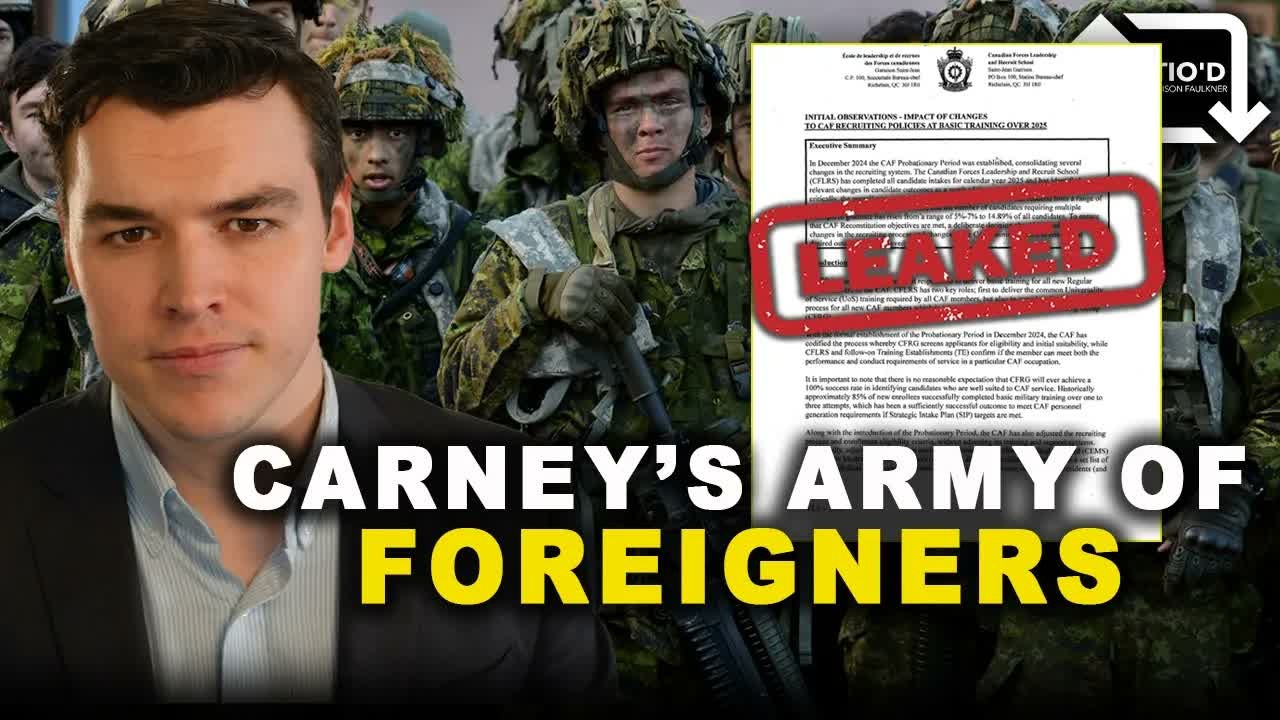
Canada needs a serious military. That means enough people, yes — but also the right training, language capacity, security screening, discipline, cohesion and readiness. A military cannot be rebuilt by chasing enrolment headlines while ignoring what happens after recruits arrive.
A new Juno News video, “Leaked military docs reveal SURGE in foreign CAF recruits,” reports that internal military documents describe dysfunction linked to a rapid rise in foreign-born, non-citizen recruits entering the Canadian Armed Forces pipeline. Juno says the documents point to recruits arriving at basic training unable to read or communicate effectively in English or French, and to officer-training platoons experiencing ethnic and cultural conflict.
National Defence announced in April that the CAF reached its highest Regular Force recruitment in more than 30 years, enrolling 7,310 Regular Force members in fiscal year 2025/26. The same government backgrounder says the CAF enrolled 1,400 permanent residents that year — up from 823 the year before and 109 in 2023/24.
That does not mean every permanent-resident recruit is a problem. It does mean the system changed quickly, and Canadians are entitled to ask whether training, screening, language requirements and unit cohesion kept pace.
- Are standards being maintained, or adjusted to meet recruitment targets?
- Are recruits arriving with the language and literacy capacity needed for military training?
- Are permanent-resident enrolment rules clear, consistent and tied to operational needs?
- Is the government measuring success by readiness — or by press-release numbers?
The government itself acknowledged that on February 23, 2026, the CAF updated permanent-resident enrolment eligibility because most military occupations require members to be Canadian citizens or to have completed three years of physical residency in Canada as a permanent resident to become fully employable. That is an important admission: employability, security and occupation-specific requirements matter.
The Auditor General has also warned that the CAF did not know why applicants abandoned the recruiting process between April 2022 and March 2025. In other words, Ottawa has been trying to fix a recruitment crisis while still lacking basic management information about why people drop out of the system.
The point is not to attack immigrants, permanent residents or anyone who wants to serve Canada honourably. The point is that a military is not a social-program dashboard. It is a fighting institution. Standards exist for a reason. Language capacity exists for a reason. Security screening exists for a reason. Unit cohesion exists for a reason.
If the Liberal government is expanding recruitment while lowering or blurring standards, Canadians deserve to know. If leaked documents show problems the government has not admitted publicly, Parliament should demand answers. And if everything is fine, National Defence should be able to prove it with transparent data — not slogans.
The Liberal message is that recruitment numbers are improving. The accountability question is more important: is Canada's military actually becoming more ready?
- Juno News — “Leaked military docs reveal SURGE in foreign CAF recruits,” May 1, 2026
- National Defence backgrounder — CAF recruitment results and permanent-resident enrolments, April 20, 2026
- National Defence release — highest recruitment in 30 years, April 20, 2026
- Auditor General report — Recruiting for Canada's Military