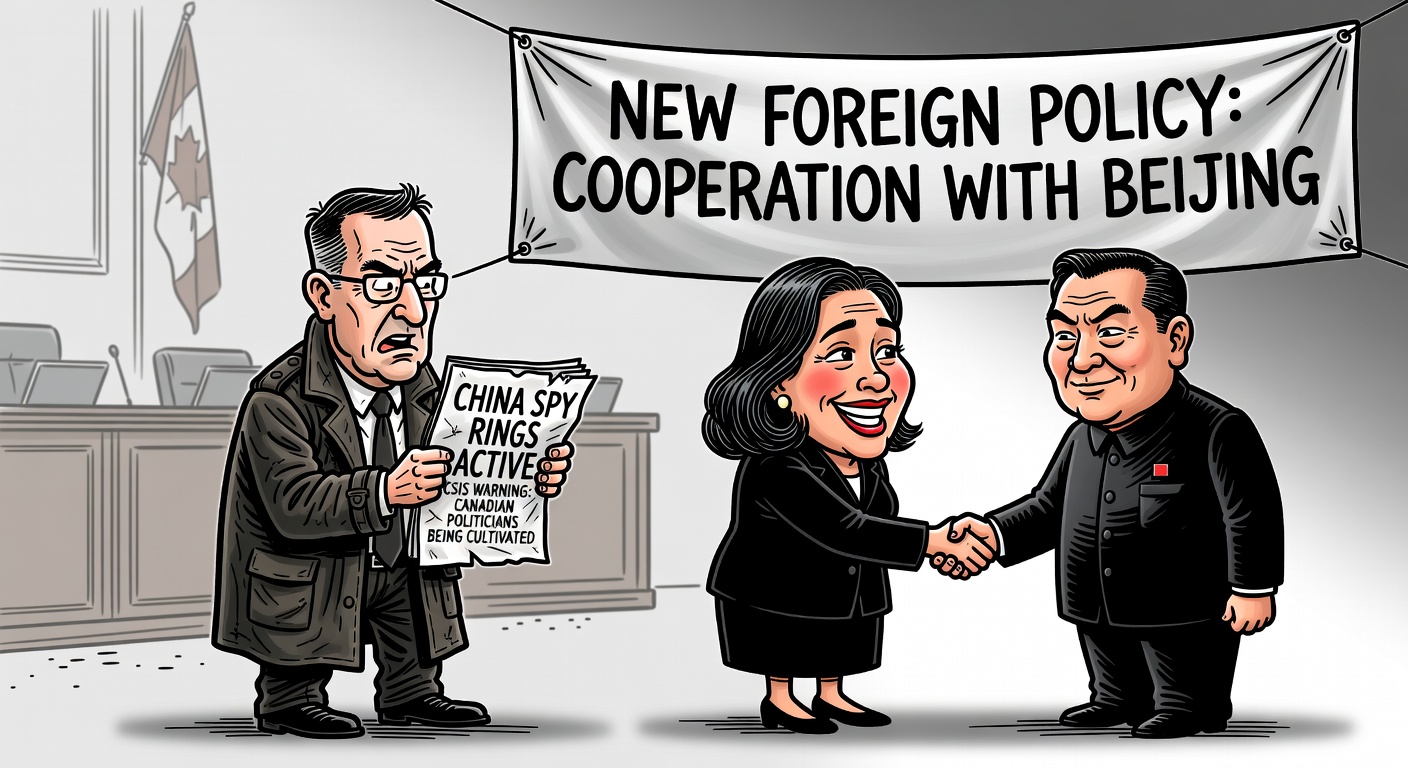
CSIS Just Confirmed China's Spy Rings Are Still Active in Canada — Days After Anand Announced "Cooperation" with Beijing
A new Canadian Security Intelligence Service report to Parliament names the People's Republic of China as a leading perpetrator of espionage and foreign interference — including the active "cultivation of relationships" with unnamed Canadian politicians. The report dropped the same week Foreign Minister Anita Anand unveiled a new foreign policy framework emphasizing "cooperation" with Beijing. The contradiction is impossible to miss.
What CSIS Actually Said
According to the security report tabled in Parliament and reviewed by Blacklock's Reporter, China remains a leading perpetrator of espionage and foreign interference operations targeting Canada. The report explicitly warns that hostile state actors are "cultivating relationships" with Canadian politicians and other decision-makers in order to shape Canadian policy in Beijing's favour.
The CSIS finding, as quoted in the report:
"Threat actors' goal is to influence Canadian decision makers to align with positions, narratives and policies that promote a positive image of their country."
Translation: foreign agents are working to make Canadian politicians repeat their talking points. CSIS is telling Parliament that this is happening right now — not in some Cold War archive, not in a distant theoretical future, but in 2026 — and that the People's Republic of China is at the top of the list.
Anand's "New Foreign Policy": Cooperation with Beijing
Just days before this CSIS report became public, Foreign Minister Anita Anand announced a "new foreign policy" framework that places renewed emphasis on cooperation with the People's Republic of China — the same regime CSIS is warning is cultivating Canadian politicians as foreign assets. The Liberals branded the shift as economic pragmatism. CSIS is, in effect, calling it dangerous.
This is not a partisan reading. This is what the timeline plainly shows:
- Mid-2024 to 2025: The Hogue Commission concludes that the PRC was the most active state actor interfering in Canada's federal elections, including targeting individual MPs.
- April 2026: Foreign Minister Anita Anand unveils a "new foreign policy" repositioning Canada toward "cooperation" with the PRC and away from confrontation.
- May 2026: CSIS reports to Parliament that China's foreign interference operations remain active, including targeting Canadian politicians.
You don't need to be a national security analyst to see the problem. Canada's spy agency is publicly stating that Beijing is operating an active influence campaign against our political class in the same week the Foreign Minister is publicly stating that we should be friendlier with Beijing. One of these institutions is reading the threat correctly. It is not Global Affairs.
The Pattern: Carney's Liberals and the China File
This is not the first time Carney's government has tilted toward Beijing while CSIS has tilted away. Earlier this week we reported that Industry Minister Mélanie Joly granted Chinese state-backed automakers "unprecedented access" to the Canadian market because they are "very popular" — and refused to engage on whether their supply chains use Uyghur slave labour. Last week we reported that Carney quietly removed forced-labour and human-rights language from Global Affairs documents. The week before, Carney named "one negotiator" to handle U.S. trade talks while shutting Conservatives out of any oversight of the Beijing-adjacent files.
The pattern is consistent. CSIS warns. Parliament hears. Carney's cabinet softens its language. The PRC gets a more friendly tone, looser scrutiny on its corporations, and reduced public pressure on its human rights record — while Canadian intelligence officers go on telling Parliament that Chinese foreign interference is the number-one national security threat to this country.
Who Are the Politicians Being "Cultivated"?
CSIS, of course, will not name names in a public report. That is not how intelligence agencies operate. But Canadians remember the Hogue Inquiry findings. They remember Han Dong. They remember Michael Chong being targeted while the government sat on intelligence warnings for years. They remember the Liberal MPs who attended Beijing-aligned events and the staffers who appeared on CSIS briefings.
The question CSIS has put to Parliament — implicitly, but unmistakably — is whether Canadian voters can trust their elected officials to be acting in Canada's interest, or in the interest of a foreign power that is actively running operations against them. That is a question every voter is entitled to ask. It is also a question this government has done everything possible to avoid answering.
Source
Primary source: Blacklock's Reporter, "China Spy Rings Active: CSIS" (May 5, 2026), summarizing a CSIS security report to Parliament. The report follows Foreign Minister Anita Anand's announcement of a new foreign policy framework emphasizing cooperation with the People's Republic of China. Background on Carney's record on China-related files documented in earlier iVoteLiberal coverage and the Hogue Commission of Inquiry into Foreign Interference (final report, January 2025).
The Bottom Line
You cannot pivot to "cooperation" with a regime that your own intelligence service is actively warning Parliament about. You cannot give Chinese state-backed automakers "unprecedented access" while CSIS is reporting that Beijing is cultivating influence inside your caucus. You cannot ask Canadians to take national security seriously while your Foreign Minister is publicly asking them to be friendlier with the country those threats are coming from.
If Carney's Liberals refuse to name and confront PRC foreign interference, that refusal is itself the policy. CSIS has done its job. Now Parliament — and the voters who put it there — have to do theirs.