"Very Popular": Joly Opens Canada to Chinese State-Backed EVs — Won't Answer on Slave Labour
Industry Minister Mélanie Joly told reporters Cabinet has granted Chinese state-backed automakers "unprecedented access" to the Canadian market because "they are very popular across the country." Pressed on whether those vehicles are built using Uyghur forced labour, the minister did not answer directly. Instead she said: "We're all in favour of affordability." On the same day, federal records confirmed Mark Carney's "Buy Canadian" policy still treats 100 per cent foreign-owned companies as Canadian.
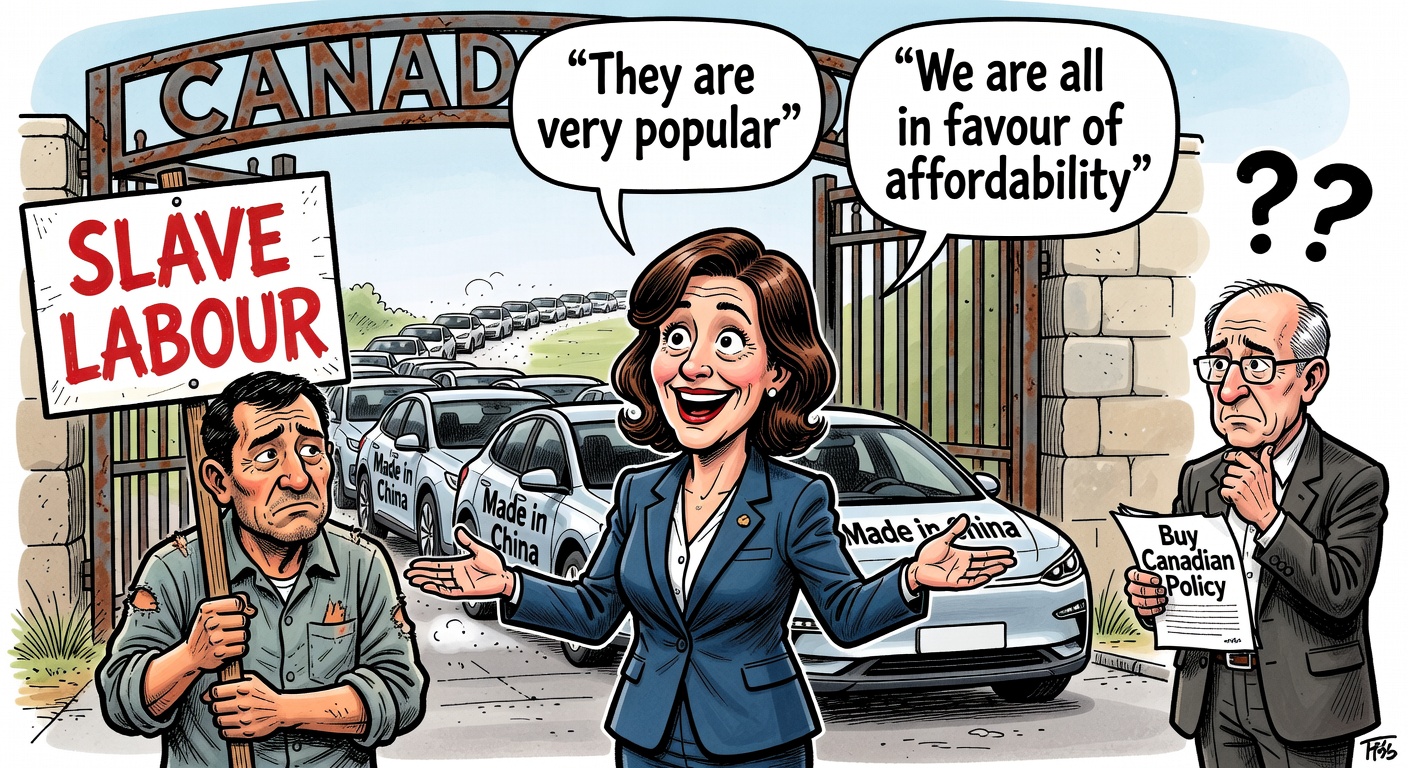
"They Are Very Popular Across the Country"
That sentence — delivered by Industry Minister Mélanie Joly to reporters in Ottawa on Monday — is now the official Government of Canada justification for handing Chinese state-backed automakers an open door into our auto market. Not national security review. Not human rights screening. Not a single mention of the labour conditions under which these vehicles are produced. Just that they are "very popular."
What Joly was not willing to discuss, when reporters pressed her directly, was whether any of the Chinese EVs now flowing into Canada are produced using forced Uyghur labour in Xinjiang — a practice the United States, the United Kingdom, the European Union, and the Canadian House of Commons itself have all formally identified as a likely crime against humanity.
Her answer to that question, on the record: "We're all in favour of affordability."
A Policy Reversal With No Explanation
For most of the past three years, both Canada and our closest ally, the United States, have aggressively walled off the North American auto market from Chinese state-subsidized EVs. Washington imposed a 100 per cent tariff. Ottawa, under Justin Trudeau in 2024, matched it. The reason was bipartisan and obvious: Beijing pours hundreds of billions into its EV industry to undercut Western automakers, and many of those vehicles are produced in regions credibly linked to ethnic minority forced labour.
Now, less than two years later, the Carney Liberals have quietly reversed course. Cabinet has granted Chinese-state-backed automakers what Blacklock's Reporter described as "unprecedented access" to the Canadian market. There has been no public security review released. No human rights audit released. No supply chain audit released. Just Joly waving the question off with a focus-group line about affordability.
"Buy Canadian" — Even When It's Made in Beijing
This story does not exist in a vacuum. On the same day, federal records published by the Department of Public Works confirmed something Canadians have a right to be furious about: under Prime Minister Mark Carney's much-trumpeted "Buy Canadian Policy," companies that are 100 per cent foreign-owned still qualify as "Canadian." The definition is so broad it captures foreign-owned firms with little more than a storefront branch in Canada — including, on its face, the Bank of China.
Officials, asked to defend it, said: "We need to go back to what the Prime Minister said." Translation: the bureaucracy can't justify the policy on its own merits, so they're hiding behind the Prime Minister's talking points.
Put the two stories side by side and a pattern emerges. The Carney Liberals are happy to brand as patriotic — Buy Canadian, Canada Strong, made-here, sourced-here — while in practice opening procurement and consumer markets alike to companies controlled by foreign and adversarial states. Patriotism as marketing. Foreign sourcing as reality.
What Conservatives Said in Question Period
Conservative MPs lit up Question Period over both files. The line of attack: this is a government that lectures Canadians about climate, ethics, and values — while quietly inviting in the products of a one-party state that runs internment camps for Uyghur Muslims and that subsidizes its EV industry to dump vehicles on Western markets and bankrupt domestic competitors.
Affordability matters. Of course it matters. But "affordability" cannot become a magic word that closes every uncomfortable conversation. Cheap consumer goods produced under forced-labour conditions are not affordable in any meaningful moral sense. They are subsidized — in dollars, by Beijing, and in suffering, by people who cannot speak for themselves.
The Bottom Line
Mélanie Joly was given a chance, in front of cameras, to say one sentence: "Canada will not allow products of forced labour into the Canadian market." She didn't. She talked about popularity. She talked about affordability. She talked about anything except the question.
Mark Carney was given the chance to define "Buy Canadian" in a way that actually protects Canadian jobs and Canadian industry. Instead, his policy lets foreign-owned firms — including, theoretically, banks and brands controlled by adversarial governments — wear the maple leaf for procurement purposes.
This is not affordability policy. This is not industrial policy. This is a government that chose the path of least resistance with Beijing, slapped a Buy Canadian sticker on it, and hoped Canadians wouldn't notice. The Conservatives noticed. Blacklock's noticed. And on the record, Mélanie Joly's defence is: "They are very popular."
Blacklock's Reporter: "Call China EVs Very Popular" (May 5, 2026); Blacklock's Reporter: "Buy Canadian Not Canadian" (Department of Public Works records, May 2026).