The Case Ottawa Lost — and the China Police Door It Left Open
William Majcher was acquitted. That matters. But the trial still exposed something Canadians cannot ignore: RCMP cooperation with China’s Ministry of Public Security was active enough that Chinese police were hosted in Canada — and three allegedly disappeared for six hours in Vancouver.
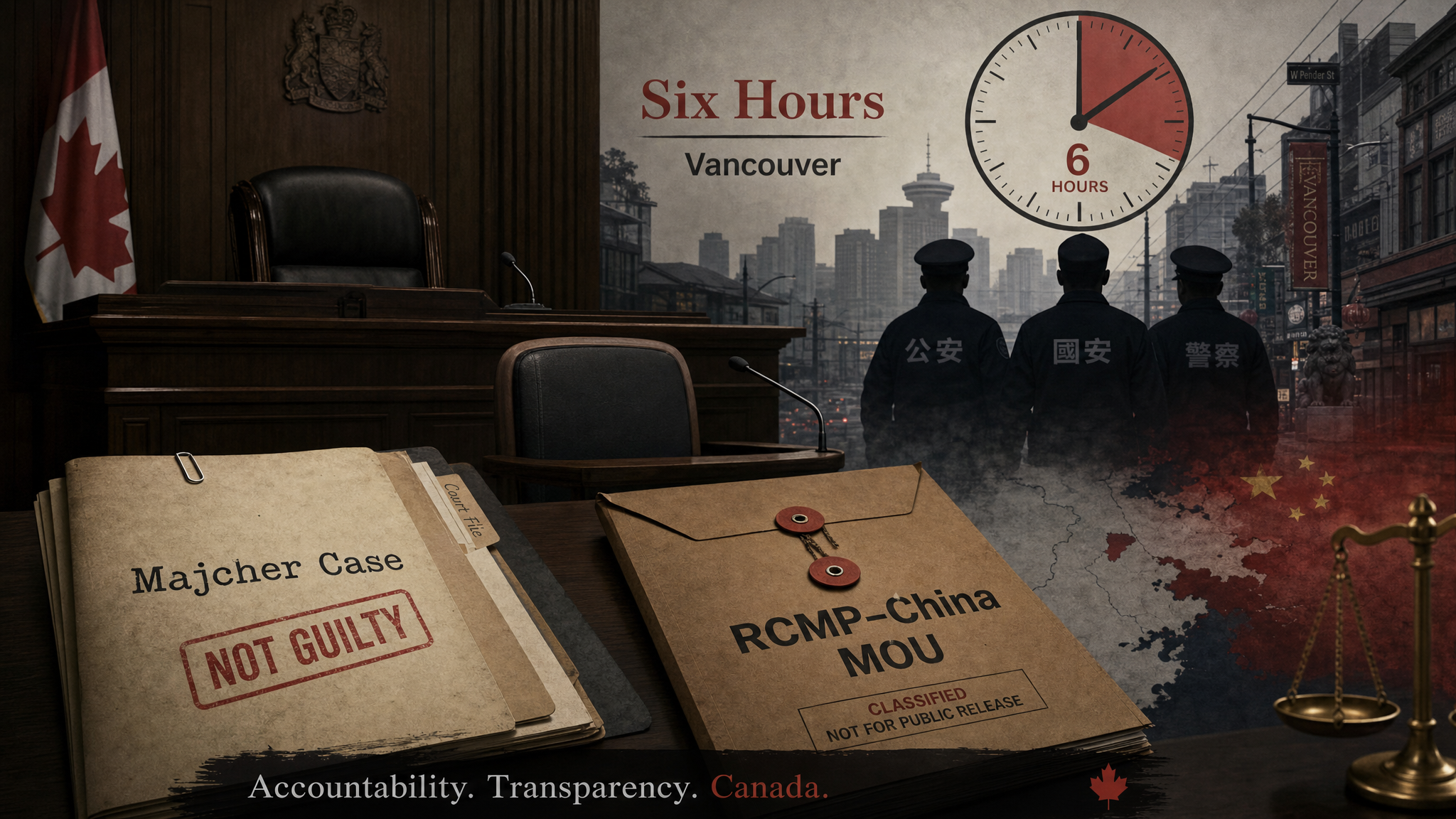
Ottawa lost the William Majcher case. Canadians should not lose the public-interest lesson buried inside it.
On May 13, B.C. Supreme Court Justice Martha Devlin found the former Mountie not guilty of a Security of Information Act charge connected to alleged work for China’s government. That verdict must be respected. Majcher is not guilty. The Crown failed to prove its case. Any honest article about this story has to start there.
But a failed prosecution can still reveal a successful warning.
Majcher’s trial pulled back the curtain on a world most Canadians rarely see: police-to-police cooperation between the RCMP and China’s Ministry of Public Security; Chinese officers travelling in Canada on mutual files involving alleged fraud, money laundering and “economic fugitives”; RCMP concern that some people in Vancouver could be improperly returned to China; and a six-hour disappearance by three Chinese police officials during an RCMP-escorted visit.
That is not a conspiracy theory. That is reporting from a Canadian Press courtroom account. And it lands directly beside the question raised by this week’s iVoteLiberal investigation: why is the Carney government renewing or maintaining a Canada-China policing MOU while refusing to show Canadians the text?
Majcher was acquitted. The MOU is still hidden. The cooperation question is still alive.
Majcher was a former RCMP officer with a long career in undercover and financial-crime work. The RCMP announced charges against him in July 2023, alleging he used his knowledge and network of Canadian contacts to obtain intelligence or services that would benefit the People’s Republic of China. The RCMP also alleged he contributed to Chinese government efforts to identify and intimidate an individual outside Canadian law.
Those were allegations.
At trial, the Crown’s theory centred on alleged preparatory acts connected to Hongwei “Kevin” Sun, a Vancouver-area figure accused by Chinese authorities of major financial crimes. Prosecutors alleged Majcher was preparing to help induce or pressure Sun to return to China. The defence argued the case was circumstantial and did not prove criminal intent.
Justice Devlin agreed that the Crown had not met its burden. Reporting from The Canadian Press says the judge found doubt about the nature and extent of Majcher’s actions and could not find evidence that the required preparation for the offence actually took place. In plain English: the state brought a very serious national-security case, and the court said the proof was not enough.
That matters because this site does not need to smear an acquitted man to make the larger point. The larger point is stronger because it does not depend on Majcher being guilty. It depends on what the case exposed about the operating environment around China, fugitives, money, pressure and police channels.
During the trial, RCMP Supt. Peter Tsui testified about a 2018 visit by Chinese Ministry of Public Security officers to Vancouver and Toronto. According to The Canadian Press report published by CityNews Vancouver, the officers were being hosted by Canadian police and were working on “mutual files” related to market fraud, money laundering and alleged economic fugitives.
That phrase — mutual files — is where the real story starts. Canada does have legitimate reasons to fight money laundering, fraud, cybercrime, fentanyl networks and organized crime. Chinese authorities may have information relevant to some files. Canadian authorities may have information relevant to others.
But China’s Ministry of Public Security is not just a police service in the ordinary democratic sense. It is a security organ of an authoritarian state. The same state has been repeatedly linked by Canadian agencies, inquiries and allies to foreign interference, transnational repression, cyber activity and pressure on diaspora communities.
So the threshold for cooperation should be high. The safeguards should be public. The exclusions should be explicit. And any agreement governing police cooperation should be available to Parliament and to Canadians whose safety may depend on its limits.
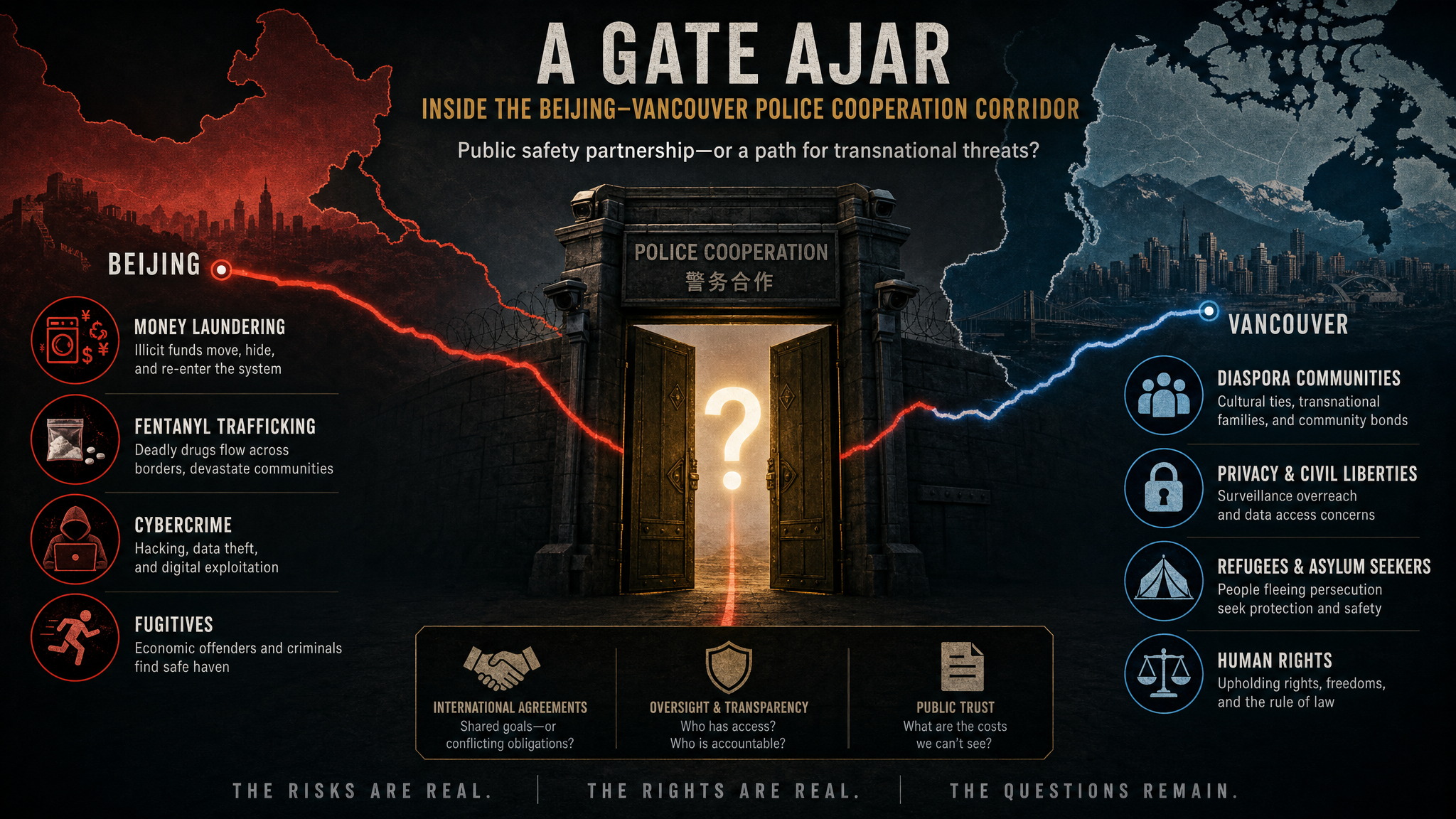
The most explosive detail from the Majcher trial was not about Majcher himself. It was about the visiting Chinese officers.
Tsui testified that three of roughly 14 Chinese police officials visiting Vancouver failed to show up to a scheduled meeting and were unaccounted for for about six hours. Canadian police did not know where they had gone. The testimony described RCMP concern serious enough that safeguards were put in place at borders and airports because there were individuals in Vancouver authorities worried could be returned to China.
That is the open door Canadians need to understand. When Chinese police operate through official channels in Canada, even under host supervision, what guarantees exist that the channel cannot be misused? If visiting officials disappeared for six hours in 2018, what changed after that? Were procedures rewritten? Was cooperation narrowed? Were diaspora-risk protocols created? Was Parliament told?
Most importantly: if that episode damaged police-to-police trust, why should Canadians trust the current Canada-China MOU without seeing it?
One reason this story is difficult is that Beijing often frames repatriation efforts around economic crime. Some targets may indeed be accused of serious fraud or money laundering. Canada should not become a safe haven for dirty money. Vancouver, in particular, has paid a high social price for foreign capital flows, real-estate distortion and money-laundering concerns.
But authoritarian states also know how to wrap political coercion in criminal language. A person can be called a fraud suspect, a separatist, a terrorist, a foreign agent or a national-security threat by a regime whose legal system does not meet Canadian standards. That is why due process matters. Extradition treaties, court hearings, disclosure, defence rights and judicial review exist for a reason.
Police-to-police cooperation cannot become a back channel around that system.
If China wants someone returned from Canada, the answer cannot be informal pressure, private investigators, visiting police delegations, family intimidation or quiet operational coordination. The answer has to be Canadian law, Canadian courts and Canadian transparency.
This is why the Majcher trial belongs beside the unreleased RCMP-China police MOU.
The Carney government has publicly described cooperation with Beijing as part of a broader Canada-China reset. Public Safety Canada has said the MOU involves information exchange, investigative assistance, technical expertise, training and law-enforcement coordination. But the full text has not been released. RCMP testimony before a Senate committee indicated the agreement contains a disclosure restriction requiring permission from the other party before details are made public.
That means Canadians are being asked to accept assurances about a police channel whose actual rules they cannot inspect.
After the Majcher trial, that is not good enough. The public now has a concrete example of Chinese police officials being hosted in Canada, going missing during a visit, and triggering concern about possible illicit repatriation. The government cannot respond to that record with “trust us.”
Before this story disappears into the weekend news cycle, MPs should demand answers:
- What exact operational lessons did the RCMP draw from the 2018 incident in which three Chinese police officials allegedly went missing in Vancouver?
- Were any Chinese officials disciplined, barred, removed from liaison work or formally protested after that incident?
- Did the incident change Canada’s rules for hosting Ministry of Public Security delegations?
- Does the current RCMP-China MOU allow visits, liaison work, information exchange, technical assistance or joint coordination involving alleged economic fugitives?
- Does the MOU explicitly prohibit assistance in political cases, Hong Kong national-security-law cases, speech cases, religious cases, protest cases and diaspora-activism cases?
- Are refugees, asylum claimants, permanent residents, dissidents, journalists, Hong Kongers, Uyghurs, Tibetans, Taiwanese Canadians and Falun Gong practitioners specifically protected?
- How many requests has China made through police channels since the MOU was renewed?
- How many were approved, denied or escalated for human-rights review?
- Who audits these exchanges — NSIRA, Parliament, the Privacy Commissioner, the courts, or nobody outside the executive branch?
- Why should Beijing have any practical ability to stop Canadians from seeing the safeguards in a Canadian policing agreement?
There is a lazy way to debate this issue, and Ottawa will probably use it. Critics will be accused of being anti-China, anti-cooperation or unserious about crime. That misses the point.
The point is not that Canada should refuse all cooperation with Chinese authorities in every circumstance. The point is that cooperation with an authoritarian security ministry requires sunlight, hard limits and independent oversight. If the government cannot show those safeguards, Canadians are right to assume the door is open too wide.
Chinese Canadians and other diaspora communities are not props in this debate. They are the people most exposed when Ottawa gets the balance wrong. They need protection from crime, yes. They also need protection from foreign-state pressure, intimidation, surveillance and informal repatriation attempts.
The Majcher verdict closes one criminal case. It does not close the public file on RCMP-China cooperation. If anything, it makes the accountability question sharper: the Crown could not prove Majcher committed the offence, but the trial still showed Canadians enough to demand the MOU.
Release the agreement. Publish the safeguards. Show Parliament the request logs. And explain how three Chinese police officials could disappear for six hours in Vancouver without Canadians learning what changed afterward.
The weekend question is simple: if Ottawa wants Canadians to trust police cooperation with Beijing, why is Ottawa still hiding the rulebook?
William Majcher was acquitted. This article does not allege he committed the offence. It uses the trial as a public-interest window into RCMP-China police cooperation, the 2018 Vancouver incident described in testimony, and the continuing transparency problem around the unreleased Canada-China police MOU.
- CityNews Vancouver / The Canadian Press — Chinese police went “missing” for hours during Vancouver visit, April 21, 2026: court testimony report
- iNFOnews / The Canadian Press — William Majcher found not guilty, May 13, 2026: verdict report
- RCMP — 2023 announcement of charges against Majcher: RCMP release
- Prime Minister of Canada — Canada-China leaders’ joint statement, January 16, 2026: PMO statement
- Senate of Canada — committee evidence on RCMP-China MOU disclosure restrictions: Senate evidence
- The Canadian Press / InfoNews — Public deserves answers on Canada-China policing agreement, May 2026: MOU transparency report
- Global Affairs Canada — 2026 parliamentary briefing material on China, foreign interference, cyber and transnational repression: GAC briefing