Elizabeth May’s Opaque-Carney Charge Needs a Receipts Test
If Carney is not running government behind opaque glass, publish the decision logs, committee records, climate math and consultation files.
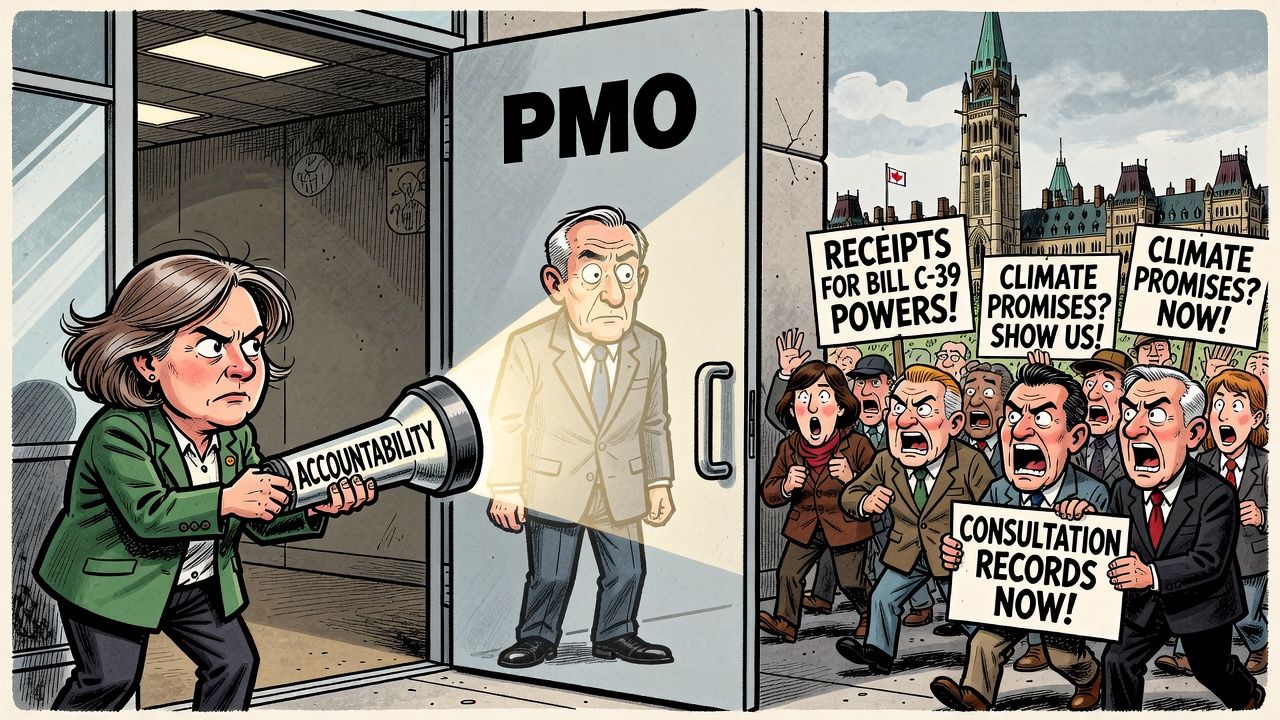
Elizabeth May has handed Prime Minister Mark Carney a simple test: prove that the new Liberal government is not as opaque and unaccountable as its critics say.
APTN reported this week that May, now the outgoing Green Party leader but still the MP for Saanich—Gulf Islands, called Carney “the most opaque, unaccountable person in politics” she has seen. That is not coming from a Conservative attack ad. It is coming from a long-serving opposition MP who has often worked across party lines and who supported Carney’s budget after receiving a pledge on Paris climate commitments.
That makes the charge harder for Liberals to wave away. May’s complaint is not merely that she disagrees with Carney’s policy choices. It is that major choices are being concentrated behind the Prime Minister’s Office, while Parliament is asked to trust the outcome after the fact.
The obvious place to start is Bill C-39. Green Party statements say the bill changes 20 federal laws and removes Bill C-5’s five-year sunset clause on extraordinary cabinet powers. They also say May sought to participate in the special committee study and was denied a seat. If the government believes these powers are narrow, justified and democratically supervised, it should publish the receipts: the rationale for the committee structure, the legal memos on cabinet authority, the project-approval criteria, the promised review schedule and the safeguards for affected communities.
The climate file needs the same treatment. APTN linked May’s criticism to Carney’s 2025 budget support pledge on Paris commitments, while noting the government’s continued backing of oil and gas projects makes those commitments difficult to square. The answer is not another podium line about ambition. It is a public emissions ledger showing how each approved project, subsidy, regulation and exemption changes the path to Canada’s targets.
So does the Indigenous-rights and consultation file. Fast-track laws that touch resource corridors, infrastructure approvals and federal project powers cannot be defended with private assurances. The government should disclose consultation timelines, affected-rights assessments, accommodation offers, cabinet conflict screens and reasons for proceeding where communities object.
Carney’s defenders may argue that every prime minister centralizes some power. Fair enough. But the question is whether this prime minister, sold as a competent technocrat, is willing to submit that competence to parliamentary proof. Competence without transparency is not accountability. It is management by trust-us memo.
The fix is practical: publish a Parliament-first accountability calendar for Bill C-39 and Bill C-5 powers, release decision logs before final approvals, table climate math with the budget, and give MPs a real route to test the evidence before cabinet locks in the outcome.
May made the accusation. Carney has the office, the documents and the authority to answer it. If the government is not opaque, it should stop asking Canadians to judge silhouettes through frosted glass.
- APTN News — Elizabeth May comments on Carney transparency and accountability: https://www.aptnnews.ca/nation-to-nation/outgoing-green-party-leader-says-carney-is-the-most-opaque-unaccountable-person-in-politics/
- Green Party statement on Bill C-39: https://www.greenparty.ca/en/news/green-party-denounces-bill-c-39
- Green Party warning on Bill C-39 process: https://www.greenparty.ca/en/news/greens-warn-bill-c-39-amounts-to-legislating-with-a-blindfold
- Canadaland episode summary — May criticism of Carney, Parliament and Bill C-5/C-39: https://podcastrex.com/shows/canadaland/carney-has-no-respect-for-parliament-elizabeth-may
- OpenParliament Commons debate record for September 24, 2026: https://openparliament.ca/debates/2026/9/24/?singlepage=1
This article treats May’s criticism as an accountability claim that can be tested with public records, not as proof by itself. The proposed remedy is disclosure of decision, climate, consultation and parliamentary-process receipts.