Ottawa’s Buy Canadian Exemptions Went 19-for-19. Publish the Receipts.
A reported 19 requested Buy Canadian exemptions were all approved. Ottawa should publish the full exemption receipt file.
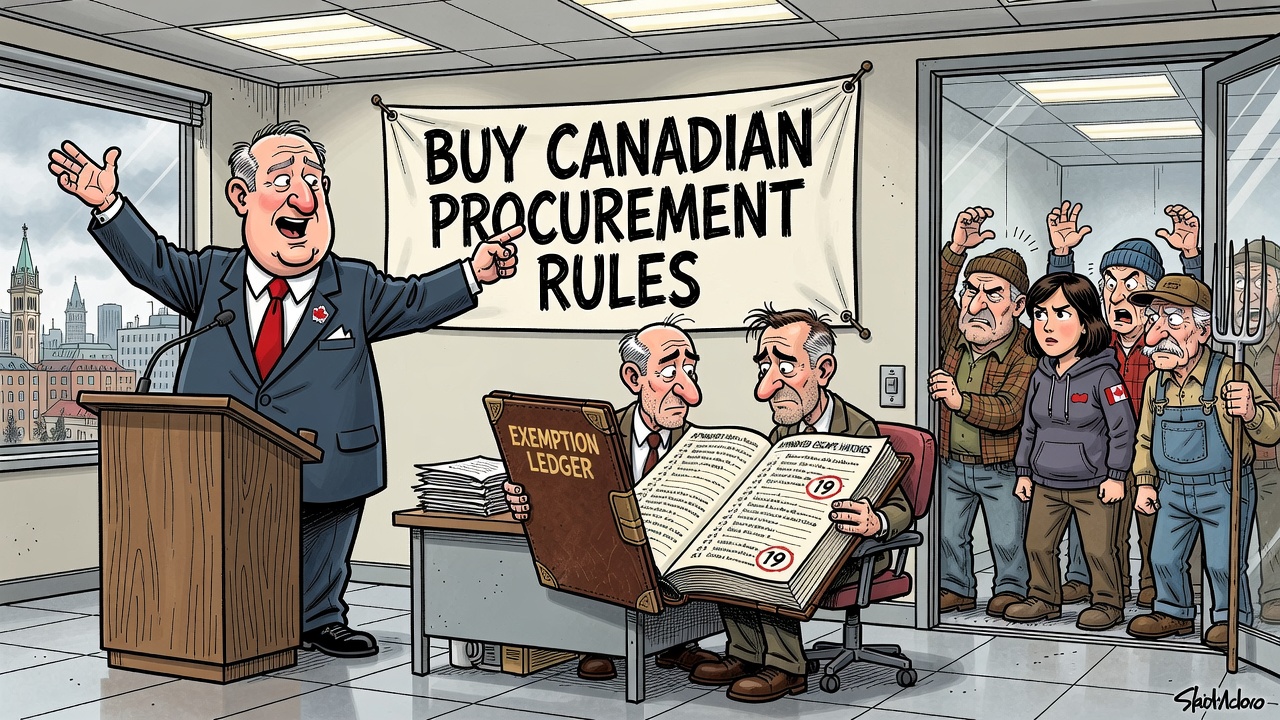
The Carney government sold “Buy Canadian” as a simple promise: federal purchasing would protect Canadian workers, strengthen domestic supply chains and put Canadian suppliers first. That is a defensible goal. Conservatives should want Canadian tax dollars to build Canadian capacity where value, security and reliability make sense. But a procurement rule is only as strong as its exemption file, and the first reported ledger points to a policy that may be easier to escape than to enforce.
According to Rebel News, a November 18 response to Order Paper Question Q-1501 shows federal departments asked 19 times for permission to bypass the Buy Canadian policy — and all 19 requests were approved. The question, submitted by Conservative MP Kelly DeRidder, asked for the checks and balances, the criteria for exceptions, the number of requests, the details of each request and whether each was approved or denied. That is exactly the kind of basic accountability Parliament should demand before Ottawa congratulates itself for industrial patriotism.
The government’s own public materials say the Buy Canadian Policy is meant to prioritize Canadian workers and industries, with new procurement rules rolling out across federal departments. Treasury Board’s policy notice says the framework took effect December 16, 2025, initially applying to procurements valued at $25 million and up, then lowering to $5 million and up by June 15, 2026. CanadaBuys also says approvals for exception requests are supposed to sit with the responsible minister or common-service-provider minister. In other words, this is not a small internal memo. It is a cabinet-level procurement framework with political ownership.
That is why a 100% approval rate matters. Some exemptions may be legitimate. Canada should not freeze a defence buy, delay critical infrastructure or pay wildly inflated prices simply to satisfy a slogan. But if every request clears the bar, taxpayers deserve to know whether the bar is real. Which departments applied? What contract values were involved? Which suppliers benefited? Were Canadian alternatives unavailable, too expensive, too slow — or merely inconvenient?
The answer cannot be another press release about supporting Canadian jobs. It should be a searchable exemption registry, updated in real time, listing the department, approving authority, contract category, value range, Canadian-sourcing rationale, recipient country where applicable and a plain-language explanation of why the public interest required an exception. Commercially sensitive details can be protected without hiding the policy’s operating record from taxpayers.
Procurement nationalism without disclosure becomes theatre. It lets ministers campaign on “Canada first” while departments quietly route around the rule. If Ottawa believes these 19 approvals were justified, it should publish the evidence and let Canadian suppliers, MPs and taxpayers test the claim.
A Buy Canadian policy can be serious, or it can be a slogan with an escape hatch. The difference is the ledger. Publish it.
- Rebel News: https://www.rebelnews.com/buy_canadian_not_really_ottawa_approved_every_single_exemption_after_announcing_procurement_crackdown
- House of Commons written question Q-1501: https://www.noscommunes.ca/written-questions/45-1/Q-1501
- Government of Canada: Buy Canadian: https://www.canada.ca/en/public-services-procurement/services/acquisitions/selling-federal-government/buy-canadian.html
- Treasury Board Secretariat: Contracting Policy Notice 2025-7: https://www.canada.ca/en/treasury-board-secretariat/services/policy-notice/2025-7.html
- CanadaBuys: Policy on Prioritizing Canadian Suppliers and Canadian Content in Strategic Federal Procurements: https://canadabuys.canada.ca/en/buy-canadian-policy/policy-prioritizing-canadian-suppliers-and-canadian-content-strategic-federal-procurements
This article supports prudent procurement exceptions where they are justified. It argues that Ottawa should publish an auditable exemption ledger so taxpayers can distinguish necessity from convenience.