Carney’s Shenzhen Model Needs an AI Guardrails Ledger
If Ottawa wants China-linked growth lessons and artificial-intelligence cooperation, it owes Canadians the screening rules before the deals are celebrated.
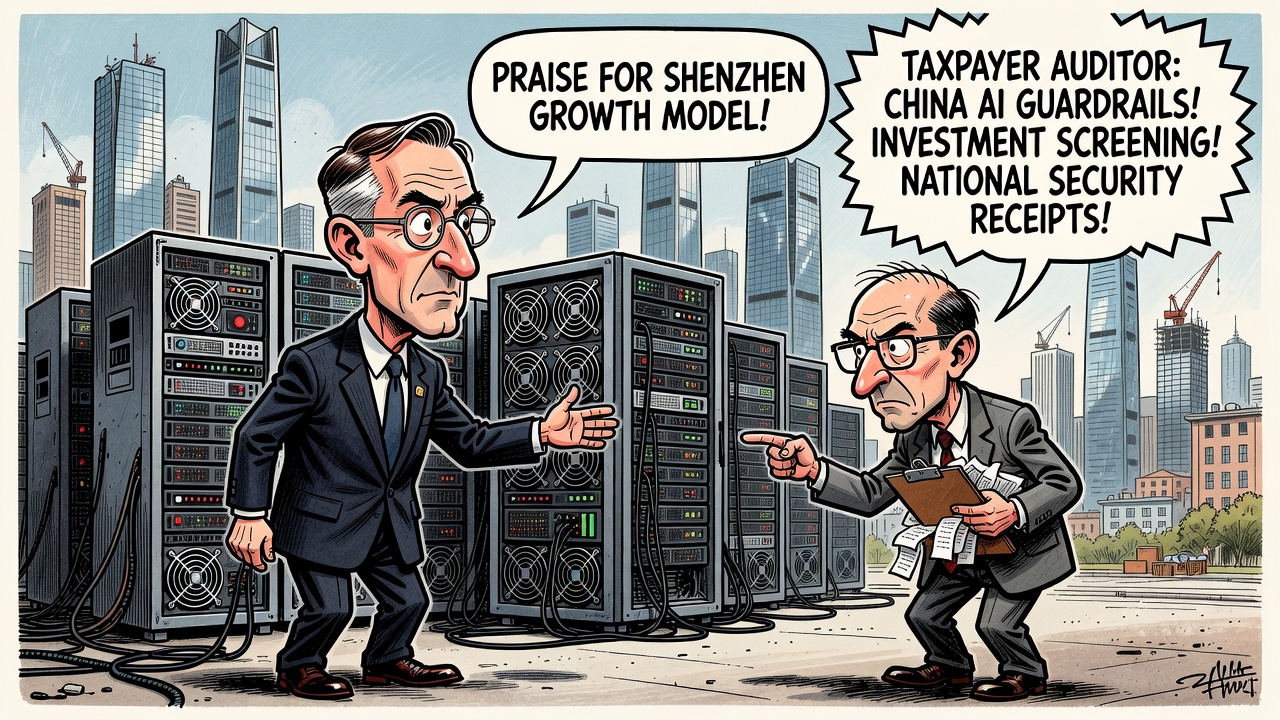
Prime Minister Mark Carney’s China trip has moved beyond trade arithmetic. The new accountability question is whether Ottawa can praise the “Shenzhen model” and deepen China-facing commercial ties without blurring the national-security lines it previously told Canadians were firm.
Canadian Press reporting through Global News says Carney pointed to Shenzhen’s transformation from a fishing village into a high-tech megacity as a lesson in faster approvals, lower taxes and simpler trade rules. The same report says the China announcement included an artificial-intelligence partnership, even though Carney had previously identified AI, critical minerals and defence as sectors off-limits to Chinese investment in Canada.
That is not a small footnote. AI is not just another export category. It touches data, surveillance, defence, cybersecurity, intellectual property, public services and the future competitiveness of Canadian firms. When Ottawa says “partnership,” Canadians need to know whether that means academic exchanges, standards talks, cloud infrastructure, model development, data-sharing, procurement, financing, or investment by entities that could trigger national-security review.
The government’s own APEC messaging raises the stakes. PMO’s November 19 release says Canada used the Shenzhen summit to highlight capabilities in artificial intelligence, critical minerals, energy and financial technology, while also claiming restored market access for more than 90% of trade previously hit by Chinese tariff action, nearly $7.5 billion in Canadian exports. A separate November 19 readout with Singapore, Australia and New Zealand says leaders discussed AI governance and collective economic security.
Those are exactly the words that require receipts. If AI governance and economic security matter with trusted partners, then the China file needs a public guardrails ledger: what cooperation is permitted, what is prohibited, which departments approve it, which security agencies screen it, and what Parliament will be told after the fact.
This is not an argument against selling pork, seafood, canola, energy or services abroad. Canadian workers benefit when exporters regain markets. But market access cannot become a permission slip for foggy technology arrangements. The public should not have to choose between farmers’ sales and national-security clarity.
A conservative accountability test is simple. Publish the list of China-related AI initiatives. Disclose whether any involve Canadian personal data, government data, sensitive research, defence-adjacent applications or critical infrastructure. State whether the Investment Canada Act, export controls, cybersecurity reviews and research-security rules apply. Identify the red lines for state-linked firms, dual-use technologies and forced-technology-transfer risk. Then report compliance to Parliament on a fixed schedule.
Shenzhen may be a useful case study in speed. But Canada is not obliged to import opacity with the lesson. If Carney wants Canadians to believe the China reset is disciplined, he should publish the AI guardrails ledger now — before “strategic partnership” becomes another slogan without receipts.
- Global News / Canadian Press: China’s growth a model for Canada, Carney says
- Prime Minister’s Office: Prime Minister Carney strengthens economic partnerships at APEC
- Prime Minister’s Office: Prime Minister Carney meets with President Xi Jinping
- Prime Minister’s Office: APEC readout with Singapore, Australia and New Zealand
- Associated Press: China and Canada expand tariff relief while Ottawa-Washington relations are strained
This article does not allege illegal conduct. It argues that AI, investment-screening and national-security guardrails should be public, specific and auditable before Canada expands sensitive cooperation with China-linked entities.