Ottawa’s $18M Saputo Subsidy Needs a Taxpayer Ledger
A profitable dairy giant can take public support only with public receipts. The Saputo file needs the application, scoring memo, clawbacks and outcome targets.
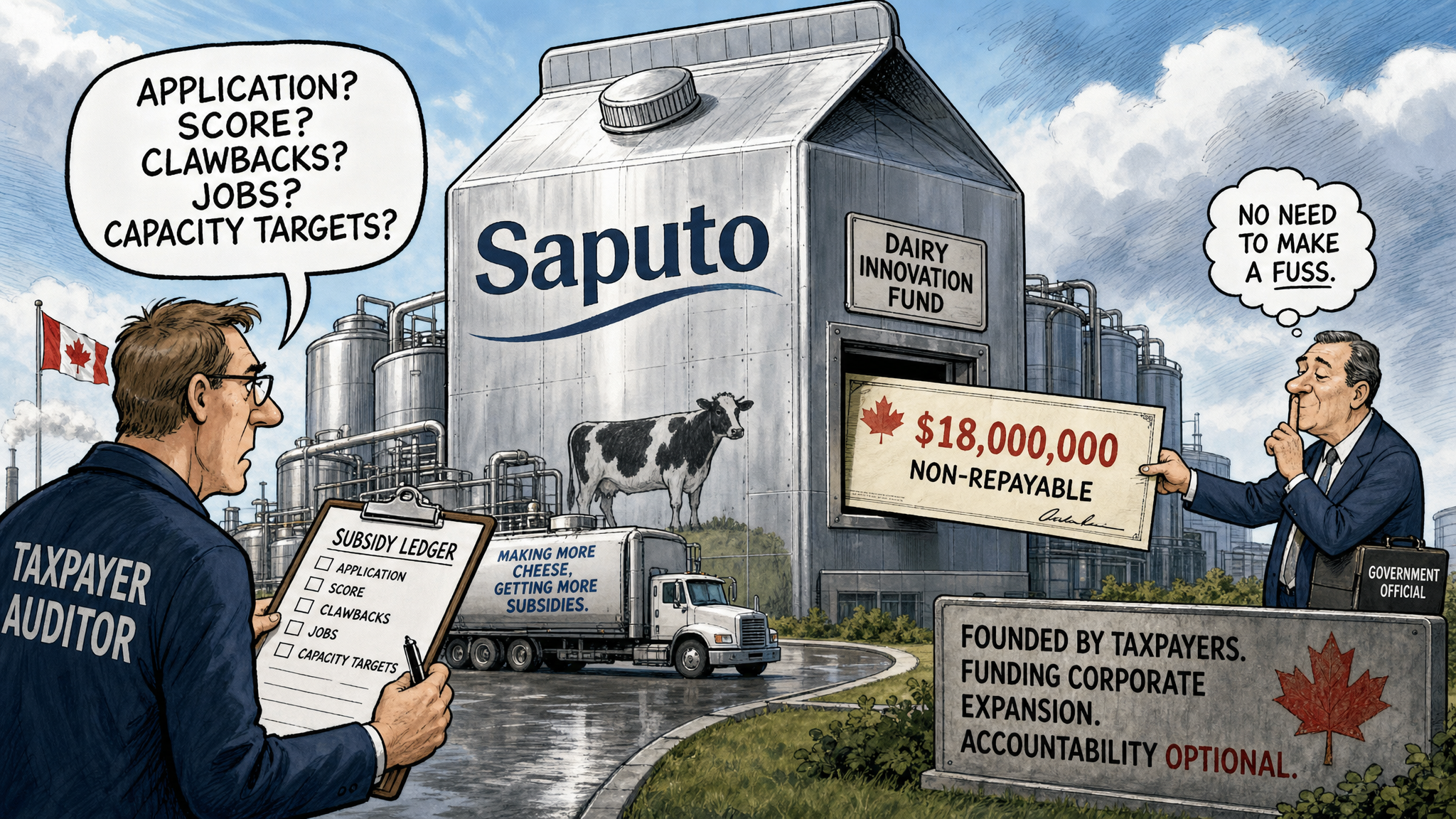
Ottawa’s grants database now lists an $18,000,000 contribution agreement with Saputo Dairy Products Canada G.P. for “Manufacturing of Milk Ingredients.” The agreement number is DIIF-014. It runs from September 1, 2026 to March 31, 2030, is tied to Agriculture and Agri-Food Canada’s Dairy Innovation and Investment Fund, and is located in Georgetown, Ontario.
The stated objective is not vague charity language. The disclosure says the project is to expand an existing dairy processing facility to facilitate processing and utilization of all milk components. The expected result is an expanded facility able to process and utilize all milk components. The record also says the project is funded and managed by the Canadian Dairy Commission.
That matters because the Canadian Dairy Commission’s own applicant guide says the Dairy Innovation and Investment Fund provides non-repayable contributions. It also says the fund has a budget of up to $333 million and runs until March 31, 2033. In plain English: this is not a loan that taxpayers automatically get back. It is public money given to support a private-sector capital project.
Saputo is not a fragile local creamery asking Ottawa for survival money. In its fiscal 2026 results, Saputo reported revenues of $17.551 billion and net earnings of $672 million. A company of that scale may still make a case for a public-interest investment, but the burden of proof sits with the government and the recipient, not with taxpayers expected to accept a disclosure line item as accountability.
The conservative accountability test is simple. If a profitable corporation receives an $18 million non-repayable federal contribution, Canadians deserve the subsidy ledger. Publish the application. Publish the scoring memo. Publish the independent review recommendation. Publish the total project cost, the company’s own contribution, any provincial or municipal support, the ministerial or CDC sign-off, and the conflict and lobbying declarations.
Then publish the performance contract. How much new capacity is promised? How many jobs are created or protected? What productivity gains, domestic-processing targets or milk-component utilization benchmarks are required? What happens if the project misses them? Are there clawbacks, holdbacks, audit rights and public progress reports? If taxpayers absorb risk, taxpayers should see the terms.
The issue is not whether dairy processing capacity can ever serve a public purpose. It can. The issue is whether Ottawa keeps treating corporate subsidies as announcements for insiders and accounting entries for everyone else. A non-repayable contribution to a large profitable firm is exactly where sunlight should be automatic.
Canadians are told repeatedly that federal finances are tight, services are strained and every dollar must be justified. Fine. Start here. Put the Saputo subsidy ledger on the table and prove this is a disciplined investment, not another quiet cheque to a well-connected corporate giant.
- Open Government grants disclosure: Saputo Dairy Products Canada G.P. — DIIF-014
- Canadian Dairy Commission: Dairy Innovation and Investment Fund applicant guide
- Saputo: Fiscal 2026 financial results
- Rebel News: Ottawa’s dairy fund commits $18 million to Saputo
This article relies primarily on official grant, program and corporate records. It does not allege illegal conduct; it calls for public disclosure of the decision record and performance safeguards for a non-repayable taxpayer contribution.