Publish the OAS Overtime Ledger Before CPP Moves Onto the Platform
A seniors’ benefit system can be mostly paying on time and still owe Canadians a hard backlog, overtime, defect and go/no-go ledger.
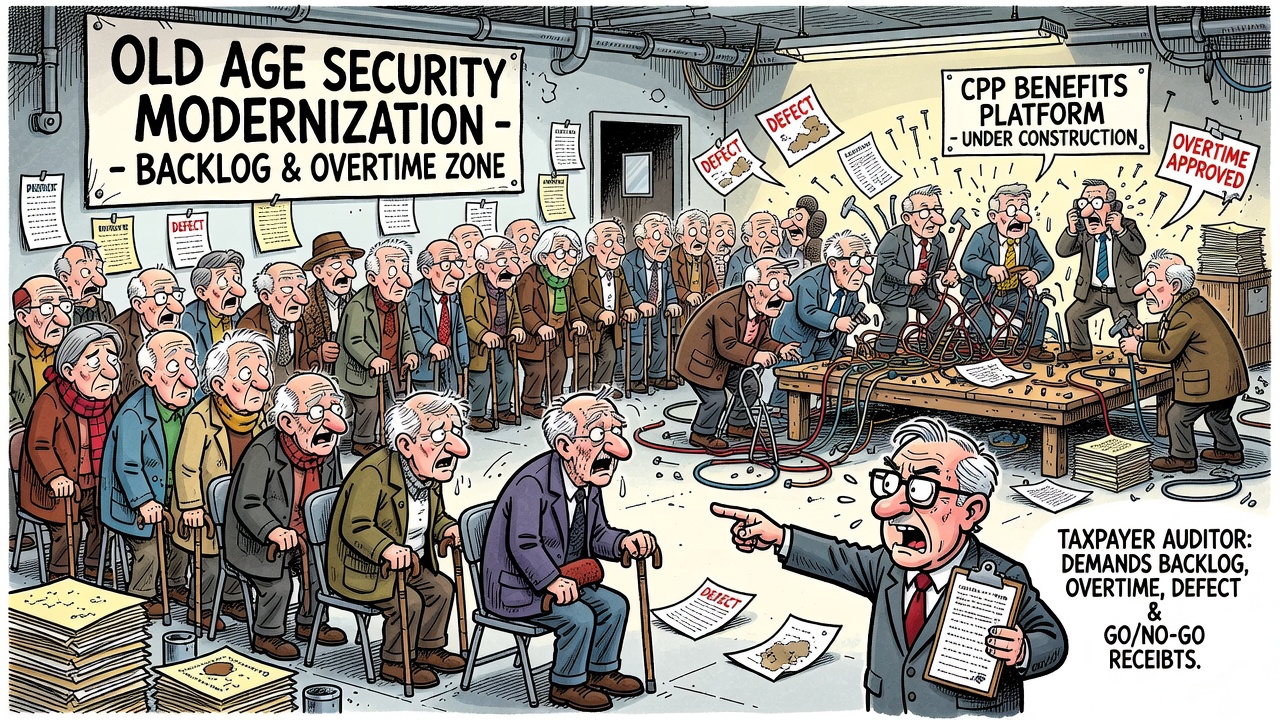
Ottawa’s Benefits Delivery Modernization program is exactly the kind of project that should be judged by receipts, not slogans. The official promise is attractive: a simpler digital interface, one sign-in, reduced wait times and faster payment of benefits. The risk is just as obvious: when a federal IT platform touches seniors’ income, “mostly working” is not a sufficient accountability standard.
Blacklock’s Reporter’s public November 19 index says federal employees have run up millions in overtime to reduce an Old Age Security payment backlog under the new system, and that the computer upgrade is 267 percent over budget. That summary fits a broader public record already visible in committee evidence. In March, Minister Patty Hajdu told HUMA that the number of past-due OAS cases had fallen from 85,000 to 63,000, while also saying more than 7.7 million seniors had been migrated and were receiving benefits on time.
Both facts can be true. Most seniors can be paid accurately each month, and tens of thousands of seniors can still be stuck in a queue that matters intensely to the household missing a cheque. A conservative accountability approach does not need to pretend the whole platform collapsed. It asks why vulnerable seniors were delayed, how much overtime was required to clean it up, which defects or workflow failures caused the pressure, and whether those lessons are locked in before Ottawa expands the same platform.
The expansion risk is not theoretical. ESDC says BDM is meant to move Old Age Security, the Canada Pension Plan and Employment Insurance onto a cloud-based platform. Its departmental results report says the program began with a $1.75 billion estimate and a 2030 completion target. HUMA evidence put the long-term estimate at up to $6.6 billion, covering OAS, EI, CPP and modernization of 14 ESDC call centres. Public Accounts testimony later said 7.9 million Canadians were receiving OAS accurately and on time every month, but MPs were still pressing officials on employee concerns and overtime described as “astronomical.”
That is the point. Before CPP is added to the platform, Parliament should require a plain weekly ledger: past-due OAS cases by province and benefit type; average and longest delay; call-wait times; overtime hours and dollars; vendor change orders; known defects; manual workarounds; complaint volumes; payment-error categories; and the date each fix was verified in production.
Modernizing 50- and 60-year-old systems may be necessary. But necessity is not a blank cheque, and “Phoenix was worse” is not a performance metric. If Ottawa wants Canadians to trust this platform with CPP and EI, publish the OAS receipts first.
- Blacklock’s Reporter: Garble Cost $8M In Overtime — public index excerpt, November 19, 2026
- House of Commons HUMA: Evidence, meeting 30 — Benefits Delivery Modernization and OAS backlog testimony
- House of Commons PACP: Evidence, meeting 48 — Management and Impact of the Benefits Delivery Modernization Programme
- Employment and Social Development Canada: About the Benefits Delivery Modernization programme
- Employment and Social Development Canada: 2025-26 Departmental Results Report — response to committees and audits
This article relies on public committee evidence and official ESDC pages, with Blacklock’s cited only for its public November 19 overtime/backlog lead. It does not allege benefit payments failed system-wide; it calls for a public operational ledger before CPP and EI risks expand.