Ottawa’s Court Secrecy Order Needs a Public Safeguards Ledger
A new Gazette order permanently binds the Federal Courts’ national-security proceedings section to secrecy. The public deserves the scope, safeguards and review receipts.
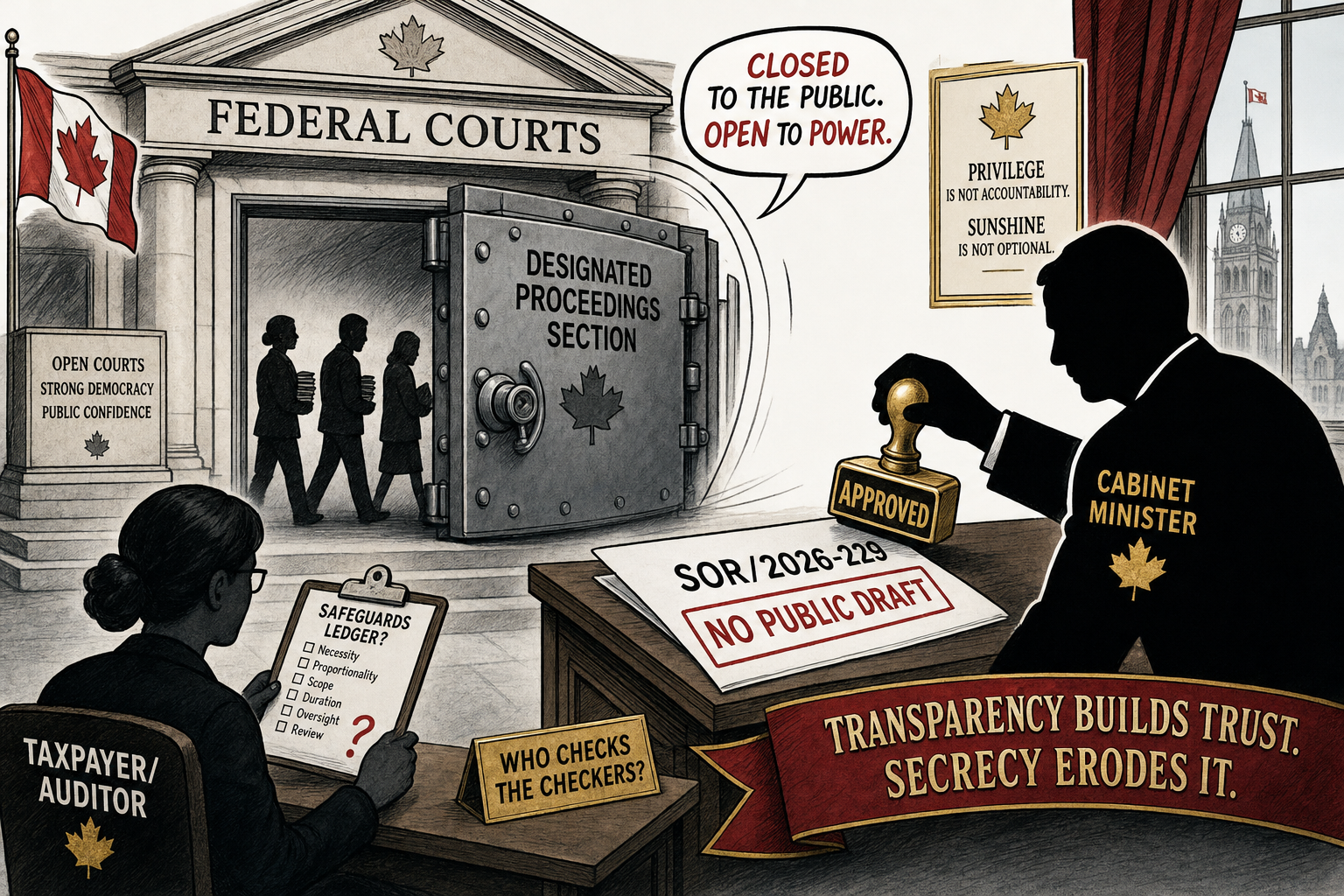
Ottawa has expanded one of the federal government’s strongest secrecy regimes into the machinery of the Federal Courts. The Canada Gazette published SOR/2026-229 on November 18, 2026. The order, registered October 30 as P.C. 2026-1056, adds the “Designated Proceedings Section of the Courts Administration Service” to Schedule 1 of the Foreign Interference and Security of Information Act.
That is not a minor housekeeping label. Under the Gazette’s own explanation, people who work for a Schedule 1 entity are deemed “permanently bound to secrecy.” The Act’s enhanced offences can apply to unauthorized communication or confirmation of special operational information, with maximum penalties described in the Gazette as five years less a day for one offence and 14 years for another. The statement also notes a public-interest defence, but the obligation itself continues after a person leaves the organization.
The section being added is not imaginary or peripheral. The Gazette says all Federal Court and Federal Court of Appeal proceedings involving national-security matters and classified material are conducted in the Designated Proceedings Section. It lists the people who work in or around those matters: specialized registry staff, court counsel, translators, law clerks for designated judges, court reporters, commissionaires and court-appointed amici curiae.
National-security cases obviously involve real secrets. Canada must protect classified material, intelligence sources, allied information and court processes that cannot be run like ordinary civil litigation. But a conservative accountability standard does not treat “national security” as a magic phrase that ends scrutiny. The more secrecy the state demands, the more precise the public safeguards should be.
Here is the problem: the same Gazette notice says no external consultations were undertaken. It says the order was not prepublished in Part I of the Canada Gazette because the amendment was considered internal, technical and administrative, and “unlikely to attract interest from the general public.” That is the line Canadians should reject. A lifelong secrecy designation covering court-administration personnel who support classified Federal Court proceedings is exactly the kind of measure that deserves a public explanation before, not after, cabinet signs it.
The government should publish a safeguards ledger. How many positions are covered? How many current and former personnel are affected? What training is provided on the public-interest defence? What guidance exists for whistleblowing, misconduct reporting and judicial-independence concerns? Who decides when someone is inside the covered group? What annual aggregate reporting will Parliament receive? What independent review, if any, checks whether the designation is being used narrowly?
The Gazette says the order reduces departmental costs by removing the need to bind people one by one. Administrative convenience is not a democratic answer. If Ottawa can permanently bind whole categories of court-related personnel to secrecy by regulation, Canadians are entitled to the receipts: scope, safeguards, review and accountability.
Protect secrets where the law truly requires secrecy. But do not ask the public to accept a no-draft, no-consultation, lifelong-secrecy order on trust alone. In a free country, even secrecy needs a paper trail.
- Canada Gazette, Part II: Order Amending Schedule 1 to the Foreign Interference and Security of Information Act, SOR/2026-229
- Rebel News: Liberal order binds Federal Court national security staff to lifelong secrecy, with no public draft
This article relies primarily on the official Canada Gazette notice. It does not allege illegal conduct; it calls for public reporting, safeguards and parliamentary accountability around a new permanent-secrecy designation.