The Budget Passed. Now Publish the Borrowing Ledger.
A House vote gives the Liberals political momentum. It does not give them a blank cheque to convert hundreds of billions in borrowing into permanent authority without receipts.
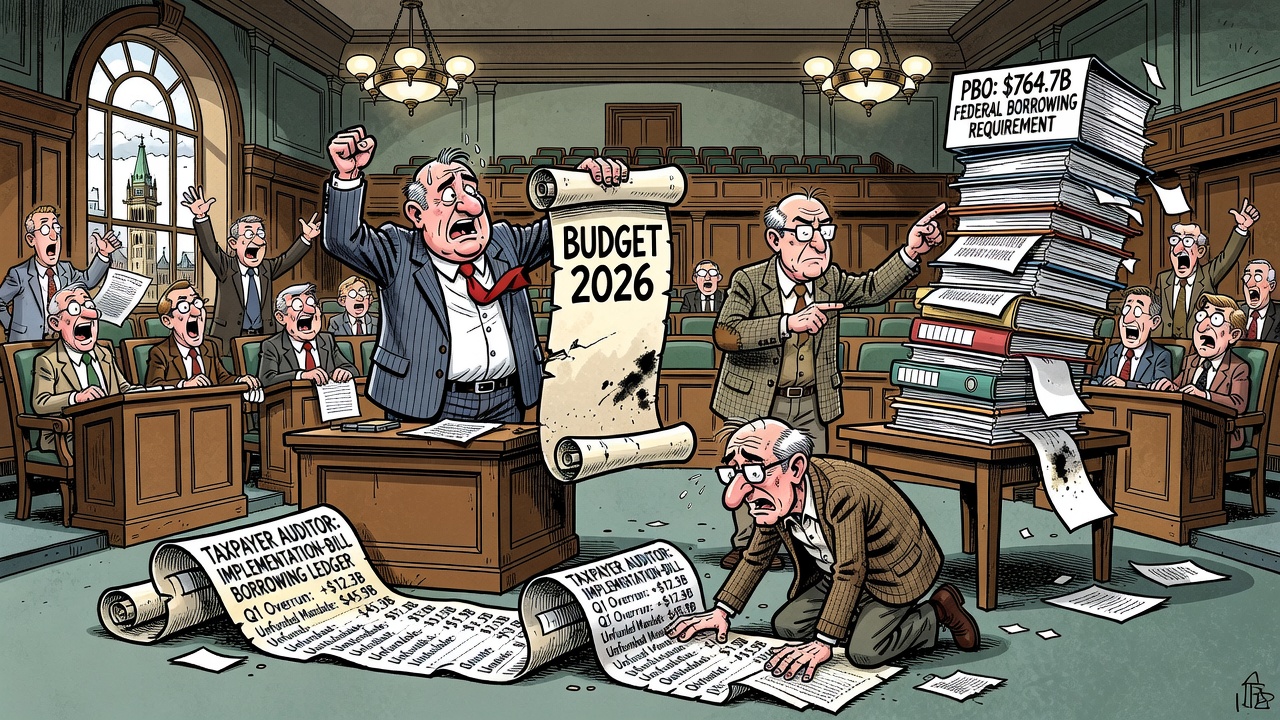
Budget 2026 has now cleared the House of Commons. Global News, citing The Canadian Press, reported Thursday evening that MPs passed the budget motion 162 to 151, with Liberal MPs cheering after the Speaker announced the result. That is a political win for Prime Minister Mark Carney’s government. It is not the end of accountability. It is the start of the implementation test.
The budget was tabled on November 5 with new borrowing and tax measures aimed largely at infrastructure construction and other capital projects. Finance Minister François-Philippe Champagne argues that confident countries invest. Conservatives do not need to reject every capital project to ask the obvious question: what exactly is being bought, who gets paid, how much is borrowed, and when do taxpayers see measurable returns?
The Parliamentary Budget Officer’s Budget 2026 note gives Parliament a reason to slow down before the government turns the budget vote into legislation. The PBO says new Budget 2026 measures total $151.5 billion over 2026-27 to 2030-31: $89.5 billion classified as capital investment and $62.0 billion as day-to-day operating spending. More important, the PBO says federal borrowing requirements over the same period total $764.7 billion — 2.6 times the cumulative deficit of $288.7 billion.
That distinction matters. A deficit is the annual accounting shortfall. Borrowing is the cash Ottawa must raise in markets. Canadians pay for both through higher debt and rising interest charges. The PBO says public debt charges are already the fastest-growing expense in the fiscal framework and are projected to reach $85.5 billion in 2030-31. Every dollar spent on interest is a dollar unavailable for tax relief, defence readiness, health transfers or basic services.
The Liberals will now need one or more budget implementation bills. Those bills are where slogans become statutory authority, tax changes, program rules, Crown-corporation financing and spending machinery. That is where Parliament must insist on a public ledger before votes are rushed.
The ledger should be clause-by-clause: the measure, the legal authority, five-year cash cost, operating-versus-capital classification, expected borrower or recipient, procurement path, Crown-corporation exposure, debt-interest sensitivity, implementation date, minister responsible and measurable outcome. If a program is sold as “capital,” publish why it qualifies, whether assets remain on the public balance sheet, and how private-sector subsidies are separated from genuine public investment.
Passing the budget was the easy part. Governing honestly means showing Canadians the invoice before the implementation bills lock it in.
- Global News / The Canadian Press: Liberals’ 2026 budget passes in House of Commons
- Parliamentary Budget Officer: Budget 2026: Economic and Fiscal Track — PDF
- Parliamentary Budget Officer: PBO assessment of Budget 2026 economic and fiscal track
- Prime Minister of Canada: APEC economic partnerships release, November 19, 2026
This article accepts that Parliament passed the budget motion and focuses on the next accountability stage: public tracking before budget implementation bills turn fiscal plans into spending, tax and borrowing authority.