Mercer Subsidy Needs a Bankruptcy-Risk Ledger
Tariff relief should not become blind-risk lending.
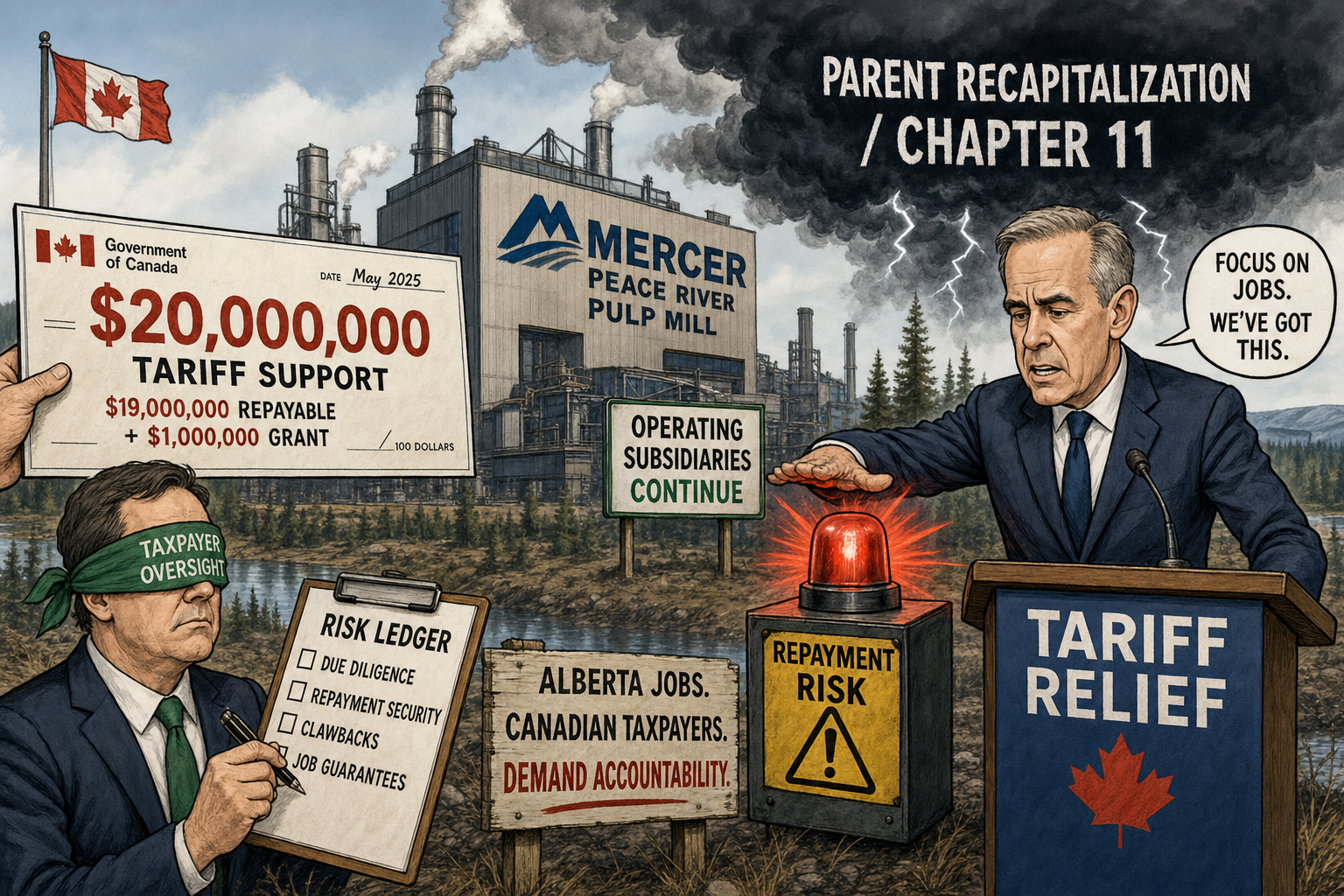
Tariff relief can be legitimate when workers are caught in a trade fight they did not start. But legitimacy depends on receipts. Ottawa announced $20 million for Mercer Peace River Pulp Ltd. on August 26. Seventy-five days later, Mercer International Inc., the mill’s parent company, announced voluntary Chapter 11 cases in the United States as part of a balance-sheet restructuring. That timeline does not prove the federal decision was wrong. It does prove taxpayers deserve a bankruptcy-risk ledger.
The government’s own announcement described the money as support for Alberta’s forest sector against U.S. tariffs. PrairiesCan said the funding would help modernize the Peace River mill, reduce production costs and strengthen competitiveness. It also said $1 million was non-repayable and $19 million was repayable through the Regional Tariff Response Initiative. That distinction matters. A grant is an expense. A repayable contribution is supposed to come back, and taxpayers are entitled to know what security, covenants and warning triggers protect that repayment.
The jobs case is real. Ottawa said Mercer Peace River directly employs 360 people, supports about 3,000 jobs in the supply chain, and contributes roughly $1.5 billion annually to the regional economy. A conservative accountability standard does not sneer at those workers. It asks whether public money was structured to protect them instead of merely cushioning a corporate balance sheet.
Mercer’s own filings show why the question is urgent. A November 5 SEC-filed quarterly release reported a net loss of US$59.2 million, restructuring support agreements involving US$1.275 billion in senior notes, and about US$26.5 million in grants and repayable contributions secured for the Peace River mill. On November 9, Mercer said the Chapter 11 cases involved the company and one non-operating subsidiary, while operating subsidiaries, including the mills, were not parties and were expected to keep operating. That nuance is important. The Peace River mill is not described by Mercer as being in Chapter 11. But taxpayers are still exposed to repayment and performance risk when public support is announced so close to a parent-company restructuring.
So publish the ledger. When did officials complete the credit-risk review? What financial statements, debt maturities and restructuring discussions were disclosed before approval? What is the repayment schedule for the $19 million? Is there collateral, a parent guarantee, a project-security interest or a set-off right? What clawbacks apply if production, employment, modernization milestones or Canadian operations change? Did Ottawa reassess the file after Mercer’s November 5 disclosure and November 9 restructuring announcement?
Carney’s government likes to frame industrial support as nation-building. Fine. Nation-building money should come with nation-building transparency. The public should not have to choose between defending forestry workers and demanding basic due diligence from the federal cabinet. If this $20 million is sound, Ottawa can prove it with dated approvals, repayment terms, job-protection conditions and risk controls. If those receipts are missing, the problem is not the workers. The problem is a government asking taxpayers to lend first and learn later.
- PrairiesCan: Federal investment helps defend Alberta’s forest sector against U.S. tariffs
- Mercer International / SEC filing: Q3 2026 release filed as Exhibit 99.1
- Mercer International press release via Finviz: Recapitalization and balance-sheet restructuring announcement
- Rebel News: Independent lead on Mercer timeline
This article relies on the official PrairiesCan announcement and Mercer’s company/SEC disclosures. It does not claim the operating mill is in Chapter 11; it argues that taxpayer-backed repayable funding requires transparent risk, repayment and job-protection receipts.