Leger Poll Shows Carney’s Budget Has Warning Lights
Carney can lead the horse race and still owe Canadians the household ledger.
Leger’s November federal politics poll gives Prime Minister Mark Carney numbers any government would rather have than explain away. The Liberals lead decided voters by 47% to 36%, satisfaction with the federal government sits at 59%, and 58% approve of Carney’s performance. But that is the headline Ottawa will want Canadians to stop reading at.
The accountability story is underneath the horse race. Leger says the Liberal lead narrowed by four points since October. More importantly, the same survey shows Canadians are not buying a simple “trust us” message on Budget 2026. Only 33% think the budget will be good for Canada, while 27% think it will be bad, 13% expect little impact, and 27% are unsure. On the question closest to kitchen tables, the numbers are colder: only 19% think the budget will be good for themselves or their family, while 28% think it will be bad and 30% expect no personal impact.
That is a flashing warning light for a government selling Budget 2026 as affordability relief and an economic transformation plan. Finance Canada’s own budget overview says Ottawa is trying to deliver affordability help today while building a stronger, more independent economy tomorrow. Fine. Then the public test is not whether the speech sounded competent. It is whether families can see the result in rent, groceries, taxes, wages, debt interest and services.
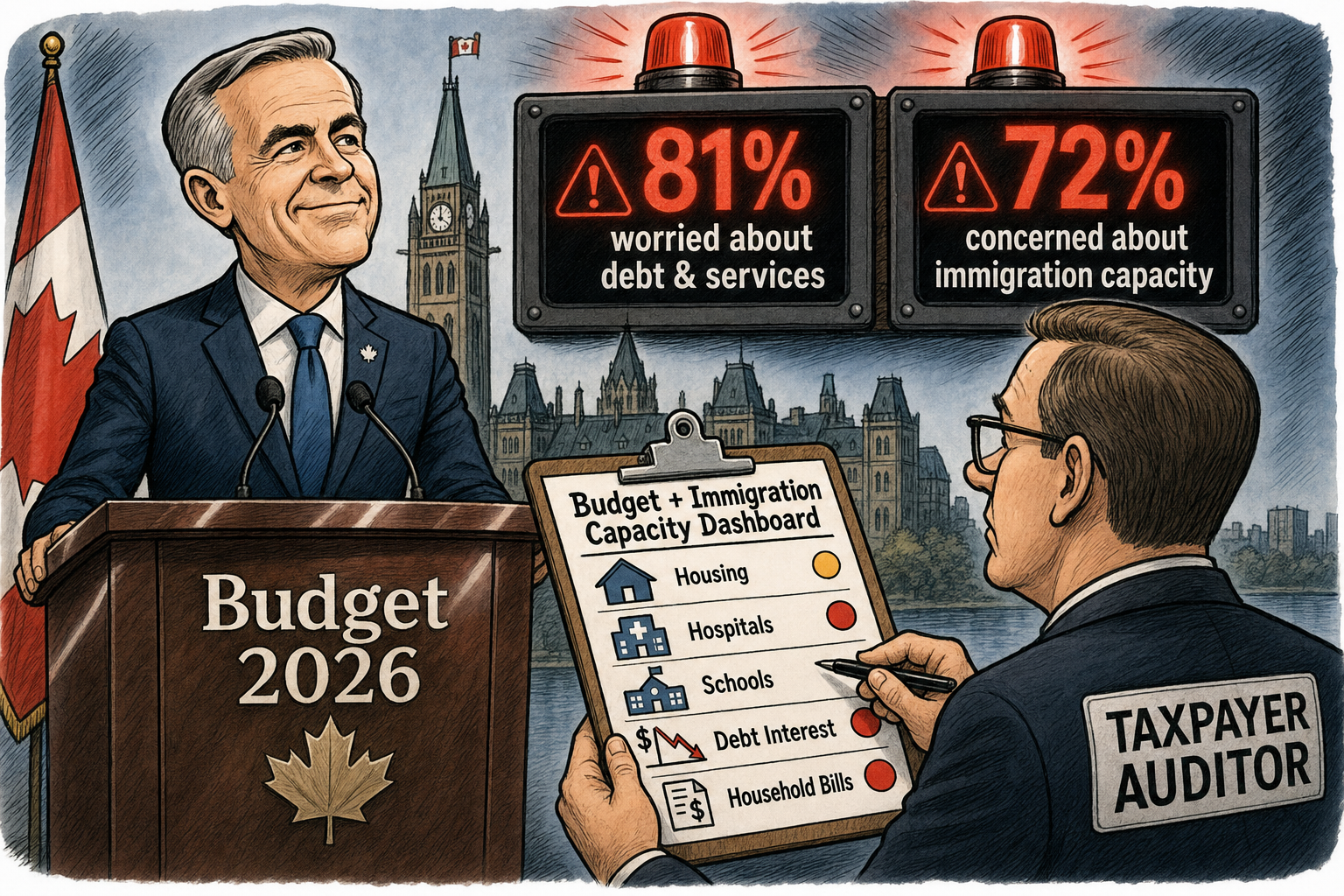
Leger’s debt finding should worry every taxpayer. The poll reports that 81% of Canadians are worried federal deficits and debt could affect Ottawa’s ability to fund important services. That is not an ideological talking point. It is a practical concern: when debt-service costs rise, every dollar used to pay yesterday’s bills is a dollar not available for health care, defence, border capacity, housing infrastructure or tax relief.
The immigration result is just as direct. Leger found 56% believe Canada currently allows too many immigrants, and 72% are concerned about a proposed increase in immigration levels for 2027. The leading worries were pressure on essential services and higher housing demand and costs. That does not justify blaming newcomers for Ottawa’s planning failures. It does require the government to prove that admissions targets, housing supply, health care, schools, settlement services and labour-market capacity are being planned together instead of announced separately.
A conservative accountability standard is simple: publish the worksheet. Carney’s government should release a monthly Budget-and-Immigration Capacity Dashboard showing the debt-service path, deficit assumptions, household budget impacts, service-risk measures, housing and infrastructure capacity, immigration-level math, temporary-resident transitions, and regional pressure points.
Personal popularity is not a blank cheque. If Canadians like Carney but worry about the bill, the services and the housing load, Parliament should treat that as an oversight mandate. Lead the polls if you can. But show the receipts before asking households to carry the risk.
- Leger: Federal Politics: Liberal Lead Narrows as Canadians Weigh Budget and Immigration
- Leger: November 2026 federal politics polling deck
- Budget 2026: Economic and fiscal overview
This article relies on Leger’s published November 2026 polling release and Budget 2026’s official overview. It does not allege misconduct; it argues that high approval numbers make transparent fiscal, service and immigration-capacity receipts more necessary.