Davos Hotel Contracts Need a Taxpayer Ledger
Before Ottawa sells another elite investment summit, publish the room bill.
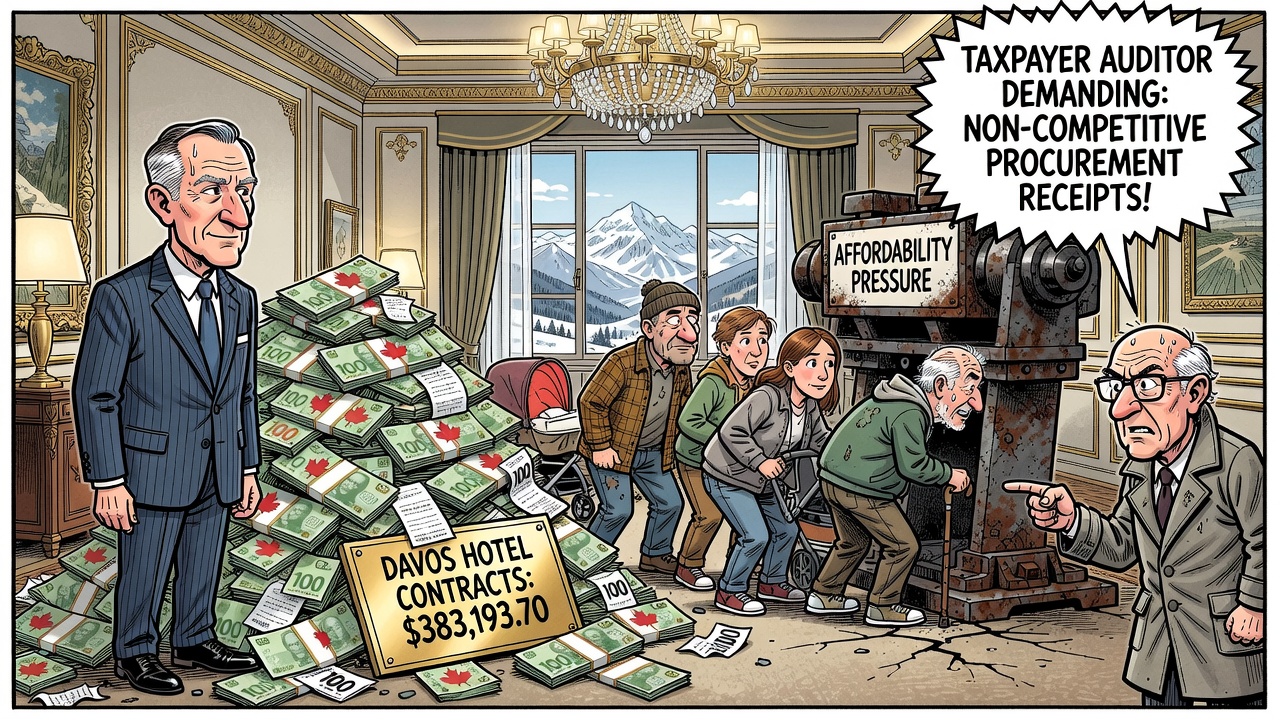
Canadians who are told to accept restraint deserve to see the receipts when a federal investment agency books Davos.
Rebel News reported on November 18 that Invest in Canada used non-competitive contracts worth $383,193.70 for hotel and venue arrangements tied to the World Economic Forum in Davos. The reported records include $216,310.18 for the Steigenberger Grandhotel Belvédère, $68,217.20 for Hotel PostMorosani AG, and $98,666.32 for TopDavos AG. Each amount is large enough to matter on its own. Together, they are a serious public-value question.
The issue is not whether Canada should ever promote investment abroad. Countries compete for capital, and ministers, agencies and trade officials will sometimes need to be in the room. The issue is whether taxpayers are being given a clear business case before the bill is booked, especially when the procurement route is described as non-competitive and the venue is Davos, the global symbol of insider access.
That standard should be even higher for Invest in Canada. The agency’s own leadership page lists Dominic Barton as chair of the board, and the Prime Minister’s Office announced Barton’s appointment to that role in March 2025. Barton is a well-known Liberal-adjacent power player, former McKinsey global managing partner and former ambassador to China. None of that makes these contracts improper by itself. It does mean the agency should be unusually transparent when public money flows into prestige events where political, corporate and bureaucratic networks overlap.
A conservative accountability test is straightforward: show the purpose, attendees, deliverables, procurement rationale and post-event return. If the public is paying more than $383,000 for Davos-related rooms and venues, the public should know who stayed, who met whom, what investment files were advanced, what cheaper options were considered, and why a competitive process was not used. “Because Davos is expensive” is not a procurement argument. It is the reason taxpayers need a ledger.
This also lands during an affordability crisis. Families are measuring grocery bills, mortgage renewals and rent increases line by line. Federal officials should expect the same discipline. Ottawa cannot ask Canadians to tighten belts at home while agencies quietly reserve luxury Swiss capacity abroad without publishing the value-for-money math.
So release the Davos file: contracts, amendments, sole-source justifications, room counts, guest lists where legally releasable, agendas, meeting outcomes and any investment commitments directly traceable to the trip. If the spending produced results, prove it. If it was image management for insiders, taxpayers should not be the last to find out.
- Rebel News: Report on Invest in Canada Davos hotel and venue contracts
- Government of Canada proactive contract search: Steigenberger Grandhotel Belvédère search record
- Government of Canada proactive contract search: Hotel PostMorosani AG search record
- Government of Canada proactive contract search: TopDavos AG search record
- Invest in Canada: Leadership page
- Prime Minister of Canada: March 2025 appointment announcement naming Dominic Barton chair of Invest in Canada
This article argues for procurement transparency and value-for-money disclosure. It does not allege the contracts were illegal or that any named individual personally benefited.