Carney’s $60B Savings Claim Needs a Net-Cut Ledger
Savings should mean net relief, not a cabinet shell game.
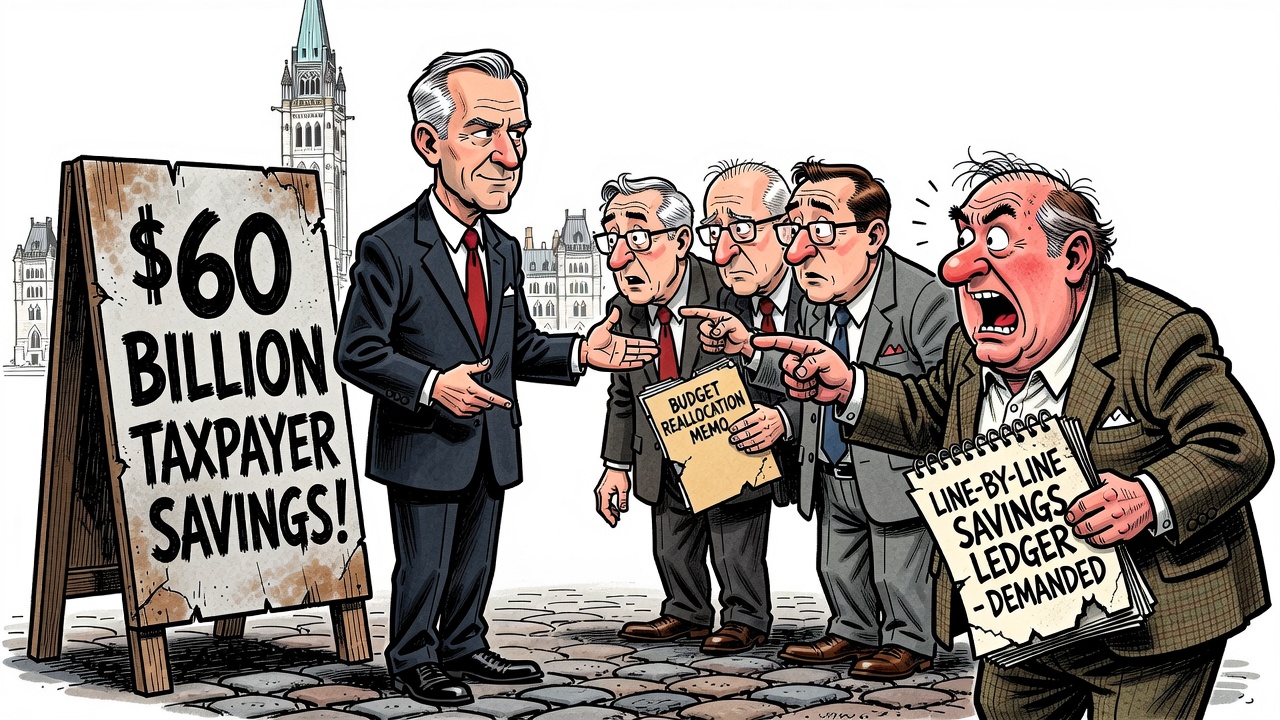
When a prime minister tells taxpayers he has found $60 billion in savings, the next document should be a ledger, not a slogan. Mark Carney’s November 7, 2025 Canadian Club speech said Budget 2025 would “save Canadian taxpayers a total of $60 billion over five years” by restructuring operations, consolidating internal services and rightsizing programs. That is a major claim. It should mean less pressure on borrowing, interest costs and future taxes.
But the Commons government operations committee record points to a much narrower reality. In April 2026 testimony on the comprehensive expenditure review, Finance official Nick Leswick said the proceeds of the exercise “were reallocated to other programs and services.” Pressed on the point, he added: “There are no net savings to the fiscal framework.” That does not make every reallocation wasteful. It does mean taxpayers should not be sold a net-savings story if the money is simply moved from one cabinet priority to another.
This is not a semantic quibble. Ottawa is already carrying debt-interest costs that crowd out real services. In the same OGGO evidence, Leswick said public debt charges were projected at $55.6 billion for 2025-26 and $60 billion for 2026-27, while admitting that lower public debt charges are better than higher ones. If the alleged $60 billion in savings does not reduce the fiscal framework, Canadians deserve to know exactly what it does reduce.
A conservative accountability standard is simple: a dollar saved is a dollar that lowers spending, borrowing or taxes after all reallocations are counted. A dollar shuffled is a policy choice. It may be defensible, but it is not the same thing. If cabinet cuts one program, books the “saving,” and then spends the proceeds elsewhere, the public balance sheet has not received the relief implied by the word savings.
That distinction matters even more because Carney’s speech paired the savings claim with promises to reduce the public service by 10 percent and cut management consultants by 20 percent. Those moves affect workers, services, contracting markets and departments across the country. If the government is asking Canadians to accept disruption in the name of discipline, it owes them proof that discipline actually improves the bottom line.
So publish the $60 billion ledger. For every claimed dollar, show the department, program, fiscal year, gross reduction, reallocation destination, net impact on the fiscal framework, job effect, service effect and borrowing impact. Separate true reductions from internal transfers. Show whether consultant spending falls in cash terms, not just in a selected category. Show whether public-service reductions lower total compensation costs or are offset by outsourcing, temporary staffing or new agencies.
Carney promised a government that would spend less so Canadians could invest more. Good. Then prove the “less.” Until the ledger is public, the $60 billion line should be treated as an unverified cabinet talking point, not a taxpayer dividend. Canadians do not need another fiscal word game. They need a net-cut receipt.
- Prime Minister of Canada: Canadian Club Toronto remarks on Budget 2025 and the $60B savings claim
- House of Commons OGGO: Committee evidence on the comprehensive expenditure review, reallocations, debt interest and fiscal-framework impact
- Blacklock’s Reporter: Public excerpt, “Claimed Savings Don’t Exist”
This article distinguishes between gross internal reallocations and net savings to the fiscal framework. It does not claim every reallocated dollar is wasteful; it argues that taxpayers deserve the line-by-line ledger before accepting the $60B savings label.