Carney’s Shenzhen Deal Needs a China Concession Ledger
More market access for Canadian farmers and fishers may be welcome. But a serious country does not trade away tariff leverage without showing workers and taxpayers the full receipt trail.
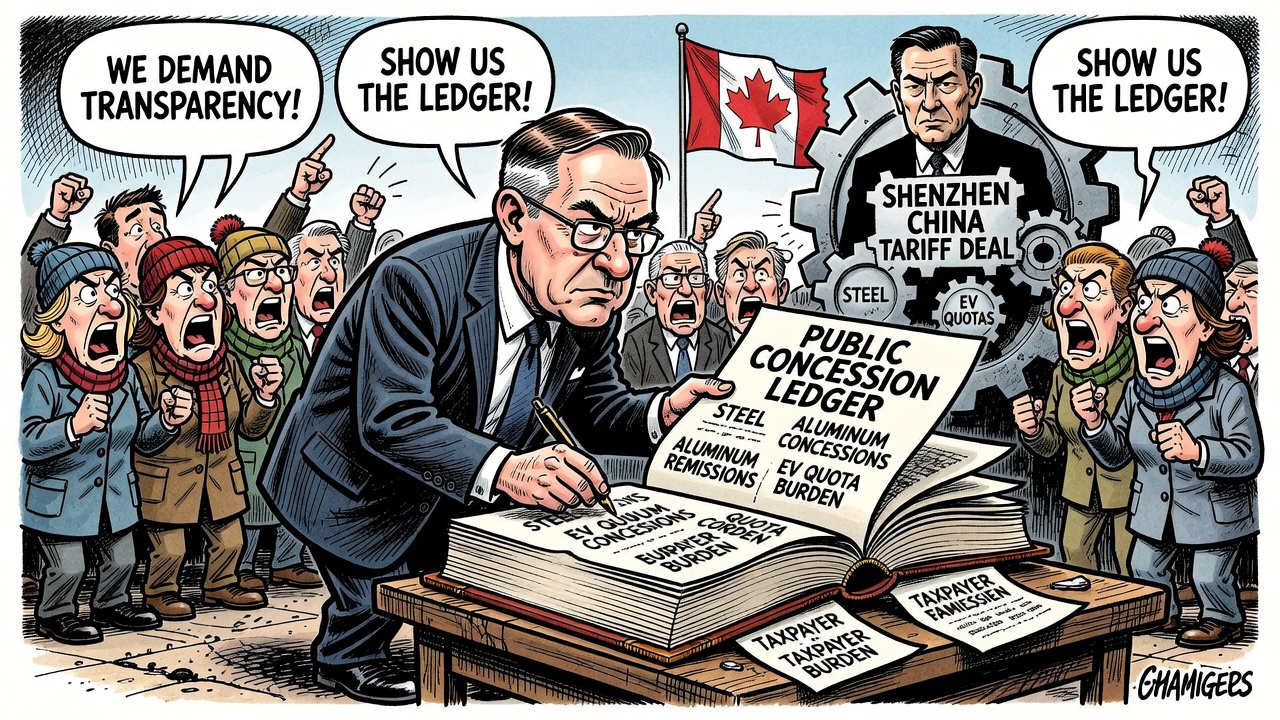
Prime Minister Mark Carney met Chinese President Xi Jinping in Shenzhen on November 17 and declared the Canada-China strategic partnership “working successfully.” The official readout says the two leaders agreed to extend and expand a trade arrangement that reduces Chinese tariffs on more Canadian products, including frozen pork cuts, Greenland halibut, shrimp and prawns, geoduck, sea cucumbers and other seafood.
That is real relief for exporters who have been caught in the middle of Beijing-Ottawa trade fights. PMO says the new relief covers roughly $400 million in Canadian exports: $116 million in frozen pork cuts and $285 million in fish and seafood. If the deal puts money back into Canadian communities, Ottawa should be able to show the benefits clearly.
But the reciprocal side deserves just as much daylight. The same PMO release says Canada agreed to extend existing remission measures for certain Chinese steel and aluminum products by two years and expand remission coverage to 32 additional tariff items where Canadian supply is described as insufficient or unavailable. Global Affairs Canada’s backgrounder breaks that down as 23 steel and 9 aluminum tariff items.
That is not a footnote. It is the core accountability question. Which importers benefit? Which Canadian steel and aluminum producers were consulted? What test proves Canadian supply was actually unavailable? What safeguards stop tariff relief from weakening domestic capacity while Beijing gains a stronger position in strategic supply chains?
The EV file makes the ledger even more urgent. Global Affairs says the January 2026 arrangement created a 49,000-vehicle quota for Chinese electric vehicles at a 6.1% tariff; since March, 16,211 EVs have been imported, roughly half below $35,000, and a second China-based original equipment manufacturer began importing in November. Affordable vehicles matter, but so do Canadian auto jobs, data security, forced-labour screening, battery supply chains and whether Ottawa is quietly reshaping the market before workers see the plan.
A conservative accountability standard is simple: trade deals can be pragmatic, but concessions must be measurable. Publish the product-by-product ledger, the company-by-company remission beneficiaries, the EV quota usage, security reviews, labour and forced-labour screens, cabinet approvals, and the modelling for jobs in steel, aluminum, fisheries, agriculture and autos.
No one needs to pretend every Canada-China agreement is automatically bad. Canadians do, however, deserve more than a victory lap from a government that keeps asking them to trust elite deal-making. If Carney’s Shenzhen bargain is as good as advertised, the receipts should make that obvious. Publish the China concession ledger.
- Prime Minister of Canada: Prime Minister Carney meets with President Xi Jinping
- Prime Minister of Canada: Canada’s strategic partnership with China across trade, commerce and culture
- Global Affairs Canada: Expanding trade between Canada and China
- Associated Press: AP report on Carney-Xi meeting
- Global News / The Canadian Press: Carney meets Xi at Shenzhen summit
This article relies primarily on official PMO and Global Affairs Canada records, with mainstream wire coverage for context. It does not allege illegality; it argues for a public concession ledger.