PBO Says Carney Spent the Fiscal Room
The watchdog’s November 17 review puts hard numbers beside Ottawa’s fiscal-discipline branding: new room appeared, and almost all of it was absorbed.
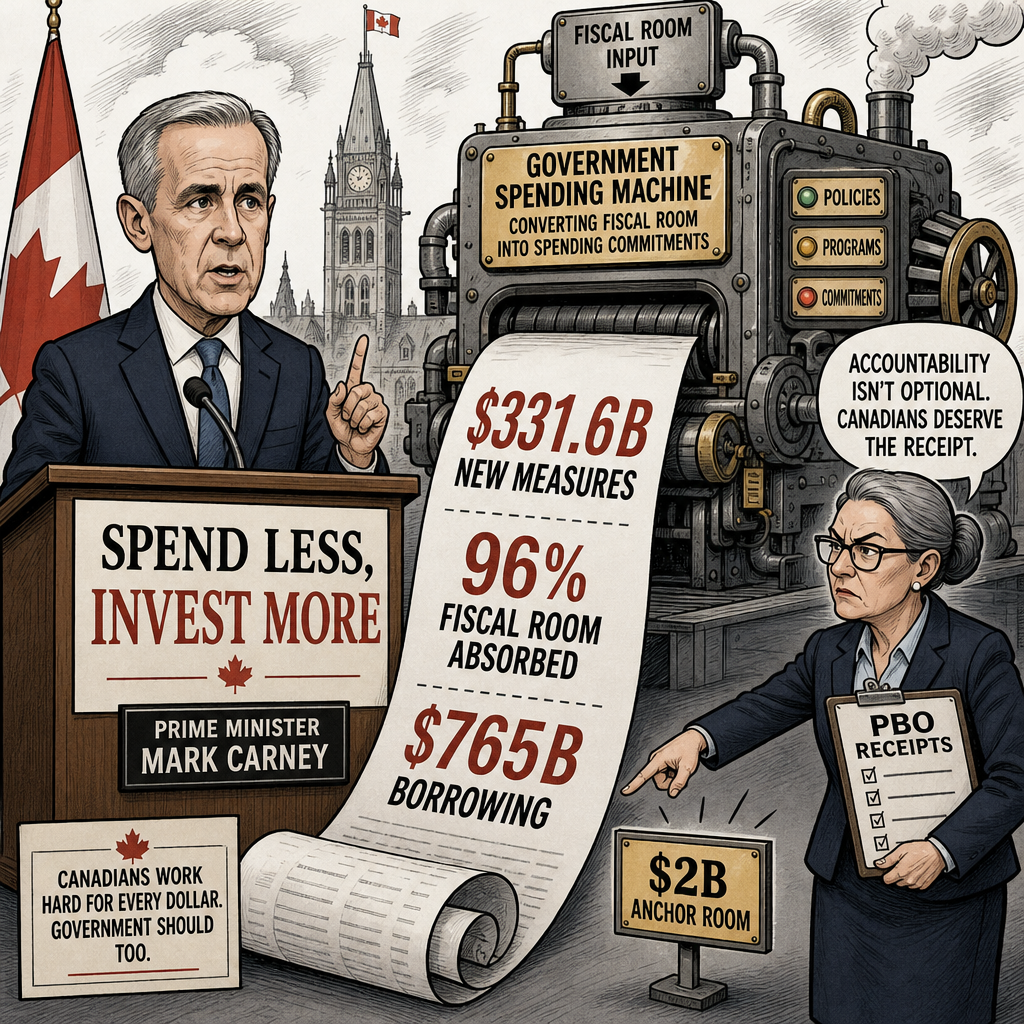
Prime Minister Mark Carney sold Budget 2026 as a discipline exercise: spend less, invest more, and protect fiscal anchors. The Parliamentary Budget Officer’s November 17 review tells a harder story. Ottawa received new fiscal room, then used almost all of it.
The PBO says Budget 2026 introduced $151.5 billion in new measures over five years. That absorbed 96 per cent of the $158.3 billion in new fiscal room created since the Spring Economic Update. In plain English, the government found a windfall and spent nearly the whole thing instead of driving the deficit down in a serious way.
The broader ledger is worse. Since the 2024 Fall Economic Statement, the PBO says new measures total $324.8 billion — nearly twice the $176.7 billion in fiscal room created by economic and fiscal developments. In a separate fiscal-anchor review, the PBO says new measures in Budget 2025, the Spring Economic Update 2026 and Budget 2026 total $331.6 billion. That is not austerity. It is a spending expansion dressed in investment language.
Some of the new money is classified as capital. The PBO’s economic-and-fiscal note says $89.5 billion of Budget 2026’s $151.5 billion in new measures is classified as capital investment under the government’s framework. But the same review also identifies $62.0 billion as day-to-day operating spending. Canadian Press reported PBO Annette Ryan’s blunt summary: “This budget spends more, invests more and borrows more.”
The anchor story is equally thin. The PBO says Budget 2026 projects the government will meet both fiscal anchors, but some margins are close: the deficit anchor has about $2 billion of room in 2027-28 and is not met in the budget’s downside scenario. A federal fiscal plan that can lose its anchor on a $2 billion miss is not a fortress. It is a tightrope.
Borrowing is the part Ottawa most wants voters to miss. The PBO says neither fiscal anchor limits borrowing, which totals about $765 billion over five years — roughly $476 billion more than cumulative deficits of $289 billion. Those cash needs still have to be financed, and the PBO’s economic review says public debt charges are already the fastest-growing expense in the fiscal framework.
A conservative accountability test is straightforward: publish the bridge. Canadians deserve a measure-by-measure table showing which policies consumed the fiscal room, which are operating versus capital, how much deficit reduction was forgone, and how Ottawa will protect the anchor if revenues soften or interest costs rise.
Carney’s government cannot claim discipline merely because it renamed borrowing as investment. The PBO has put the receipt on the table. Now Finance should publish the full ledger.
- Parliamentary Budget Officer: PBO Assessment of Budget 2026: Economic and Fiscal Track
- Parliamentary Budget Officer: PBO Assessment of Budget 2026: Fiscal Anchors and Fiscal Sustainability
- Canadian Press via CityNews: Federal government spending up $331.6 billion under Carney, budget watchdog says
This article relies on PBO reports and Canadian Press reporting published November 17, 2026. It argues for fiscal transparency and does not allege criminal wrongdoing.