Bill C-22’s Senate Hearing Needs a Tech-Exit Risk Ledger
If Ottawa’s lawful-access bill is safe for privacy, encryption and Canadian competitiveness, the government should be able to show the risk ledger before senators move it forward.
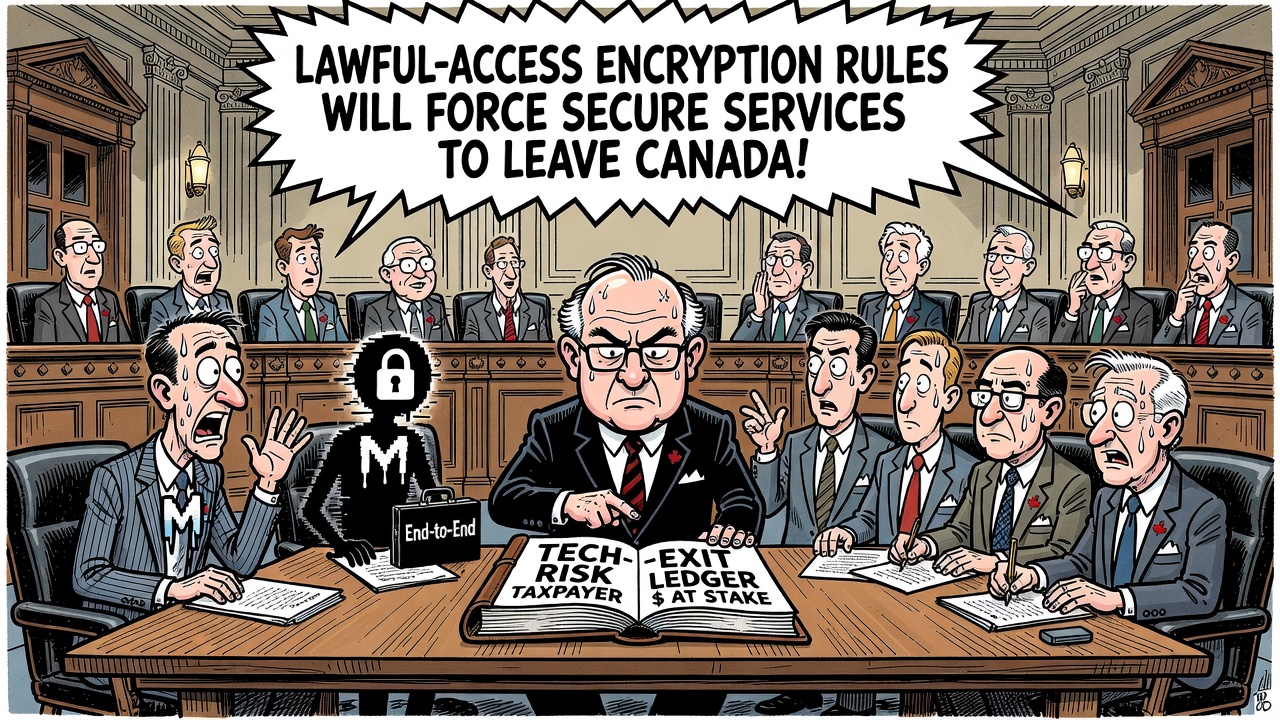
Bill C-22 is no longer a theoretical privacy fight. On November 16, the Senate National Security, Defence and Veterans Affairs Committee held a lawful-access hearing with witnesses from Meta, Signal, Tailscale, OpenMedia, the Canadian Civil Liberties Association, Citizen Lab and legal scholars including Michael Geist. That witness list alone should tell Canadians the bill has moved from routine public-safety messaging into a real test of encryption, cybersecurity and trust.
The government’s own lawful-access explainer says the bill is meant to help police and CSIS obtain legally authorized information and require electronic service providers to maintain technical capabilities. It also says ministerial orders under the new Supporting Authorized Access to Information Act would be reviewed by the Intelligence Commissioner, that providers could seek judicial review, and that metadata-retention obligations were reduced from one year to six months.
Those safeguards matter. So does the reason police ask for modern tools. Conservatives should not pretend criminals, child exploiters, foreign agents and organized networks do not use digital platforms. But a serious public-safety law cannot be built on “trust us” when the people who run secure communications systems are warning that the architecture may not survive the mandate.
Reporting from The Canadian Press says Meta told senators it would have to consider pulling encrypted services from Canada if Bill C-22 passes without further changes. Signal’s witness was even blunter: if forced to choose between betraying users and leaving Canada, Signal would not compromise Canadians’ security. Bloomberg Law separately reported that Meta, Apple and Alphabet were pushing to rewrite the bill before passage.
Meta’s own public position draws the line clearly: Part 1 may provide law enforcement a workable evidence framework, but Part 2 could require companies to build or maintain capabilities that weaken encryption or install third-party surveillance tools. Meta asks for stronger systemic-vulnerability language, removal of obligations to add surveillance tools, a codified challenge process and liability protection while disputes are pending.
That is the accountability question Ottawa keeps dodging. Which services are actually covered? Which technical capabilities can be ordered? What counts as a systemic vulnerability? Who sees the order? How fast can a company challenge it? What happens if a foreign production order conflicts with Canadian privacy law? How many Canadians’ metadata records would be retained, by which providers, and at what cybersecurity risk?
Before clause-by-clause Senate work, the Carney government should publish a tech-exit risk ledger: encryption red lines, metadata limits, ministerial-order review steps, company challenge rights, services-at-risk, foreign-access safeguards, breach-risk modelling and the economic impact if secure products withdraw from Canada.
Public safety is real. So is cybersecurity. A government that weakens secure communications in the name of catching criminals may hand criminals, hostile states and hackers a bigger target. Bill C-22 should not advance on assurances. It needs receipts.
- Senate of Canada: Bill C-22 meeting notice and witness list
- Government of Canada: Lawful access explainer
- Parliament of Canada: Bill C-22 third-reading text
- Today in Canada / The Canadian Press: Meta would consider pulling services if bill passes as-is
- Bloomberg Law: Meta, Apple and Alphabet push to rewrite Canada’s data-access bill
- Meta: Meta’s position on Canada’s Bill C-22
This article relies on official Senate, Government of Canada and Parliament records, plus mainstream and primary-source technology statements. It does not allege illegality; it argues for public risk disclosure before passage.