Ottawa’s Immigration Cut Needs a Fine-Print Ledger
The headline target was one number. The full immigration ledger needs more columns.
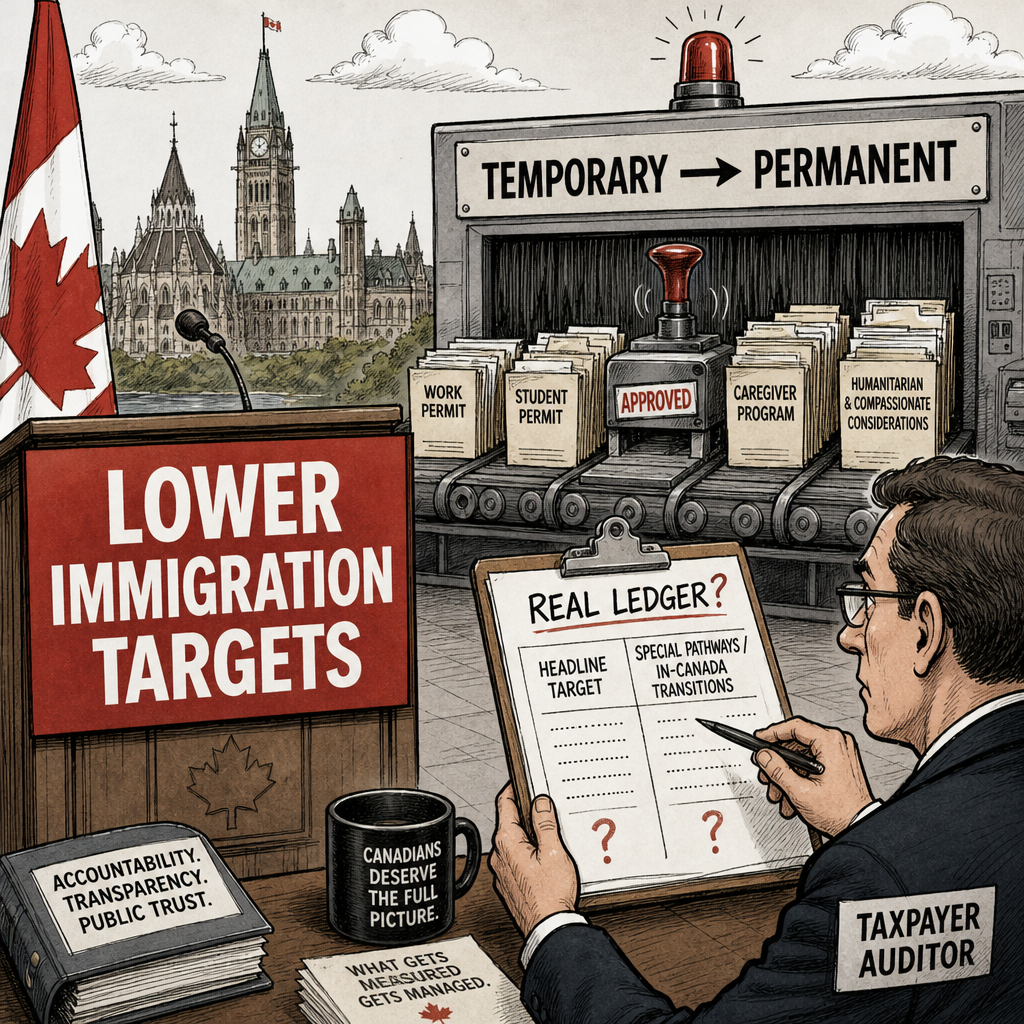
Blacklock’s Reporter put a hard charge on Ottawa this morning: the government’s immigration story, it says, does not match the full ledger. The public excerpt says Cabinet “let 42 percent more landed immigrants” into Canada than claimed last year. That is the kind of claim that has to be handled carefully, because immigration numbers are easy to weaponize and easy to misread.
Here is what the government’s own documents show. IRCC’s 2025–26 Departmental Plan advertised a reduction in overall permanent-resident admissions to 395,000 in 2025, then 380,000 in 2026 and 365,000 in 2027. The 2026 Annual Report to Parliament says Canada welcomed 393,770 permanent residents in 2025, within the official range. On the narrow headline target, Ottawa can say it hit the number.
But that is not the end of the accountability test. The same annual report says 145,735 temporary work-permit holders became permanent residents in 2025. It also says 20,790 former study-permit holders became permanent residents. Add those two status-transition categories and Canadians get 166,525 people who moved from temporary status to permanent residence inside the same permanent-resident total.
That distinction matters. A person already in Canada does not create the same immediate border-arrival impact as a new arrival. But a conversion to permanent residence still changes Canada’s long-term population, housing demand, health-care demand, school demand and labour-market planning. Voters deserve a government that explains both numbers plainly: the headline permanent-resident admissions target, and the share achieved by converting temporary residents already here.
Instead, Ottawa has spent years selling immigration targets in simple round numbers while the real system runs through categories, ranges, extensions, exemptions and transitions. The result is predictable: ministers claim restraint; critics find another column; Canadians lose trust in all of it.
That trust problem is not anti-immigrant. It is pro-accountability. New Canadians deserve honest planning too. If Ottawa invites people to build lives here while underbuilding homes, underfunding services, and hiding the operational math behind bureaucratic labels, the failure belongs to government — not to families following the rules.
The fix is straightforward. IRCC should publish a one-page annual immigration ledger that separates new permanent-resident arrivals, in-Canada temporary-to-permanent transitions, temporary-resident arrivals, permit extensions, public-policy exemptions and planned departures. It should show the housing, health-care and classroom assumptions attached to each category. It should also state, in plain English, whether a target is about admissions, arrivals, net population growth or administrative status changes.
If the government’s numbers are defensible, it should welcome that ledger. If ministers prefer applause for a lower target while relying on fine print to explain the rest later, then Blacklock’s has exposed the real issue: not simply how many people Canada admitted, but how casually Ottawa expects voters to accept a headline in place of a full accounting.
- Blacklock’s Reporter: PM Hid Immigration Figures
- IRCC: 2025–26 Departmental Plan
- IRCC: 2026 Annual Report to Parliament on Immigration
This article does not argue against immigration or allege wrongdoing by immigrants. It argues that Ottawa should present headline targets and status-transition mechanics in one transparent public ledger.