PHAC’s New Brunswick Brain-Disease Review Needs a Patient Follow-Up Ledger
No public-health agency should confuse “no single mystery disease found” with “the accountability file is closed.”
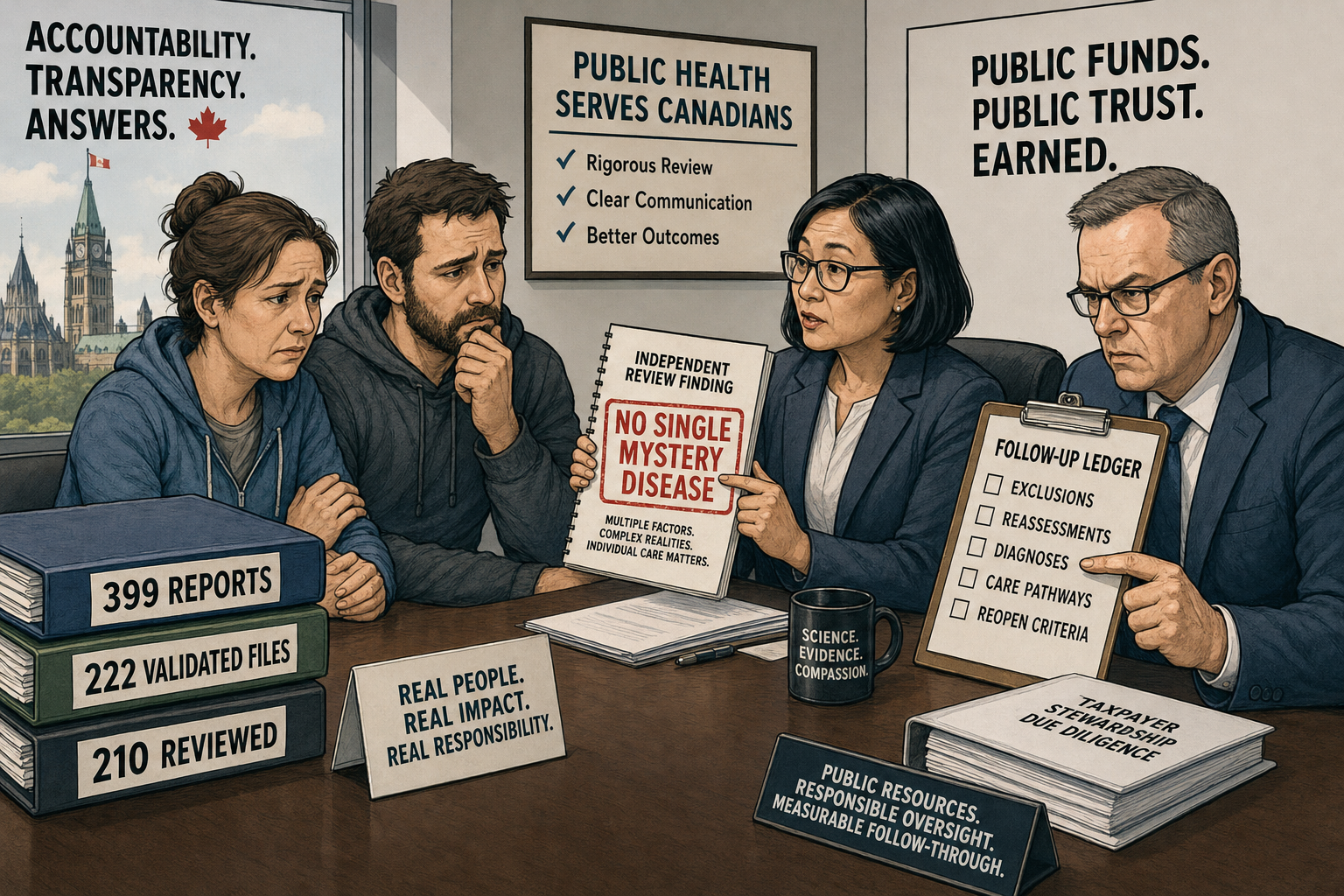
The Public Health Agency of Canada says it found no evidence of an unusual pattern of neurological illness in New Brunswick after reviewing population surveillance, information from patients and caregivers, engagement with the reporting neurologist and available patient data. That is an important finding. It is not a permission slip for governments to leave sick people in a fog.
The numbers alone demand a public ledger. New Brunswick’s earlier data report says one-page notifications covered 399 patients as of November 1, 2025. The province later received complete and validated enhanced surveillance reports for 222 patients. PHAC says it reviewed de-identified data for 210 of those 222 patients — 94.6 per cent — reported from a single neurological practice.
That means the public deserves a plain explanation of the path from 399 to 222 to 210. Which files were incomplete? Which patients declined participation or could not be validated? What information was missing? How many people still lack a diagnosis? How many have been reassessed, referred, treated or discharged from the concern list? Those are not conspiracy questions. They are basic public-administration questions after years of fear, headlines and official reviews.
PHAC’s own report identifies the core limitation: although extensive medical testing was available, the data did not include the clinical neurology interpretation needed to define a common health event, diagnosis or well-defined syndrome for most patients. Death-certificate information for 23 deceased patients showed a range of known neurological and non-neurological diagnoses, not one shared condition. PHAC also said the available evidence did not support more environmental testing or a new exposure investigation.
Fair enough. But if the decisive problem is diagnostic uncertainty, the solution is not bureaucratic closure. It is measurable follow-up. New Brunswick says it accepted PHAC’s recommendations: continued engagement with patients, caregivers and the reporting neurologist; access to clinical re-evaluation; collection and review of updated diagnoses; and clearer rules for future reporting. The province also says a reassessment process is established, with a dedicated nursing resource and a phone line.
Then publish the scoreboard. Not private medical records. Not names. A public, anonymized patient follow-up ledger: referred files, validated files, PHAC-reviewed files, excluded files by reason, reassessment offers, reassessments completed, updated diagnoses collected, unresolved cases, specialist access timelines, care pathways offered and the trigger for asking PHAC to re-engage if subgroup evidence appears.
CityNews/The Canadian Press reported that PHAC declined an interview request and said publication of the review concluded its response to New Brunswick’s assistance request, while remaining ready to discuss additional support if requested. That may be administratively tidy. It is not enough for patients who were told for years that something serious might be happening, then told the evidence does not support a single mystery disease.
A conservative accountability standard protects patients and taxpayers at the same time. It does not invent a disease PHAC says it did not find. It does insist that public-health agencies show their work, track unresolved cases and report whether promised reassessments actually happen. The ledger is simple: respect the science, respect privacy, and respect the people still waiting for answers.
- Government of New Brunswick: Investigation of cases of undiagnosed neurological illness
- Government of New Brunswick / PHAC: PHAC independent review and analysis report
- Government of New Brunswick: Environmental substances data-analysis report
- Global News: PHAC finds no evidence of mystery brain disease in New Brunswick
- CityNews / The Canadian Press: Public Health Agency finds no evidence of a “mystery” brain disease
This article does not claim a single mystery disease exists or contradict PHAC’s finding. It argues that patients and taxpayers deserve transparent, privacy-protected follow-up reporting.