The Inclusion Council Contract Ledger: Non-Competitive Contracts Need Public Receipts
An advisory council that influences public policy should not also become a foggy contract ledger.
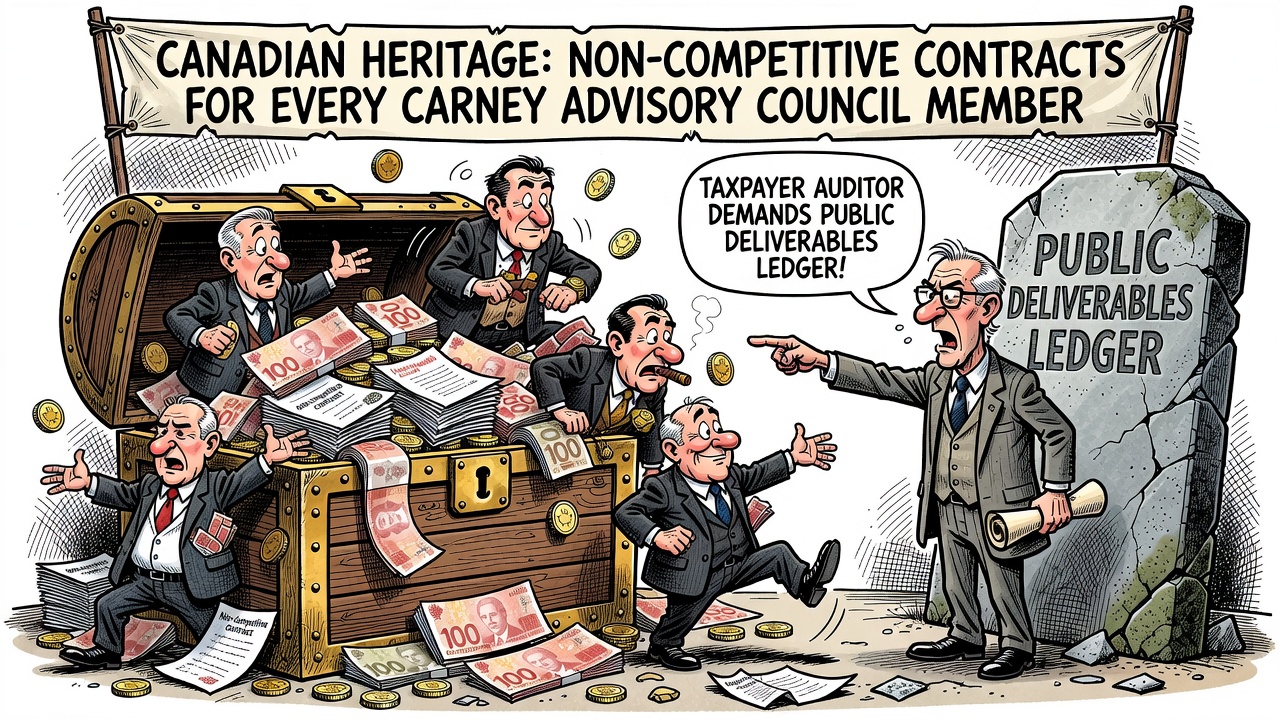
Prime Minister Mark Carney’s government launched the Advisory Council on Rights, Equality and Inclusion as a body to help guide Ottawa’s work against racism and hate. That is sensitive public work. It is also exactly the kind of work where the public deserves clean procurement records, clear deliverables and visible conflict safeguards.
Rebel News reports that all nine members of the council received Canadian Heritage non-competitive contracts worth a combined $185,200. The report points to federal proactive-disclosure records and says the contracts were dated July 24 to July 28, 2026, with end dates of August 1, 2028. That does not prove wrongdoing. It does prove the government owes Canadians a better explanation than a list of names and vague service descriptions.
The official record for former Liberal cabinet minister Omar Alghabra is a useful example. Open Government lists Canadian Heritage as the organization, “Management Consulting” as the description, “Coaching and Expert Assistance Services” as the additional comment, a July 28, 2026 contract date, an August 1, 2028 end date, a total value of $20,000, one bid and a “Non-Competitive” solicitation procedure. The Article 6 exception says only one person is capable of performing the contract.
That last phrase is where taxpayers should pause. If Ottawa believes every member of a ministerial advisory council is uniquely capable of the work, publish the reason. What statement of work did each person sign? Are these retainers, honoraria, meeting fees or consulting contracts? What deliverables are required? Are minutes, recommendations and reports public? Who approved the sole-source rationale? What conflict declarations were filed, especially for former office-holders and politically connected figures?
Canadian Heritage announced on June 26 that the council had nine members: Donald Bolen, Corrine Sparks, Omar Alghabra, Aftab Erfan, Marc Gold, Gary LaPlante, Catriona Le May Doan, Avnish Nanda and Martine Roy. The department said the council would advise the minister on social cohesion, shared identity and combatting racism and hate. The Prime Minister’s Office had announced the council on June 1 and said it would begin with antisemitism, including data, public institutions, federal policy alignment and measuring results.
Those goals are serious. That is why accountability matters. A government cannot ask Canadians to trust a council’s advice while making its payment rules hard to understand. Conservatives should not attack members for serving. They should demand the receipts: the appointment terms, payment policy, contract justifications, deliverables, meeting calendar, attendance, published work product, conflict screens and total spending by member.
The standard is simple. If the council is important enough to influence federal policy on rights, equality and inclusion, it is important enough for a public contract ledger. Sunlight protects taxpayers, protects the council’s legitimacy and protects the public from another Ottawa habit: announcing virtue in June, then burying the cheques in procurement records by July.
- Rebel News: Carney’s advisory council members got $185,200 in non-competitive Canadian Heritage contracts
- Open Government Canada: Canadian Heritage contract record for Omar Alghabra
- Canadian Heritage: Two new members of the Advisory Council announced
- Prime Minister of Canada: Prime Minister announces council and antisemitism measures
This article does not allege illegality or corruption. It argues that non-competitive public contracts connected to a policy advisory body require transparent public receipts.