Carney’s China Auto Plan B Needs a Jobs-and-Security Ledger
If Chinese automakers are Ottawa’s fallback, Canadians should see the ledger before the leverage becomes policy.
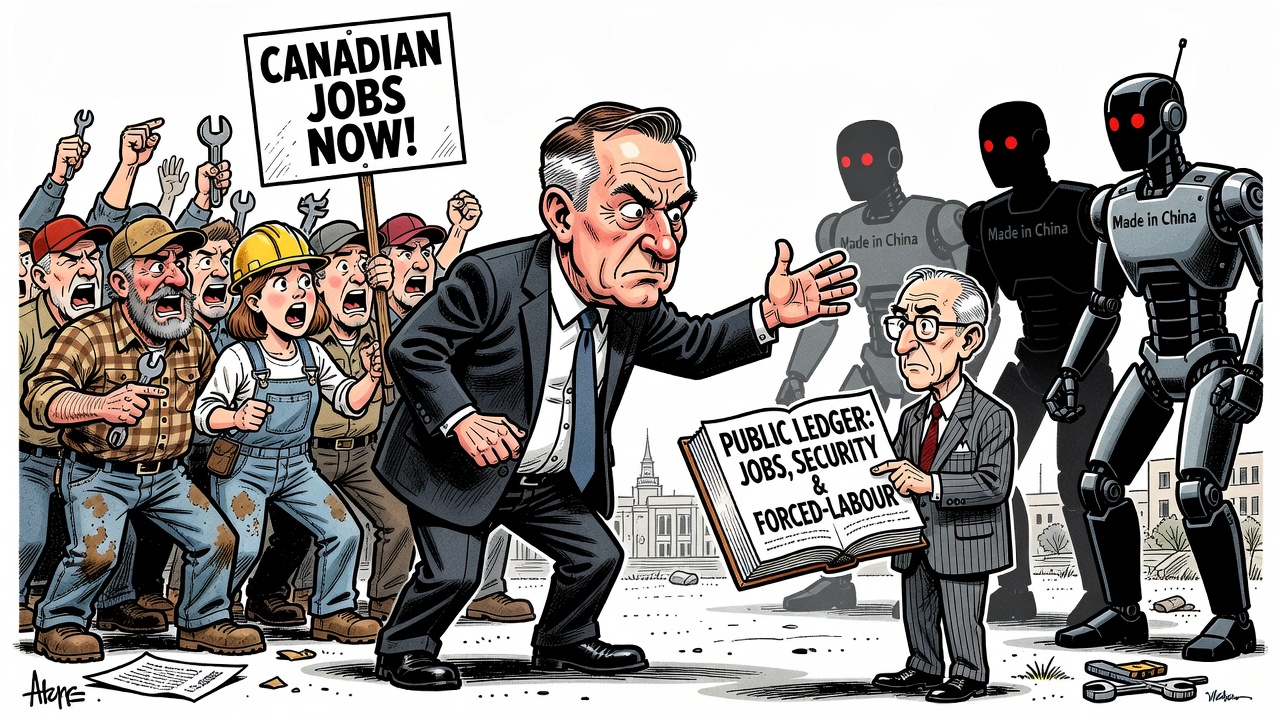
Prime Minister Mark Carney is right about one thing: Canada cannot sign a U.S. trade deal that leaves the domestic auto sector hollowed out. Global News reported on November 14 that Carney said Ottawa would not accept an agreement with Washington unless it was consistent with a viable Canadian auto industry. That is the correct test. But it is not the only test.
The Associated Press reported that Carney said Canada could turn to Chinese automakers if trade talks with U.S. President Donald Trump fail. AP placed the comments in Cambodia, ahead of Carney’s planned stop in Shenzhen, where Chinese auto manufacturing was expected to be discussed. The Prime Minister’s own itinerary shows him departing Phnom Penh for Shenzhen on November 16, and his Manila remarks said he would meet President Xi “in three days” to discuss increasing trade with China.
That sequence matters. Ottawa appears to be using a China auto option as leverage in U.S. negotiations. Maybe that is tactical. Maybe it is a genuine industrial fallback. Either way, Canadians should not have to guess whether the plan protects Canadian workers, supply-chain security and taxpayers — or merely swaps one dependency for another.
Carney has already acknowledged limits. Global News reported that Chinese investment in Canada’s auto sector is restricted by a set timeline and vehicle volume, and will be reassessed partly against Canada’s integration into the U.S. automotive sector. Good. Then publish the numbers. What is the timeline? What is the volume cap? Which companies are eligible? Are vehicles assembled in Canada, merely imported into Canada, or counted through some looser investment arrangement? What Canadian-content rules apply? What happens to existing plants, parts suppliers and union jobs?
There is also a security ledger. Any Chinese auto presence should face transparent national-security review, data and connected-vehicle rules, forced-labour screening, battery and critical-mineral sourcing disclosure, and enforceable penalties if commitments are breached. Conservatives should not pretend trade diversification is automatically wrong. They should insist that a government flirting with Beijing for bargaining power show its work before Canadian workers become the bargaining chips.
The Brampton lesson is fresh enough. When big industrial promises collapse or shift, the press conference fades but workers and communities live with the consequences. If Ottawa wants to tell Washington that Canada has alternatives, fine. But a Plan B that involves Beijing requires more than a slogan. It requires a public accounting of job impacts, security screens, cabinet approvals, provincial consultations, labour safeguards, subsidy exposure and exit clauses.
The standard should be simple: no China auto reset without receipts. If Carney’s fallback is real, publish the ledger. If it is only negotiating theatre, say so. Either way, Canadians deserve to know whether Ottawa is defending the auto sector — or auctioning uncertainty in two capitals at once.
- Associated Press: Carney says Canada could turn to Chinese automakers if Trump trade talks fail
- Global News / Canadian Press: Canada-U.S. trade deal must include viable auto sector, Carney says
- Prime Minister of Canada: November 16, 2026 itinerary
- Prime Minister of Canada: November 14 Manila remarks
This article does not allege illegality. It argues that any Chinese-auto fallback in Canada’s trade strategy requires public job, security and taxpayer-risk receipts before it becomes policy.