The Luxury EV Tax-Carveout Ledger
If a household can buy a six-figure electric vehicle, Ottawa should explain why that purchase needs tax relief before ordinary Canadians get affordability relief.
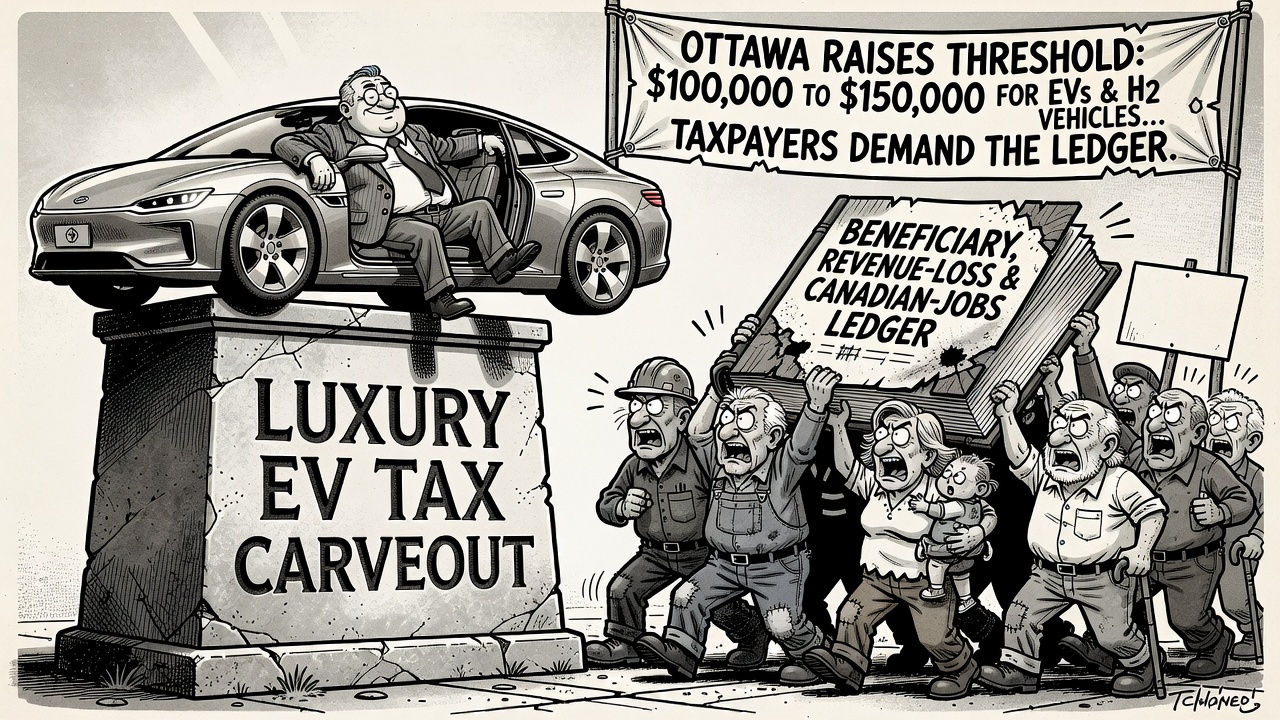
Ottawa’s latest zero-emission vehicle move is being sold as climate policy. It should be audited as tax policy.
On November 12, Finance Canada announced that the federal luxury-tax threshold for fully electric and hydrogen-powered vehicles would rise from $100,000 to $150,000. The change took effect the next day, subject to parliamentary approval. All other vehicles remain under the $100,000 threshold. Under the luxury-tax rules, the tax is generally the lesser of 10 per cent of the vehicle’s full value or 20 per cent of the amount above the threshold.
That means a buyer shopping below $150,000 for a qualifying zero-emission vehicle now sits outside a tax Ottawa still applies to other luxury vehicles. Global News reported that the change would exempt electric vehicles priced under $150,000 from the 10 per cent tax and noted that some BMW, Mercedes-Benz, Audi, Cadillac and Tesla models can run above $100,000. iPolitics reported the Conservative criticism that no zero-emission vehicles built in Canada sell above $100,000, meaning the practical benefit could flow heavily to foreign-made luxury models.
The government’s defence is predictable: sellers asked for relief, and the tax could discourage zero-emission vehicle adoption. But a conservative accountability test starts with priorities. Canada has families facing food-bank lines, rent shock, mortgage stress and higher everyday costs. A household able to buy a $120,000 or $145,000 vehicle is not the first place most taxpayers would look for urgent relief.
The question is not whether Canada should encourage cleaner technology. The question is whether Ottawa has proved that this carveout is fair, targeted and good for Canadian workers. If the stated goal is emissions reduction, publish the expected emissions impact. If the stated goal is industrial strategy, publish the Canadian assembly and parts-content table. If the stated goal is affordability, publish the buyer-income distribution. If the stated goal is competitiveness, publish the revenue loss and the lobbying record behind the decision.
Ottawa also owes Canadians a model-by-model beneficiary list. Which vehicles now escape the tax? Where are they assembled? Which companies asked for the change? How much federal revenue is being given up? How many Canadian jobs are expected to result? What is the measurable public benefit of removing a tax from luxury purchases while keeping ordinary Canadians under pressure?
Good climate policy should survive public arithmetic. Good tax policy should be neutral, transparent and defensible. This measure may help a small class of high-end buyers and imported premium EV brands; if the government believes otherwise, it should prove it with receipts.
Before Parliament blesses the change, Finance Canada should publish the luxury EV tax-carveout ledger: vehicle models, assembly countries, buyer-income bands, expected revenue loss, emissions assumptions, lobby meetings, seller requests and Canadian-job impacts. Six-figure tax relief should not move by press release.
- Department of Finance Canada: Government of Canada adjusts the taxable value threshold for zero-emission vehicles
- Department of Finance Canada: Draft legislation: Select Luxury Items Tax Act amendments
- Global News: Luxury tax exemption raised for electric vehicles
- iPolitics: Conservatives say government subsidizing foreign automakers by exempting EVs priced up to $150K from luxury tax
This article supports lower-emission technology while applying a public-receipts standard to tax fairness, industrial-policy claims and affordability priorities.