Federal Court Immigration Backlog Needs an IRCC Failure Ledger
Ottawa is adding court money after immigration cases flooded the Federal Court. Taxpayers need to know which IRCC failures are being pushed downstream.
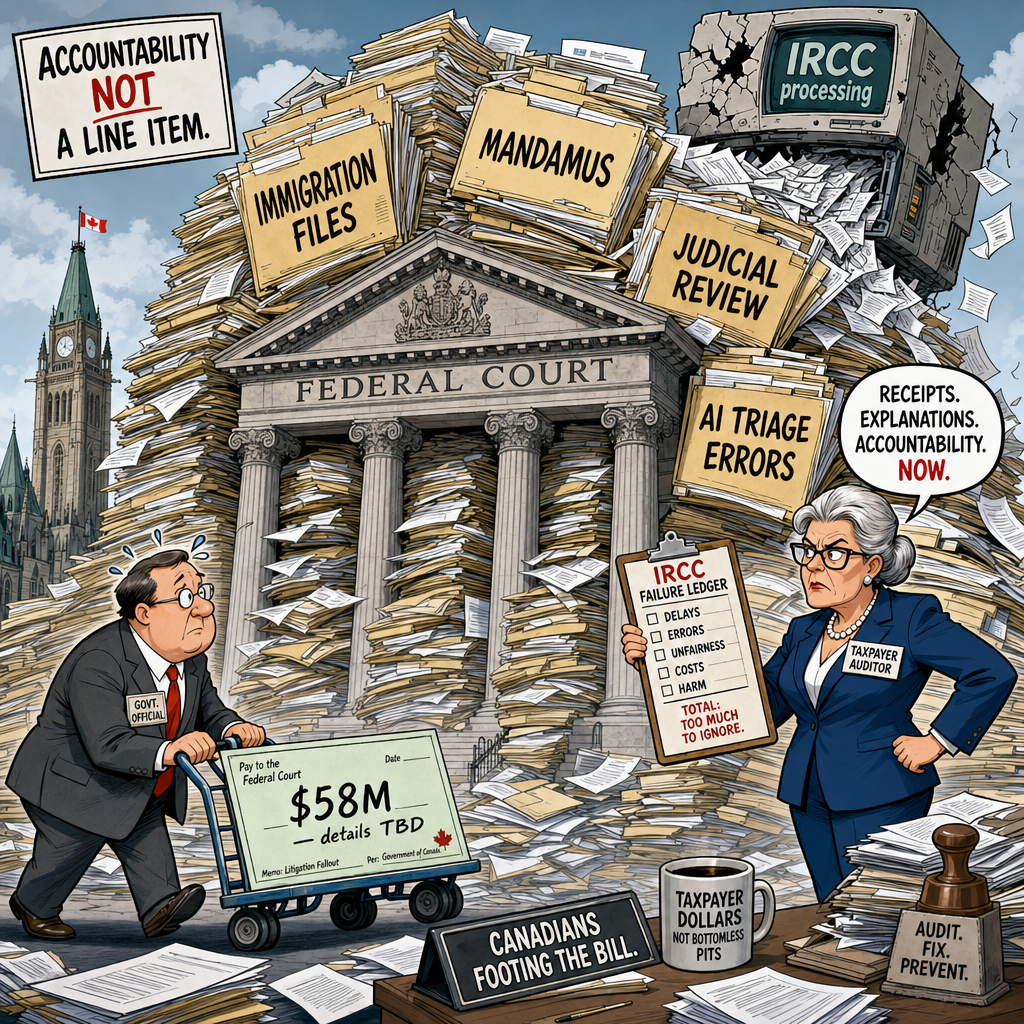
Budget 2026 has produced a familiar Liberal move: money first, receipts later. Canadian Press reports the federal budget includes $58 million in additional court-administration funding, but Chief Justice Paul Diner says the Federal Court does not yet have details on how the funding will be divided among its stated purposes.
The numbers show why vague funding announcements are not enough. The Federal Court’s official statistics for January 1 to September 30, 2026 show 30,845 proceedings commenced, 27,644 of them in the immigration and refugee category. Total pending files stood at 43,536, and immigration and refugee files made up 87 per cent of the court’s pending inventory.
That is not a normal caseload fluctuation. CP reports the court asked for resources after proceedings ballooned to nearly 31,000 by September 30, up from about 7,600 in all of 2020. CAS’s own 2026-27 departmental plan says the national courts face rising backlogs and delays, with immigration filings quadrupling since 2019 and Federal Court pressure driven most notably by immigration volume.
Budget 2026 lists the Courts Administration Service measure as $12 million, $14 million, $17 million and $15 million over four years, for $58 million total. The stated purposes are broad: Official Languages Act compliance, reducing a translation backlog, helping the Federal Court manage elevated caseloads, and modernizing national-court infrastructure. That is four buckets, one cheque, and no public allocation ledger.
The accountability question is not whether courts need resources. They do. A functioning justice system is basic state capacity. The accountability question is why the court system is being forced to absorb failures that appear to begin inside Immigration, Refugees and Citizenship Canada.
Immigration lawyers quoted by CP point to mandamus applications from people trying to force delayed IRCC decisions, registry delays inside the court, fewer informal correction routes at IRCC, and decision-quality concerns after the department adopted artificial-intelligence tools and new software. IRCC says its AI and advanced analytics tools remain under human oversight and do not make final decisions. Fine — then publish the audit trail.
A conservative accountability standard is straightforward: do not hide administrative failure behind emergency money. Ottawa should publish an IRCC-to-Federal-Court ledger showing which application streams generate judicial reviews, how many mandamus cases are delay-driven, how many cases involve alleged AI or software-assisted triage errors, how often IRCC reopens files before litigation, and how much of the $58 million actually reaches immigration-caseload capacity.
Canadians are asked to fund both ends of the machine: the immigration department that delays or mishandles files, and the court system that inherits the disputes. Before Liberals call this “investment,” publish the failure ledger.
- Canadian Press via CityNews Montreal: Lawyers unsure if extra funding can reduce massive caseload at Federal Court
- Global News / Canadian Press: Lawyers unsure if extra funding can reduce massive caseload at Federal Court
- Federal Court: Statistics — September 30, 2026
- Budget 2026: Chapter 6 — Strengthening the Courts Administration Service
- Courts Administration Service: Departmental Plan 2026-27
- Canadian Bar Association National Magazine: Federal budget fails to throw “drowning” courts a life ring
This article distinguishes official Federal Court, budget and CAS records from Canadian Press reporting and legal-sector commentary.