Dabrusin's Paris-Target Claim Needs a Climate Honesty Ledger
If Ottawa says Canada is still committed to its Paris targets, it should publish the emissions math instead of asking Canadians to trust another podium line.
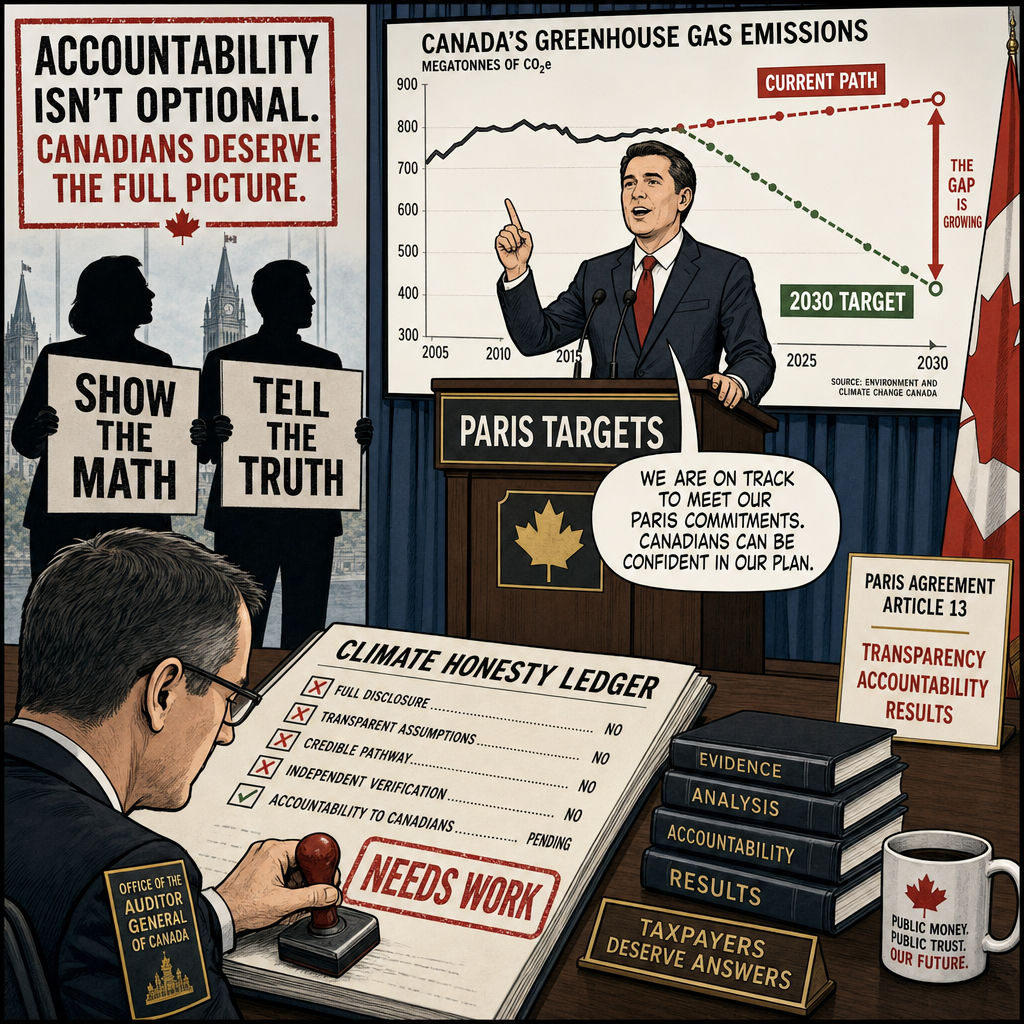
Environment Minister Julie Dabrusin arrived at COP31 in Antalya saying Canada is “absolutely committed” to its Paris climate commitments. That is now a truth-in-government problem, not just a climate-policy argument.
Canadian Press reports that two former Liberal environment ministers rejected the claim in unusually blunt terms. Catherine McKenna called it “factually untrue.” Steven Guilbeault said Dabrusin’s statement “defies reason” and pointed to the government’s own modelling and Canadian Climate Institute analysis. When former Liberal ministers are publicly saying a Liberal minister’s international line does not match the evidence, Canadians deserve more than damage-control phrasing.
The target is not vague. Canada’s 2030 commitment is a 40 to 45 per cent reduction below 2005 greenhouse-gas levels, with net zero promised by 2050. The federal 2025 Progress Report still says Ottawa is maintaining that 2030 target. But the Commissioner of the Environment and Sustainable Development reported on October 29 that Canada is moving further away from the target, that several planned measures were cancelled or weakened, and that Environment and Climate Change Canada did not report how the government would close the gap.
The watchdog’s numbers are stark. The government’s latest projections show a 28 per cent emissions reduction by 2030, down from a 36 per cent projection in 2023, and even those projections did not fully account for recent cancellations or weakening of measures. CP also reported that 2024 emissions were only 10.3 per cent below 2005 levels. That is not a credible path to 40 to 45 per cent without a publicly documented course correction.
The Canadian Climate Institute’s independent assessment reached the same basic conclusion: the 2025 progress report gives a credible picture of progress, but Canada is not on track to meet its climate goals, including the 2035 target and net zero by 2050, and the report lacks an adequate policy response to the growing gap.
A conservative accountability standard starts with honesty. If a government wants to set binding targets, spend public money, regulate industry, subsidize favoured projects and lecture Canadians internationally, it must show the arithmetic. If policies are cancelled, delayed or weakened, ministers should not pretend the old targets remain intact unless they can identify replacement reductions by measure and year.
So publish the Climate Honesty Ledger: the current emissions pathway, the megatonnes expected from every remaining policy, the losses from cancelled or weakened measures, the oil-and-gas and LNG assumptions, the 2030 and 2035 gap sizes, and exactly what Canada told COP31 delegates.
Paris commitments are not slogans. They are promises with numbers attached. If Dabrusin says Canada is still committed, show the math.
- Canadian Press via CityNews Toronto: Former environment ministers accuse Dabrusin of lying about meeting climate targets
- Global News / Canadian Press: Former environment minister says Canada’s commitment to climate targets “factually untrue”
- Office of the Auditor General of Canada: With a growing emissions gap, ECCC did not report how Canada will meet its 2030 target
- Commissioner of the Environment and Sustainable Development: Implementing the Canadian Net-Zero Emissions Accountability Act — 2026 Report
- Canadian Climate Institute: Independent assessment of Canada’s 2030 Emissions Reduction Plan progress
- Environment and Climate Change Canada: 2025 Progress Report on the 2030 Emissions Reduction Plan
- Canadian Press via CityNews Calgary: Dabrusin defends Canada’s climate record in advance of UN climate conference
This article distinguishes Canadian Press reporting from official federal watchdog, ECCC and independent Canadian Climate Institute records.