Fund Security, But Publish the CSIS Guardrails Ledger
Budget 2026 proposes a historic CSIS buildout. Before Ottawa grows foreign-intelligence capacity and intrusive tools, Canadians need the rules in writing.
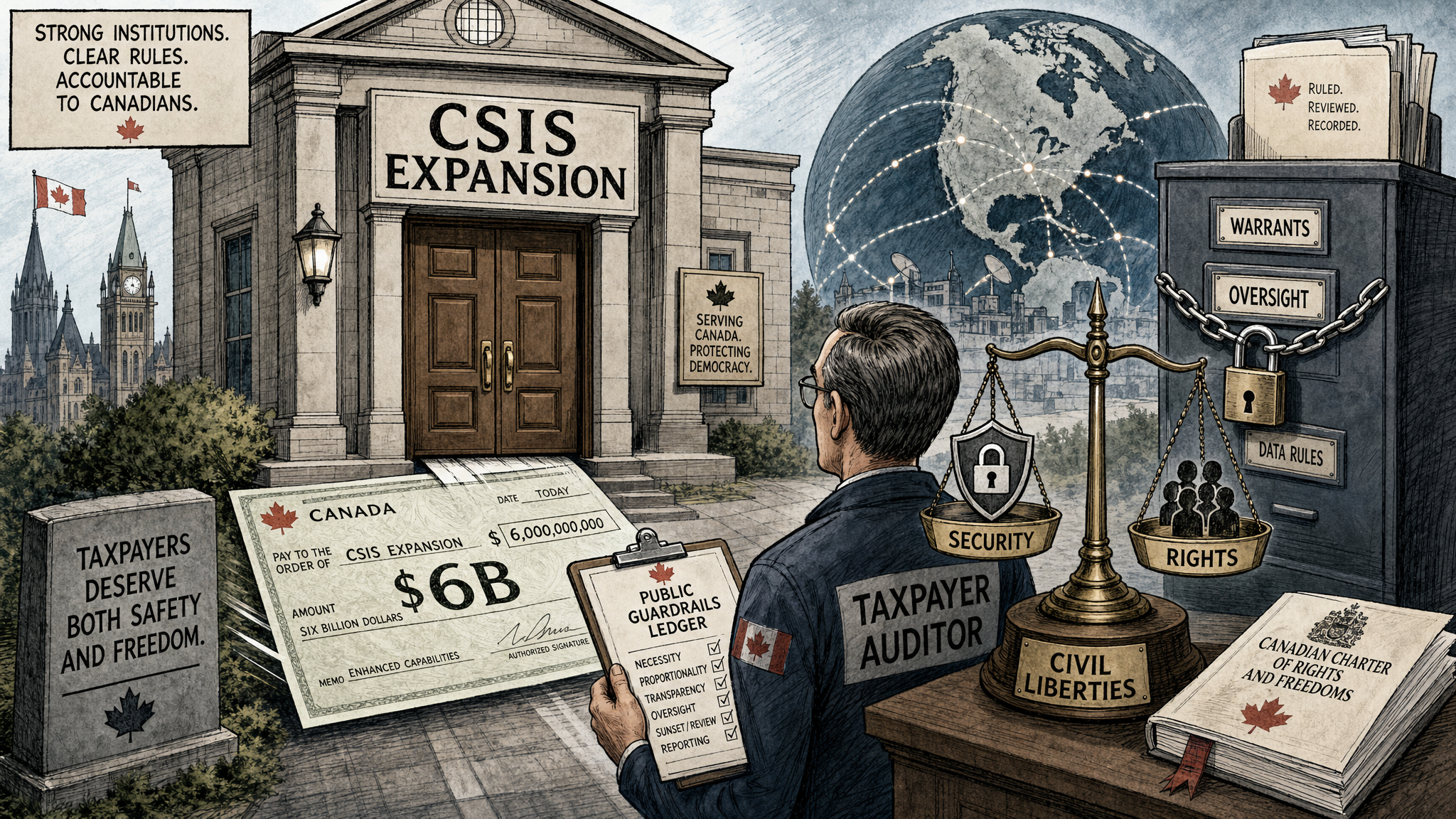
Canada needs serious intelligence capability. Terrorism, foreign interference, espionage and hostile-state coercion are real threats. But a government that asks taxpayers to fund a generational expansion of the security state must also show the democratic guardrails that keep that power pointed outward at threats, not inward at law-abiding Canadians.
Budget 2026 proposes $6.0 billion over 10 years, starting in 2027-28, plus $579.5 million ongoing for the Canadian Security Intelligence Service. The budget says the money will help CSIS expand its presence and capabilities, engage Canadians, reduce reliance on foreign partners and deepen security relationships worldwide.
That is not a routine line item. It is an intelligence-policy watershed. Global News reports the government has offered few details, while experts are openly debating whether Canada is moving toward a bigger foreign-intelligence role inside CSIS. A separate Global report notes the argument for more capability: Canada has limited ability to collect intelligence globally and has relied heavily on allies, especially the United States, at a time when Washington’s reliability is being questioned.
Fine. Conservatives should not sneer at capacity when the world is getting more dangerous. But capacity without receipts is how emergency powers become normal tools, how data programs outrun warrants, and how “trust us” replaces Parliament.
The warning signs are not theoretical. NSIRA’s 2024 annual report found CSIS did not consult Public Safety Canada before using a novel technology as required, did not advise the Federal Court of that technology, and lacked adequate policies and procedures for the program. In another NSIRA review, CSIS agreed or partly agreed with findings that documentation and reporting around otherwise-offence-related activities needed improvement.
That record does not prove bad faith. It proves why oversight must grow before, not after, the mandate grows.
Ottawa should publish a CSIS expansion guardrails ledger. It should identify what the $6 billion buys in broad categories; whether foreign human-intelligence powers require legislation; what changes, if any, are planned for warrants and Federal Court candour duties; how Canadians’ information is minimized, retained, shared and deleted; which activities remain prohibited; and whether NSIRA, NSICOP and the courts receive parallel resources to review the larger machine.
The government can protect operational secrets while disclosing democratic rules. Nobody needs source names or live operations. Canadians do need to know whether a larger CSIS means clearer legal limits, faster after-the-fact review, stronger reporting to Parliament and real consequences when internal controls fail.
National security is not a blank cheque. If the Liberal government wants billions for intelligence expansion, it should publish the guardrails ledger before the money, mandate and machinery harden into another permanent Ottawa program with answers promised later.
- Government of Canada, Budget 2026: Chapter 5: Security and prosperity
- Global News: CSIS budget boost raises questions about foreign-intelligence expansion
- Global News: Foreign-intelligence debate in a more unreliable world
- NSIRA: Annual Report 2024
- CSIS: Response to NSIRA review of the justification framework
This article supports necessary national-security capability while arguing for transparent legal limits, watchdog capacity and civil-liberties protections. It does not disclose or request operational secrets.