The Budget Was the Sales Pitch. The $24.4B Invoice Arrived Next.
Supplementary Estimates (B), 2026-27 ask Parliament for $22.1B in new voted spending and lift federal estimates to $538.3B. Canadians need the receipt ledger.
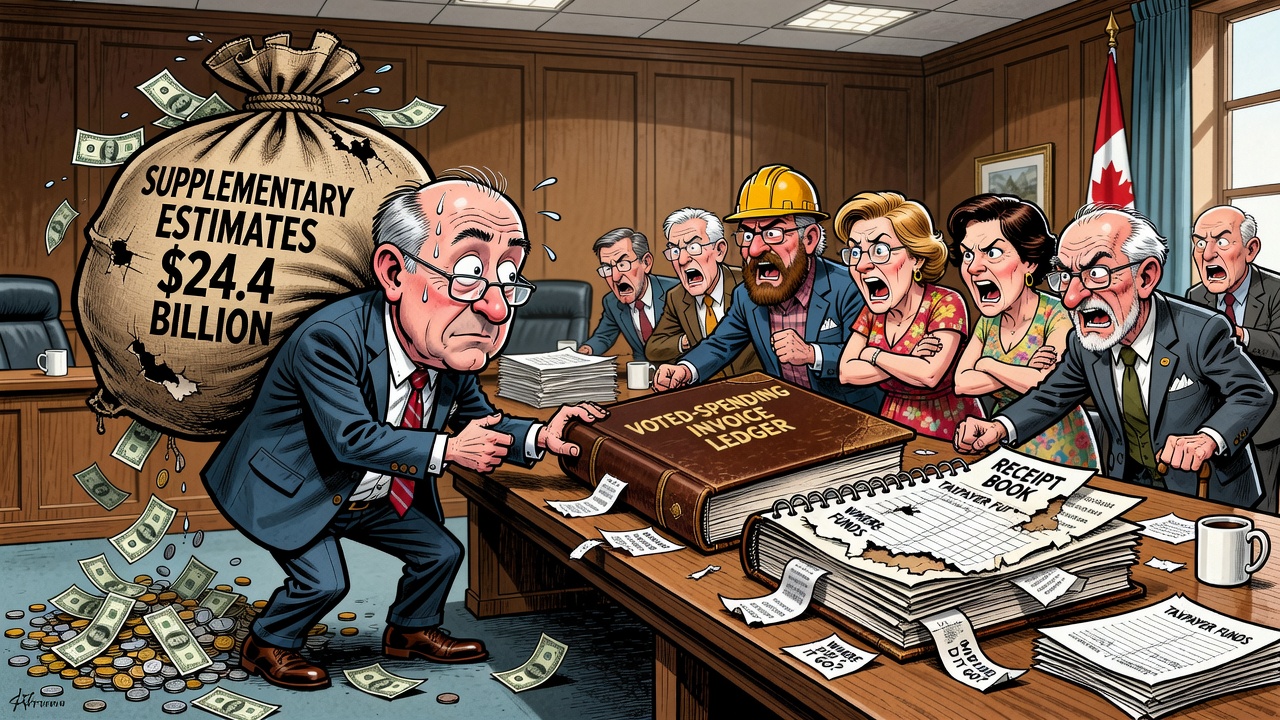
The budget is the speech. The Estimates are the invoice. And Ottawa’s invoice just got another $24.4 billion larger.
Treasury Board’s Supplementary Estimates (B), 2026-27 present $24.4 billion in incremental budgetary spending for 71 organizations. That includes $22.1 billion in voted spending that Parliament must approve through a supply bill, plus a $2.3 billion increase in statutory spending already authorized by other legislation. Treasury Board says the supply bill will be introduced no later than December 10.
That matters because this is where the slogans turn into cash. With Main Estimates, Supplementary Estimates (A) and Supplementary Estimates (B) combined, federal Estimates to date for 2026-27 now total $538.3 billion: $263.7 billion in planned voted expenditures and $274.6 billion in forecast statutory expenditures. A government that asks Canadians to accept higher debt, higher taxes and fewer services should not be allowed to bury the next invoice in procedural fog.
The largest explanations are not tiny housekeeping items. Treasury Board’s release lists National Defence money for procurement and operations, including $1.9 billion for icebreakers and $1.6 billion for satellite communications. Employment and Social Development Canada is listed for $2.4 billion for early learning and child care. Health Canada is listed for $821.6 million for the Canadian Dental Care Plan, while CMHC is listed for $195.9 million for affordable housing.
There are also major Indigenous-related amounts: Crown-Indigenous Relations’ request includes $1.2 billion for the Federal Indian Boarding Homes settlement and $760.3 million for specific claims. Indigenous Services Canada is listed for $734.5 million for health benefits, $600 million for education and $448 million for emergency management. Seven organizations would receive $841.2 million for the Regional Tariff Response Initiative, and Employment and Social Development Canada would receive $631.6 million for skilled trades training and recruitment.
Some of that spending may be defensible. Defence procurement, settlement obligations, emergency management and child care all involve real public responsibilities. But “real responsibility” is not a blank cheque. A conservative accountability standard asks the obvious questions before the vote: what was already budgeted, what changed, what is legally unavoidable, what is discretionary, what outcomes will be measured, and which programs are being topped up because earlier projections failed?
Rebel News framed the timing sharply: the request landed the day after Budget 2026, with the official Treasury Board documents dated November 6. Whether voters support or oppose each line, Parliament should not rubber-stamp billions after a budget week without a plain-English invoice.
So publish the Supplementary Estimates receipt ledger: every item over $100 million, original budget authority, new authority requested, statutory versus voted status, minister responsible, reason for the variance, delivery target, lapse history, audit flag, and final vote result. If the Carney Liberals are proud of the spending, they should be proud to show Canadians the receipts before MPs approve the cheque.
- Treasury Board of Canada Secretariat: Supplementary Estimates (B), 2026-27
- Treasury Board of Canada Secretariat: Supplementary Estimates (B), 2026-27 news release
- Rebel News: Ottawa asked Parliament for another $24.4 billion the day after the budget
This article argues for spending transparency and parliamentary accountability. It does not allege unlawful conduct by individual public servants.