Carney’s Impact Act No-Appeal Choice Needs a Rewrite Ledger
If Ottawa will amend instead of appeal, Canadians deserve the legal memo, timetable and project-transition receipts.
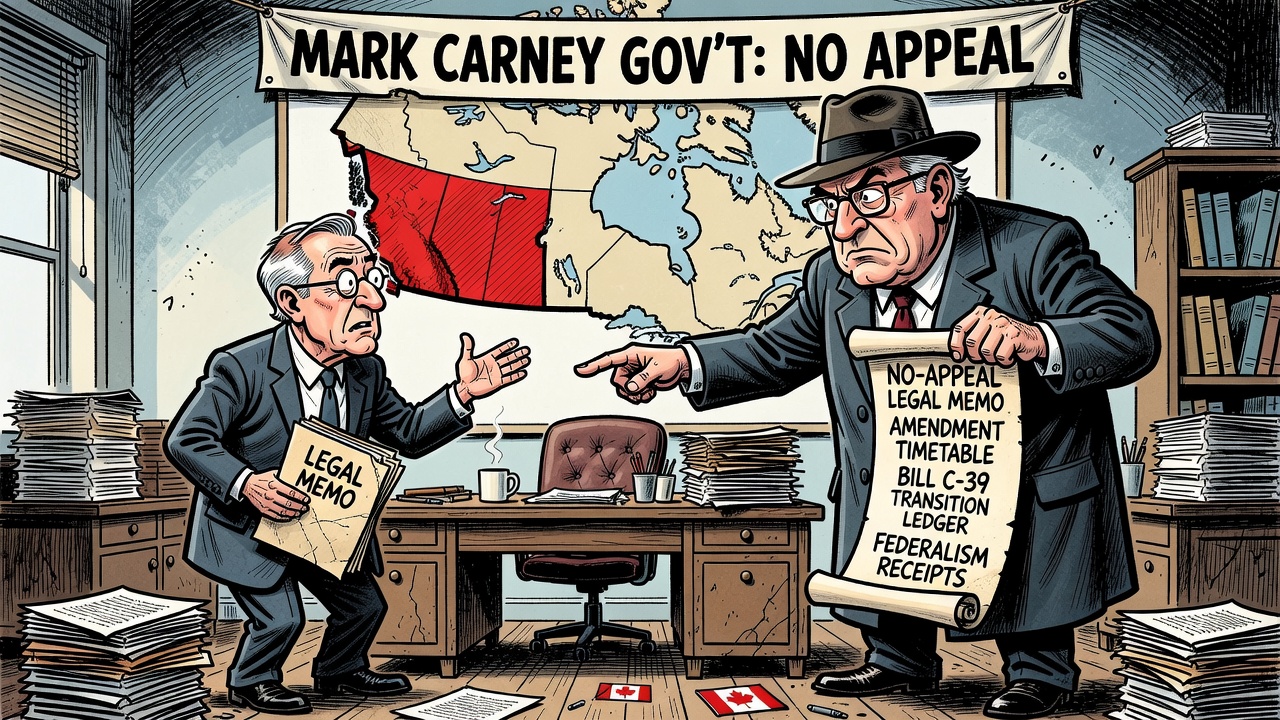
The Carney government has apparently decided not to ask the Supreme Court of Canada to review Alberta’s latest win over the federal Impact Assessment Act. That may be politically convenient. It is not enough. If Ottawa is going to accept another constitutional loss and promise another rewrite, Canadians deserve the ledger behind that decision.
The Deep Dive reported that Ottawa will not appeal the Alberta Court of Appeal’s October 9 ruling and will amend the act instead. That ruling, reported by Global News and The Canadian Press, was a 4-1 decision finding that the 2024 Liberal amendments still failed to fix constitutional defects identified by the Supreme Court in 2023. The court said the law still allowed Ottawa to stop or condition projects in provincial jurisdiction through an overly broad federal-effects framework.
This is no small technical dispute. The Impact Assessment Act governs major projects — mines, ports, pipelines and other infrastructure Canadians are told must move faster. Conservatives warned for years that Bill C-69 would become a “no more pipelines” law. Liberals answered by rebranding, amending and promising balance. Now a second Alberta reference says the fix did not fix the problem.
There are reasonable arguments for not appealing. A government may decide the Supreme Court has already spoken clearly enough, or that a negotiated rewrite is faster than another reference fight. But that is exactly why the record should be public. What did Justice officials tell cabinet? What were the odds of success? What would an appeal have clarified? Which provinces, Indigenous governments and project proponents were consulted before the decision?
The Bill C-39 interaction makes the secrecy worse. Global reported that Ottawa’s bill would move assessments for pipelines and certain energy transmission projects from the Impact Assessment Agency to the Canada Energy Regulator, while Ottawa has also said the regulator would remain bound by the Impact Assessment Act. If the underlying statute is constitutionally defective, Canadians need to know how moving the desk changes the law rather than merely changing the letterhead.
A conservative accountability standard is straightforward: stop governing by announcement and publish the rewrite ledger. Release the no-appeal legal analysis, the cabinet decision record, the amendment timetable, the Bill C-39 crosswalk, and project-by-project transition rules. List which reviews are paused, which proceed, which conditions are vulnerable, and which federal decision-makers still claim authority over provincial projects.
Environmental review can be constitutional. Indigenous rights can be respected. Major projects can be scrutinized. But federal power has limits, and uncertainty is itself a tax on investment, workers and communities. If the Carney government believes it has learned from two court losses and one Supreme Court warning, it should show its work before the next rewrite lands.
- The Deep Dive: Ottawa Accepts Alberta Court Ruling Against Impact Assessment Act
- Global News / Canadian Press: Alberta Court of Appeal says Impact Assessment Act is still unconstitutional
- McLennan Ross: Second Look, Same Result: Alberta Court of Appeal Rejects Amended Impact Assessment Act
- Osler: Alberta Court Rules Impact Assessment Act Amendments Remain Unconstitutional
This article argues for disclosure of the federal government’s legal and project-transition records. It does not argue that all federal environmental review is unconstitutional.