Cabinet-Confidence Black Hole Needs an Independent Review Ledger
Cabinet secrecy can be legitimate, but it should not be self-certified forever. Publish the cabinet-confidence review, PCO compliance and 20-year release receipts.
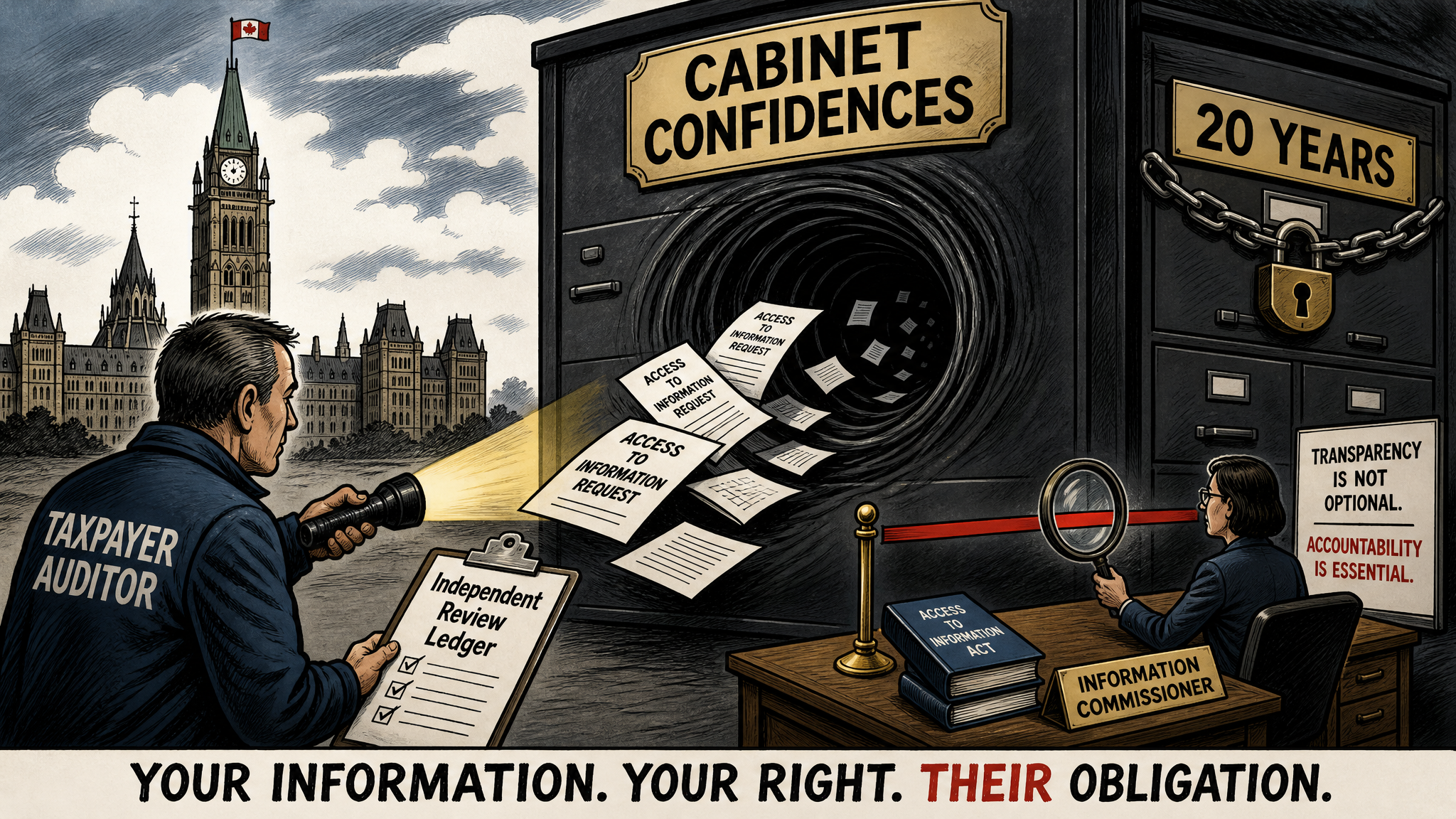
Cabinet secrecy has a legitimate place in responsible government. Ministers need space to argue, test options and reach a collective decision. But that does not give Ottawa a blank cheque to label records as cabinet confidences and then ask Canadians to trust the same system that benefits from secrecy.
The immediate trigger is fresh. Ken Rubin’s access-to-information index lists a November 11 Hill Times story by Daniel Arnold under the headline, “It’s a black hole: Information commissioner seeks window into cabinet documents.” That framing lands because the federal rule still puts cabinet confidences outside the normal access-to-information review path. Once the label is attached, the public cannot see the records, and the Information Commissioner cannot test the claim the way she can test an exemption.
Treasury Board’s own ETHI briefing describes the problem. It says the 2023 committee review recommended extending Part 1 of the Access to Information Act to cabinet confidences, except where an exemption applies, and giving the Information Commissioner power to review those records to determine whether the exemption was properly applied. The government’s recorded answer was not action; it was that it would explore improvements as part of the 2025 legislative review.
That is not good enough for a government that keeps promising competent management. The Information Commissioner’s 2025–26 annual report says PCO, the central agency supporting the Prime Minister and Cabinet, drew 63 orders in 2025–26 — the most ever for that institution — and should show a sustained commitment to transparency and timely access processing. This is the same centre of government that helps manage cabinet business. If the central agency has a performance problem, cabinet-confidence reform cannot be left to internal assurance.
The Privy Council Office policy shows how broad the category can be. Cabinet confidences include not only formal cabinet documents, but also outside documents or information that reveal what Cabinet may consider, considered, or discussed. The policy links those records to section 69 of the Access to Information Act and says the designation is lifted after 20 years. A category that broad needs an independent check before two decades pass.
The Commissioner’s November 2 ETHI remarks add the modern risk. Cloud platforms, mobile apps, instant messaging and decentralized channels can produce incomplete access responses when governance does not keep up, eroding transparency, accountability and public trust. Cabinet secrecy plus weak digital record discipline is exactly how public accountability disappears without any dramatic scandal.
The conservative accountability test is simple: keep true cabinet deliberations protected, but end self-certified opacity. Publish a cabinet-confidence reform ledger showing the current rule, proposed rule, Commissioner review power, PCO consultation process, complaint and order data, 20-year release plan, digital-retention safeguards and timelines for legislation. If Carney’s government wants secrecy, it can defend the rule in public. If it wants trust, it can publish the receipts.
- Ken Rubin: Access Stories and Articles index listing Daniel Arnold’s November 11, 2026 Hill Times item.
- Office of the Information Commissioner of Canada: 2025–2026 Annual Report
- Office of the Information Commissioner of Canada: November 2026 ETHI appearance
- Treasury Board of Canada Secretariat: ETHI briefing on access to information
- Privy Council Office: Policy on the security of Cabinet Confidences
This article argues for independent review and public process receipts. It does not allege unlawful conduct by individual public servants.