DND’s Wainwright Silence Needs a Casualty-Care Disclosure Ledger
A military tragedy requires privacy and compassion — but not a public-information blackout.
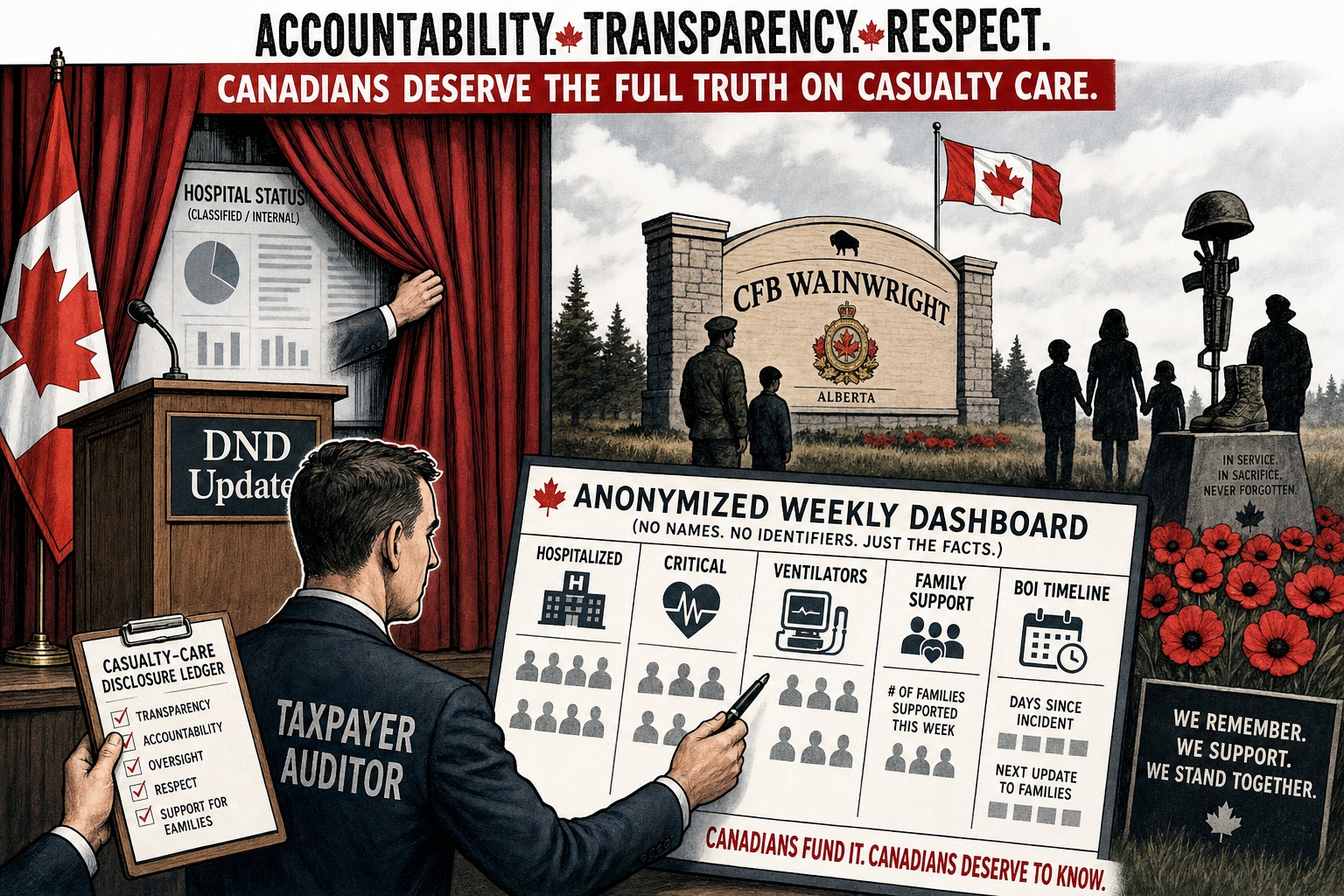
Four Canadian soldiers were killed and dozens were injured in the October 17 fire at Canadian Forces Base Wainwright. That is first a human tragedy. It is also a public accountability test for the Carney government, because Canadians can support privacy for wounded soldiers and still demand competent, consistent disclosure from National Defence.
Global News reported on November 9 that 15 soldiers remained on ventilators more than three weeks after the fire. It said a confidential Alberta Health Services briefing, confirmed through Acute Care Alberta, showed that by November 9 nine soldiers were in critical condition and 12 were stable across intensive care and medical units. Global also reported it obtained the briefing after nearly a week of unsuccessful attempts to get DND to disclose updated critical-condition figures.
DND’s own November 4 statement gave the public a narrower picture. It said 25 injured CAF members remained hospitalized, 14 had been released, and four hospitalized members had been transferred closer to home in British Columbia and Ontario. It also said families were receiving support, including designated assistants. What it did not publish was the basic anonymized severity picture Global later reported: critical-condition counts, ventilator counts, and a schedule for future public updates.
That gap matters. The public does not need names, bed numbers, diagnoses or private family details. In fact, the government should protect those fiercely. But anonymized totals are not a breach of dignity when released carefully. They are the minimum public record after a deadly training incident involving serving members, federal institutions, provincial hospitals, emergency assistance and taxpayer-funded support.
Budget 2026 proposes $25 million over two years for Canadian Forces Morale and Welfare Services and $3 million in 2026-27 for the Wainwright Military Family Resource Centre. That support may be necessary and welcome. But money without receipts is not accountability. Families, CAF members and taxpayers should know how the support is allocated, what service standards apply, and whether the assistance reaches the people affected quickly enough.
DND has also pointed incident questions to the Military Police investigation and a Board of Inquiry. Fair enough: investigations must not be contaminated by political theatre. But that cannot become a blanket excuse to withhold every non-sensitive milestone. The public can be told when terms of reference are finalized, when the board is convened, what categories of evidence are being reviewed, and when interim safety lessons will be communicated to units.
The remedy is straightforward: publish a weekly Wainwright casualty-care disclosure ledger. It should include anonymized hospitalization, critical-care, ventilator, transfer and release totals; family-support delivery metrics; budget-allocation updates; investigation and Board of Inquiry milestones; and lessons-learned actions that can be shared without compromising evidence.
Conservative accountability means respecting soldiers enough to tell Canadians the truth without exploiting private suffering. DND does not need to turn a tragedy into a press conference. It does need to stop making the public rely on leaks and fragments to understand how Canada is caring for its own.
- Global News: 15 soldiers on ventilators, 9 critical after deadly CFB Wainwright fire
- National Defence: Update on personnel injured in Canadian Forces Base Wainwright incident
- National Defence: Canadian Armed Forces Provides Update on Incident at Canadian Forces Base Wainwright
- Budget 2026: Chapter 5 — Supporting CAF members and their families after the Wainwright tragedy
This article argues for anonymized disclosure, support-funding receipts and investigation milestones. It does not publish or seek private medical records for any individual soldier.