Canada’s World Juniors Visa Override Needs a Public Legal Ledger
Standing with Ukraine does not excuse opaque discretionary immigration power. Publish the legal receipts.
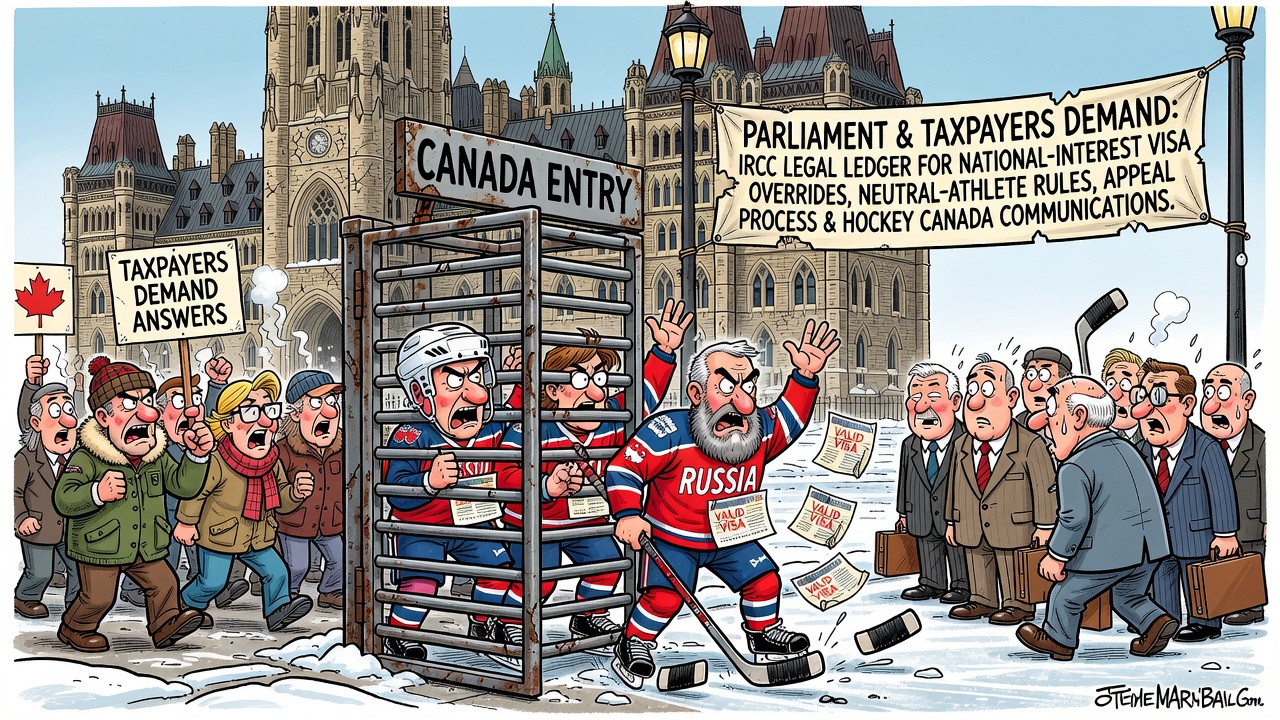
Canada is right to reject Russian state propaganda in sport. Russia’s war against Ukraine is not a normal diplomatic disagreement, and Belarus’s complicity is not a footnote. But when Ottawa says Russian hockey players can be barred from the World Junior Championship even if they already hold valid Canadian visas, the question becomes bigger than hockey: what is the legal test, and where are the receipts?
Canadian Press reported Wednesday that the federal government says Russian players will not be permitted to compete at the world juniors in Alberta even if they already have valid visas. Secretary of State for Sport Adam van Koeverden said Immigration, Refugees and Citizenship Canada will individually assess and prevent Russian and Belarusian athletes and officials from entering Canada to compete. Reuters reported the same position, including the phrase “regardless of whether they already hold valid visas.”
The government’s official November 3 statement points to subsection 22.1(1) of the Immigration and Refugee Protection Act. It says the immigration minister will use that authority to assess and prevent Russian and Belarusian athletes and officials from entering Canada under national symbols. It also says individual neutral athletes can continue to compete in Canadian-hosted events. That distinction matters. It is one thing to bar a state team. It is another to tell visa-holding people that permission already granted can be overridden weeks before a tournament.
The immediate background is messy. The Court of Arbitration for Sport ordered the International Ice Hockey Federation to admit Russian teams to several upcoming championships, including the World Juniors. The tournament begins December 26 in Edmonton and Red Deer, while multiple hockey federations have said they will not play Russia. Norway’s status has also been thrown into uncertainty. Ottawa did not create all of that confusion. But Ottawa is now using immigration power to settle it.
A conservative accountability standard should be simple: national interest powers may be necessary, but they cannot become press-conference powers. If valid visas can be politically overridden, Canadians deserve a written ledger showing the statute used, the criteria applied, the number of affected athletes and officials, how many already held visas, what notice they received, whether reconsideration or appeal is available, and who signed each decision.
That ledger should also explain the neutral-athlete rule. Does it apply only to individual sports? Does it exclude team sports categorically? What happens to Russian players already in Canada through the Canadian Hockey League? What communications went to Hockey Canada, the IIHF, the CHL, Alberta organizers and affected clubs?
None of this requires sympathy for the Kremlin. It requires respect for the rule of law. Conservatives can support Ukraine, oppose Russian state representation, and still insist that immigration discretion be transparent, reviewable and consistent. If the Carney government has a strong legal basis, it should publish it. If the policy is clear, it should publish the criteria. If the decision is defensible, it should publish the ledger.
- Global News / Canadian Press: Canada says Russian players with visas will still be barred from World Juniors
- Government of Canada: Statement from Canada on the participation of Russian and Belarusian athletes in international sport
- Reuters via WTAQ: Canada to block Russian players from entering for World Juniors
This article supports Canada’s right to oppose Russian and Belarusian state representation in sport while arguing that discretionary visa overrides require published legal and procedural accountability.