The Auditor General’s Financial-Control Ledger Shows Ottawa Still Can’t Do Basic Stewardship
A clean audit opinion does not excuse weak controls, late plans, old pay files and billion-dollar accounting errors.
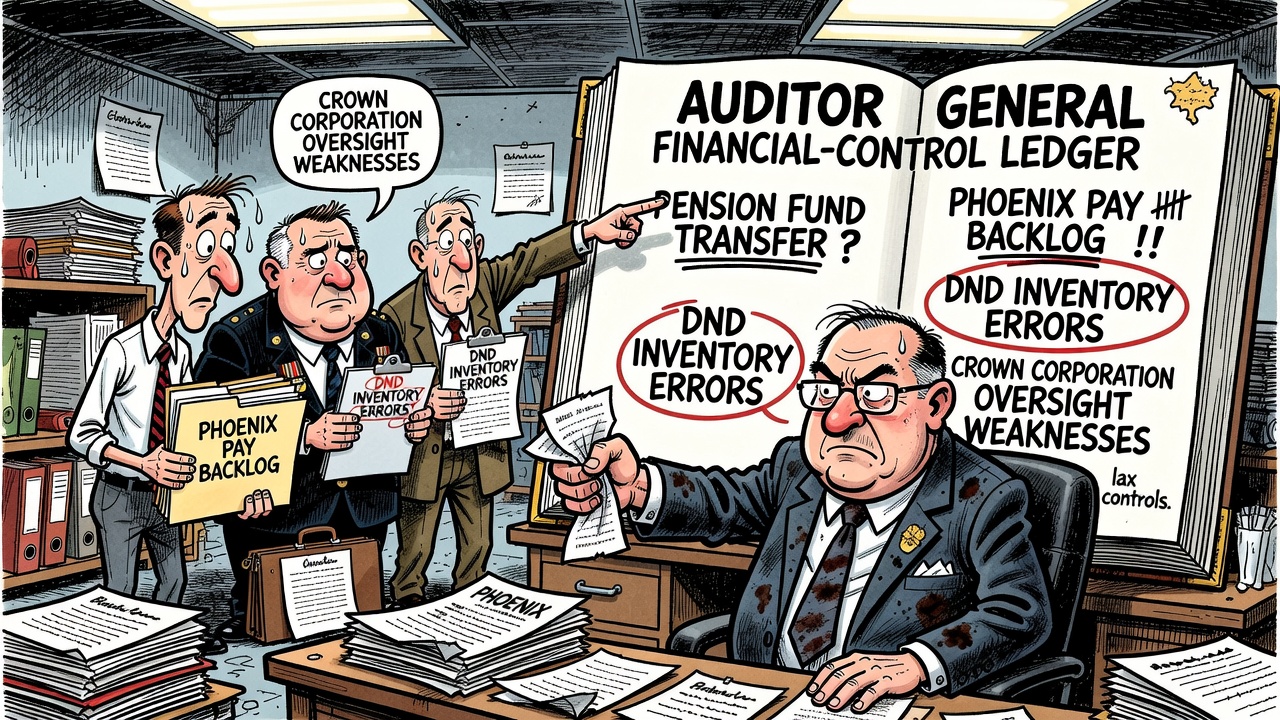
The Auditor General’s latest financial-audits commentary is not a scandal sheet. That is exactly why it matters. It is the government’s own watchdog, in careful accounting language, telling Canadians that Ottawa still has basic control problems in files that touch pensions, payroll, defence supplies and Crown corporations.
Start with the Public Service Pension Fund. The commentary says the government transferred $2.8 billion from the fund to the Consolidated Revenue Fund over two years: $1.9 billion in 2024–25 and $904 million in 2025–26, after the fund exceeded the surplus limit allowed under the Public Service Superannuation Act. That may be legal. It still deserves a plain-language public ledger showing the actuarial calculation, the legal trigger, who approved the transfer, and how pension contributors were informed.
Then there is Phoenix, the pay system Ottawa has been promising to clean up for years. Public Services and Procurement Canada missed its March 31, 2026 target to eliminate pay transactions older than one year. As of that date, the backlog was 181,649 transactions, including 110,867 older than one year. For the people affected, these are not dashboard entries. They are pay errors, tax complications, stress and time stolen by a government that cannot reliably pay its own workers.
National Defence remains another control problem. The Auditor General’s office says inventory errors understated the annual deficit by an estimated $751 million, while operating-expense errors overstated it by about $1 billion. Conservatives should be clear: Canada needs a stronger military and serious defence investment. But readiness cannot be built on books the government cannot reconcile. Ammunition, parts, equipment and expenses have to be tracked accurately because soldiers, taxpayers and Parliament all rely on those numbers.
The Crown-corporation findings point to the same culture of weak follow-through. The Auditor General’s news release says special examinations found risk-management weaknesses in 98% of examined Crown corporations, board-oversight weaknesses in 78%, and performance-measurement, monitoring or reporting weaknesses in 58%. Those are not partisan adjectives. They are governance warning lights across public bodies that handle public money, public assets and public trust.
The Liberal response will be to say the financial statements received a clean opinion. Fine. But a clean opinion is not a permission slip for sloppy stewardship. The accounting bottom line can be fairly presented while the machinery underneath still needs repair.
The accountability standard is simple: publish the ledger. For each major control weakness, Ottawa should list the responsible minister and deputy head, the dollar exposure, the correction made, the deadline for permanent repair, and the public progress update date. If a pension transfer is legal, show the paperwork. If Phoenix is improving, prove it by age bucket and department. If Defence inventory is reliable, reconcile it. If Crown boards are competent, publish the risk and performance fixes.
Canadians do not need another promise that lessons have been learned. They need receipts.
- Office of the Auditor General of Canada: Commentary on the 2025–2026 Financial Audits
- Office of the Auditor General of Canada: Federal Auditor General highlights important observations from the government’s financial reporting
- CKPG Today / Canadian Press: Ottawa wrote off $4.5B in COVID benefit repayments last year: auditor general
This article argues from official audit findings and does not allege corruption. Legal transfers and accounting corrections still deserve public, minister-level accountability receipts.