The Major Projects Office Employer List Needs a Files-Touched Firewall
Naming the employers was only step one. The real receipt is a public map of which files each seconded worker could see — and which files they were barred from touching.
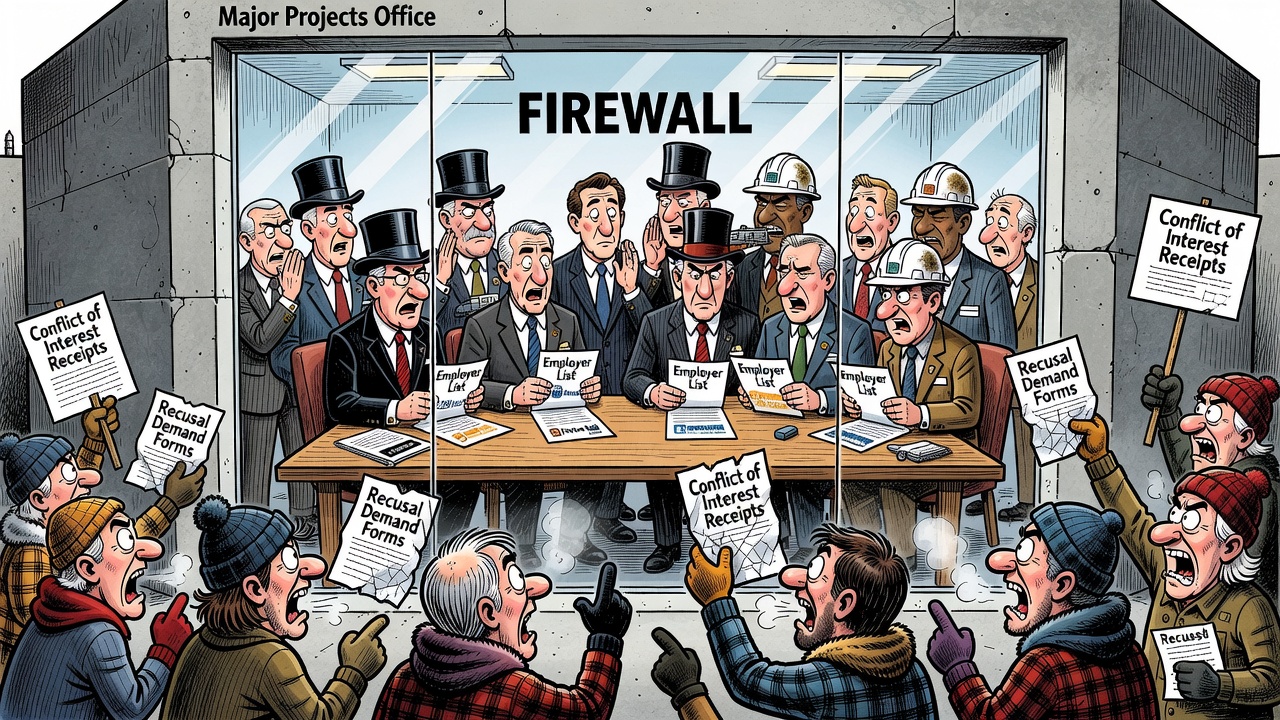
Ottawa has finally released the employer list for people loaned into the Major Projects Office. That is good. It is also not enough.
The Canadian Press reported that the list covers 41 employees seconded to the office after the federal government initially declined to make the information public. The names of the employers matter because this office is not a museum committee. It is the Carney government’s fast-track table for ports, mines, energy projects, trade corridors and other files where timing, access and regulatory confidence can be worth real money.
The list includes staff connected to major banks, railways, mining, construction, energy, law, consulting and finance: BMO, RBC, Scotiabank, CN, CPKC, BHP Canada, Ledcor, Pembina Pipeline, TC Energy, TransAlta, Torys, PwC and QSI Finance Canada, among others. CBC reported that 17 private-sector employees are involved, alongside two dozen seconded from other institutions. Federal institutions on the broader list include nine from the Canada Energy Regulator and two from Trans Mountain Corp.
No one needs to pretend expertise is useless. A serious country needs engineers, financiers, regulators, Indigenous consultation expertise and people who understand how projects actually get built. But conservative accountability starts with a basic rule: if private or regulatory insiders are temporarily inside the state, the public needs a firewall it can inspect.
Major Projects Office officials say staff are screened through Privy Council Office human resources, sign disclosures, and cannot work on projects involving their parent companies. That may be true. But the public should not have to accept the slogan “trust the process” when the same process touches project approvals, ministerial advice, confidential commercial information and regulatory coordination.
The government’s own Budget 2026 brief says 28 nation-building initiatives have already been referred to the MPO and says they could help unlock nearly $500 billion in investment opportunities. That scale is precisely why disclosure should be boring, routine and granular.
The next document should be a files-touched firewall: employer, secondee role, salary arrangement, start and end dates, files accessed, files recused from, parent-company project interests, Privy Council clearance date, Ethics Commissioner involvement where applicable, confidentiality terms and post-secondment cooling-off rules.
This is not an accusation that every secondee is conflicted. It is a test of whether the Carney government can build quickly without building a black box. If Ottawa wants Canadians to believe the Major Projects Office is serving the national interest, it should publish the conflict-screen receipts before billion-dollar project decisions move any further.
- CityNews / The Canadian Press: Ottawa releases list of companies lending staff to major projects office
- CBC News: More than a dozen private companies lend workers to Major Projects Office
- Government of Canada: Budget 2026 in brief
This article argues for public disclosure and conflict-screen accountability. It does not allege unlawful conduct by any company, secondee or official.