Canada’s Voluntary AI Safety Pledge Needs Enforcement Receipts Before More AI Subsidies Flow
A non-binding pledge is not enough when Ottawa is also writing staged taxpayer-backed equity cheques to the AI industry.
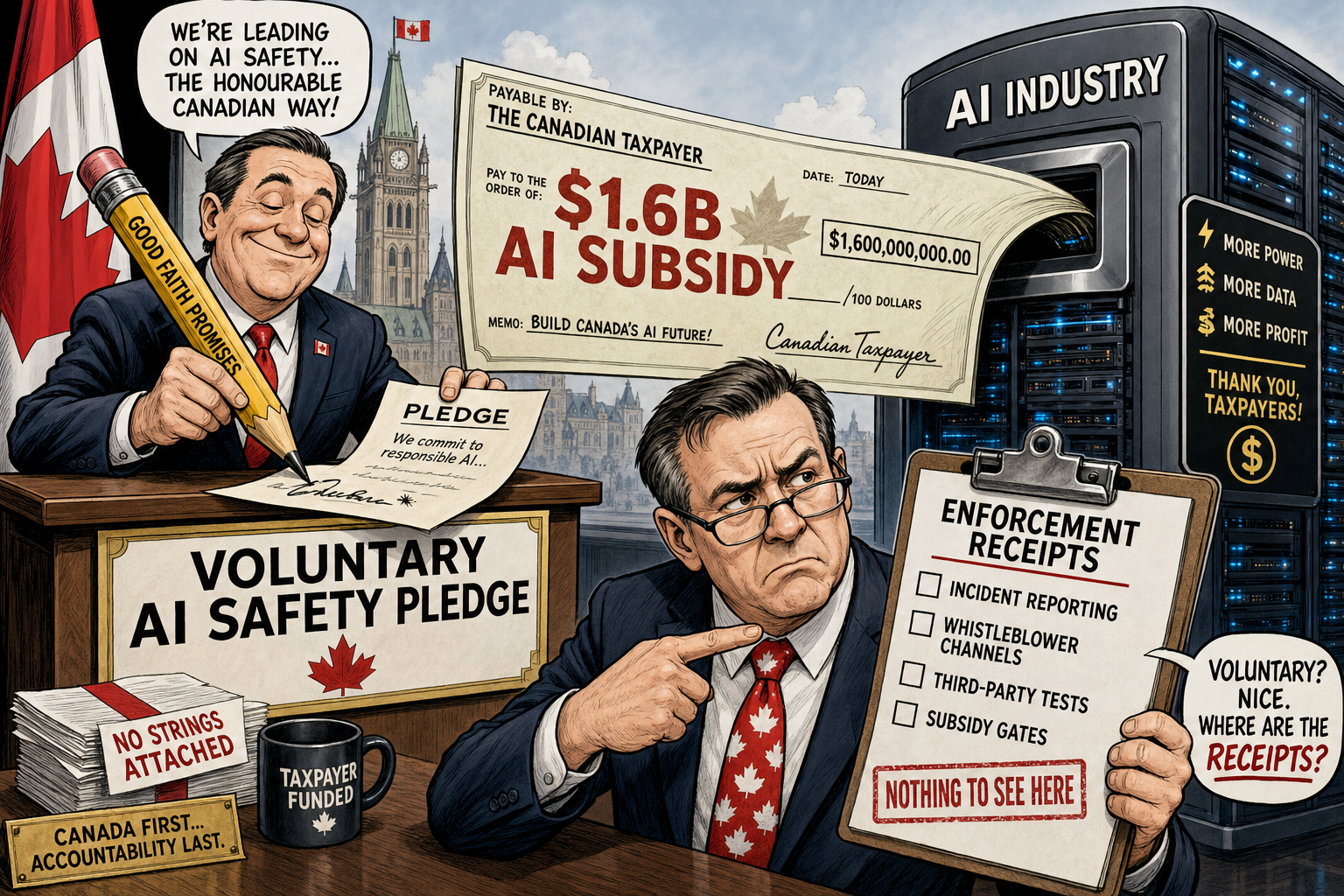
Canada has joined the Paris call for AI safety and security, a declaration signed on November 9 by six governments and major AI firms including Anthropic, Cohere, Microsoft, Mistral AI and OpenAI. The document says the parties want common risk-management frameworks, public repositories of non-sensitive evaluation findings, accountability across the AI ecosystem, incident reporting, early-warning systems, fail-safe mechanisms and protected channels for whistleblowers.
Those are worthy goals. They are also exactly the sort of promises that become meaningless unless the Carney government can show who enforces them, what happens when a company misses them, and whether public money is conditional on proof. Global News reported expert skepticism that the declaration’s voluntary, non-binding nature leaves it without real teeth. That criticism is not anti-technology. It is basic governance.
The timing makes the receipt test sharper. Less than two weeks before the declaration, Ottawa announced a planned equity investment of up to $1.6 billion in Cohere, calling it a staged commercial investment alongside private backers. The Prime Minister’s Office said Cohere would create at least 1,000 Canadian technical jobs by 2030, commit at least $1.7 billion to additional computing infrastructure in Canada by 2030, remain incorporated and headquartered in Canada, and keep working with the Canadian AI Safety Institute.
That is not pocket change. It is a taxpayer-backed bet on a company that is also one of the declaration’s signatories. If Ottawa wants Canadians to accept that this is about sovereignty, security and shared upside, then the government should publish the enforcement map before the next tranche flows. Which department owns compliance? Which regulator can demand records? Which safety commitments are binding conditions of the investment? Which failures would delay, reduce or claw back public funding?
The public also needs clarity on incident reporting. The declaration talks about serious cyber and AI control incidents, material warning signals, independent evaluation and shutdown mechanisms. Ottawa should convert that language into Canadian rules: reporting timelines, severity thresholds, third-party testing standards, secure whistleblower channels, audit rights and public summaries that do not compromise security or trade secrets.
There is a conservative way to handle AI: allow innovation, protect national capability, and refuse to socialize risk while privatizing upside. That means no blank cheques, no press-release regulation, and no insider industrial policy where safety is praised on Monday and treated as optional when subsidy money is released.
The test is simple. If the Paris call is serious, Ottawa should publish the Canadian receipts: legal authority, regulator ownership, Cohere-specific conditions, independent evaluation standards, incident-reporting rules, whistleblower protections and subsidy gates. If the government cannot show those, it is not governing AI safety. It is marketing it.
- Global News: Canada joins AI safety declaration but without “teeth,” what can it do?
- Prime Minister of Canada: Joint declaration on Paris call for AI safety and security
- Prime Minister of Canada: Canada announces landmark investment in Cohere to scale secure, sovereign AI
- BetaKit: Government of Canada signs international declaration on AI safety and security
This article argues for enforceable public conditions on taxpayer-backed AI spending. It does not allege wrongdoing by any company named in the declaration.