CBSA’s $804M CARM System Needs a Border-Revenue Ledger
An $804 million customs-revenue system with 38 manual workarounds deserves a public value-for-money ledger.
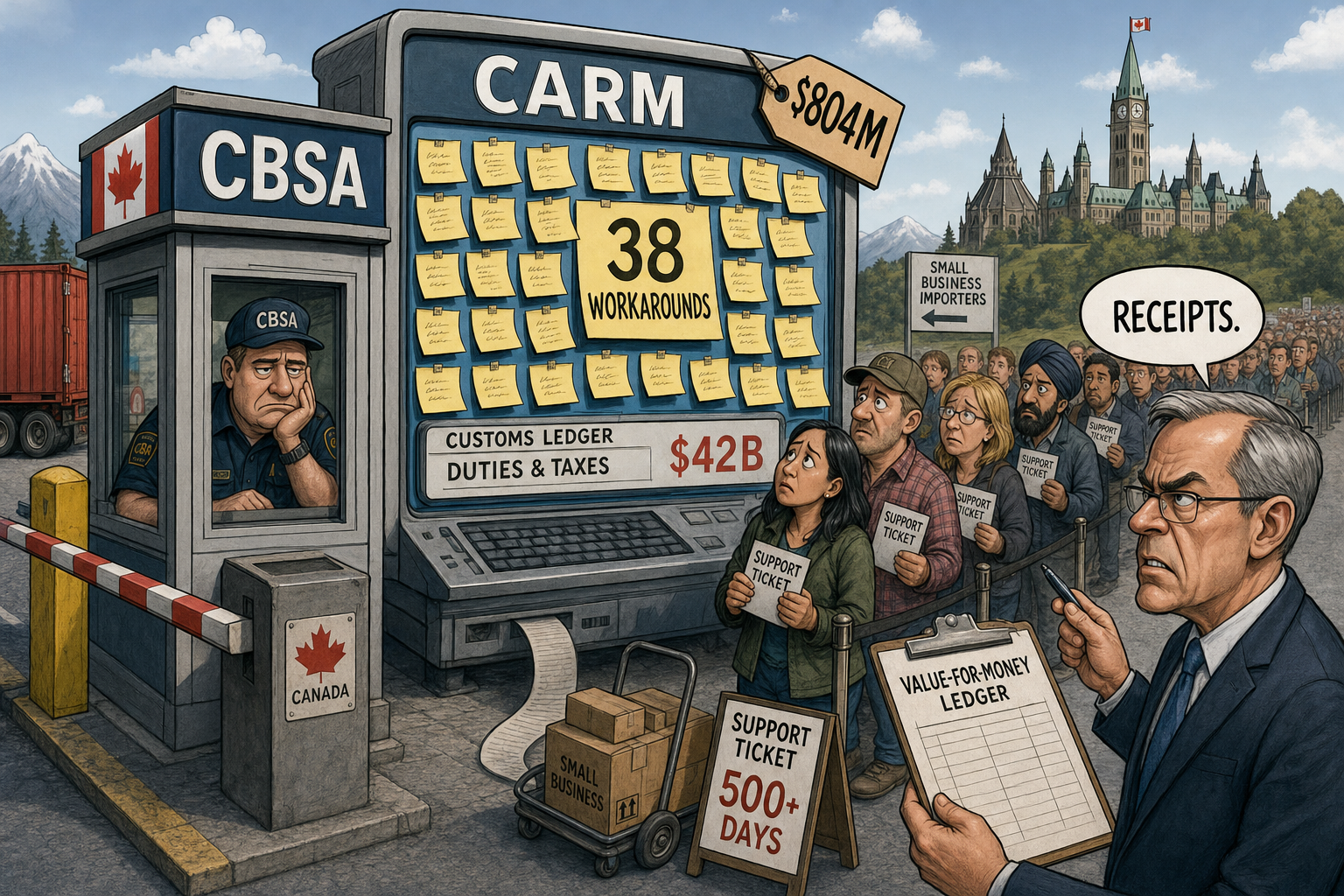
The Auditor General’s October 29 report on the Canada Border Services Agency’s CARM system is a basic test of federal competence: when Ottawa spends more than $800 million on a revenue system, Canadians should see measurable value for money, not a stack of manual workarounds.
CARM — the CBSA Assessment and Revenue Management system — is not a minor back-office tool. The Auditor General reported that it processed about $42 billion in customs duties and taxes in 2024–25. It is now central to how Canada assesses, collects and manages money owed on commercial imports. That makes weak performance measurement and slow support more than an inconvenience. It affects trade administration, business predictability and federal revenue integrity.
The system does process import declarations. CBSA’s own October 29 update says the CARM Client Portal is reliable 99% of the time, that more than 263,000 businesses use it, and that nearly all imports are processed electronically. The agency also says core development came in under its approved development budget, at $498.6 million compared with $526.8 million.
But the full bill is larger, and the promised efficiencies remain unproven. CBSA says total investment, including IT maintenance from 2010–11 through 2025–26, stands at $804 million. The Auditor General found that since 2010 the agency invested more than $800 million to develop and maintain CARM, yet the system operated inefficiently and exceeded budgeted amounts, creating an accumulated funding shortfall of about $60 million by the end of 2025–26.
The practical failure is even clearer. CARM was deployed in October 2024, three years late, while still lacking expected functions. Employees had to rely on 38 manual workarounds and older systems for CARM to function as intended. Those workarounds were supposed to be eliminated within a year of deployment, but the audit found they still existed 20 months later. The Auditor General says CBSA expects to spend at least 92,000 employee hours per year navigating those workarounds — time that could otherwise be used to assess higher-risk declarations.
Businesses were also left waiting. The audit found an average of 19,000 assistance requests per month after the transition, more than 4,000 unresolved requests as of June 2026, no service standard for responses, and an average resolution time of 34 days. Some requests had been open for more than 500 days.
This is where conservative accountability should be simple. Publish the CARM ledger: original budget, total spend, funding transfers, launch delays, deferred functions, remaining workarounds, support-ticket age, service standards, importer impacts and dates when promised efficiencies will be independently measured.
A revenue system handling $42 billion should not ask taxpayers to accept slogans about modernization. It should produce receipts.
- Office of the Auditor General: Canada Border Services Agency’s import assessment system is processing duties with expected efficiencies yet to be realized
- Office of the Auditor General: Assessment and Revenue System for Imports
- Canada Border Services Agency: The CBSA provides an update on its new Assessment and Revenue Management system
This article argues for public disclosure and value-for-money accountability. It does not allege unlawful conduct by any supplier or official.