Federal Call-Centre Contract Needs an Invoice-and-Service Ledger
Eight call centres for a 220-call-centre modernization promise is not transformation. It is a receipt problem.
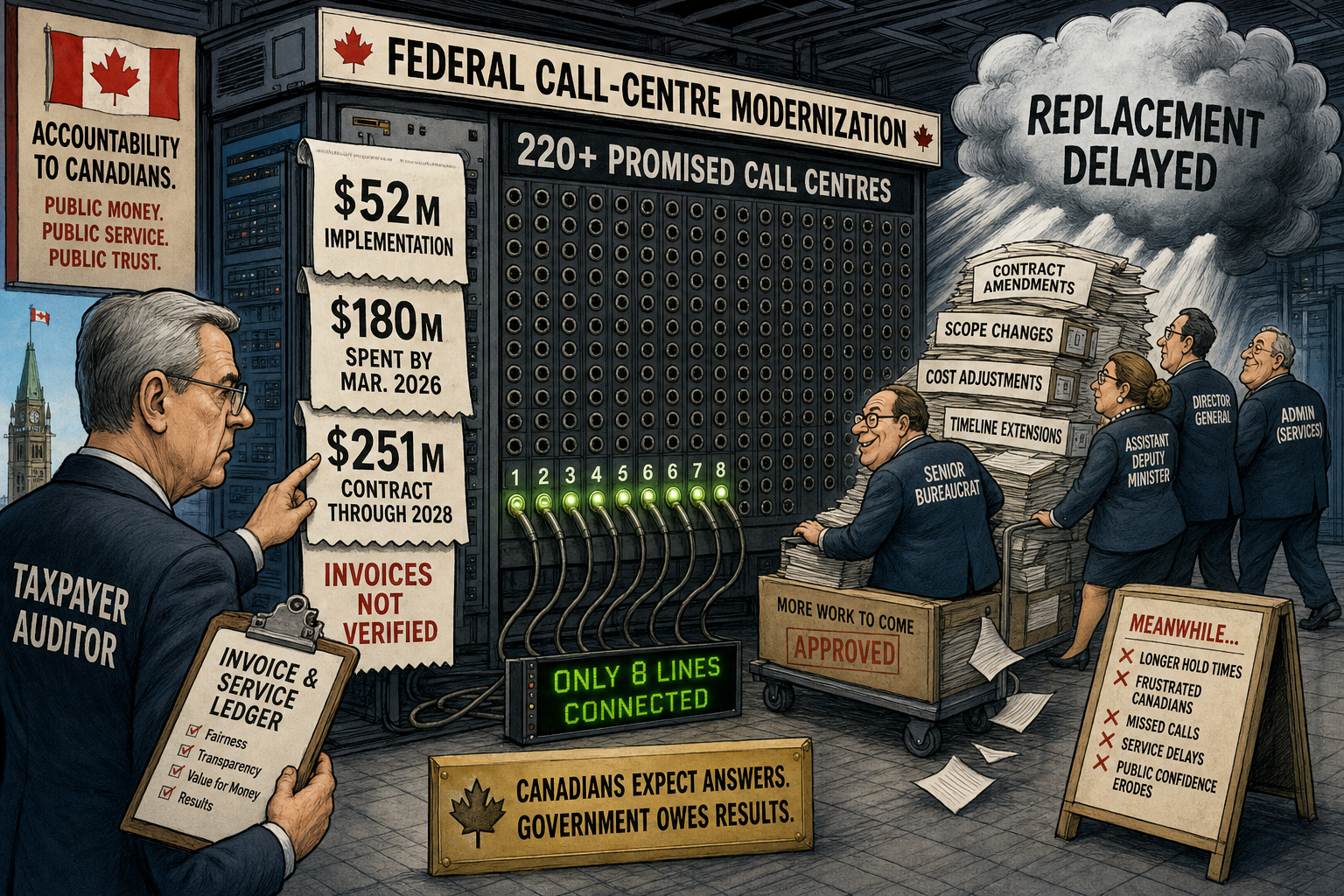
The Auditor General’s October 29 report on federal call-centre technology should be read as a warning about Liberal-era procurement culture: announce modernization, spend for years, reduce scope, extend the old arrangement, then ask Canadians to trust that the next replacement will arrive on time.
Shared Services Canada began in 2013 with a plan to support more than 220 federal call centres. The department awarded IBM Canada a 10-year Hosted Contact Centre Service contract in 2015. By 2020, the Auditor General says only 8 call centres had been onboarded, while implementation costs had climbed to $52 million — three times the original $16 million estimate.
That is not just an IT footnote. Federal call centres are where Canadians try to reach programs such as the Canada Revenue Agency, Employment and Social Development Canada and Immigration, Refugees and Citizenship Canada. When the backbone is late, narrowed or poorly managed, the service risk lands on citizens waiting on the phone.
The contract ledger is worse than the delivery count. The Auditor General reported that about $180 million had been spent on the Hosted Contact Centre Service contract by March 2026. After two option years and a 14-month extension, the overall contract value is expected to reach $251 million through 2028. The original contract value was $50 million. Taxpayers deserve a plain table showing every amendment, option, invoice, service delivered and feature removed.
The audit also found weak payment controls. Shared Services Canada did not exercise rigorous controls over payments and did not verify invoiced amounts as required. A procurement error affected the project’s cost and scope, and the department removed some intended system features rather than obtaining the best value for money. That is exactly where accountability should get practical: who reviewed the invoices, what proof of service was required, and who signed off when planned features disappeared?
The replacement file is now under the same spotlight. The Auditor General says late procurement planning increased costs, forced continued dependence on legacy systems and created risk of service interruptions. The existing Hosted Contact Centre Service reaches end of life after December 2028. That deadline is not far away in government procurement time.
A serious government would publish an HCCS/CCaaS ledger now: original scope, delivered call centres, contract amendments, invoice verification, vendor payments, removed features, replacement milestones, contingency plans and accountable executives. Canadians do not need another modernization slogan. They need the receipts before the old system expires.
- Office of the Auditor General: Rigour and accountability lacking in procurement processes to update call centre technology
- Office of the Auditor General: Procuring Technology for Call Centres
- Office of the Auditor General: Opening Statement before the Standing Committee on Public Accounts
- Canada Bid Intel: Government call centre contracts after the Auditor General's audit
This article argues for public disclosure and procurement accountability. It does not allege unlawful conduct by any supplier or official.