Carney’s PCO Still Owes Canadians a Secrecy-Orders Ledger
When the Prime Minister’s own central agency draws a record 63 access orders, Canadians deserve a public enforcement ledger — not another promise of openness.
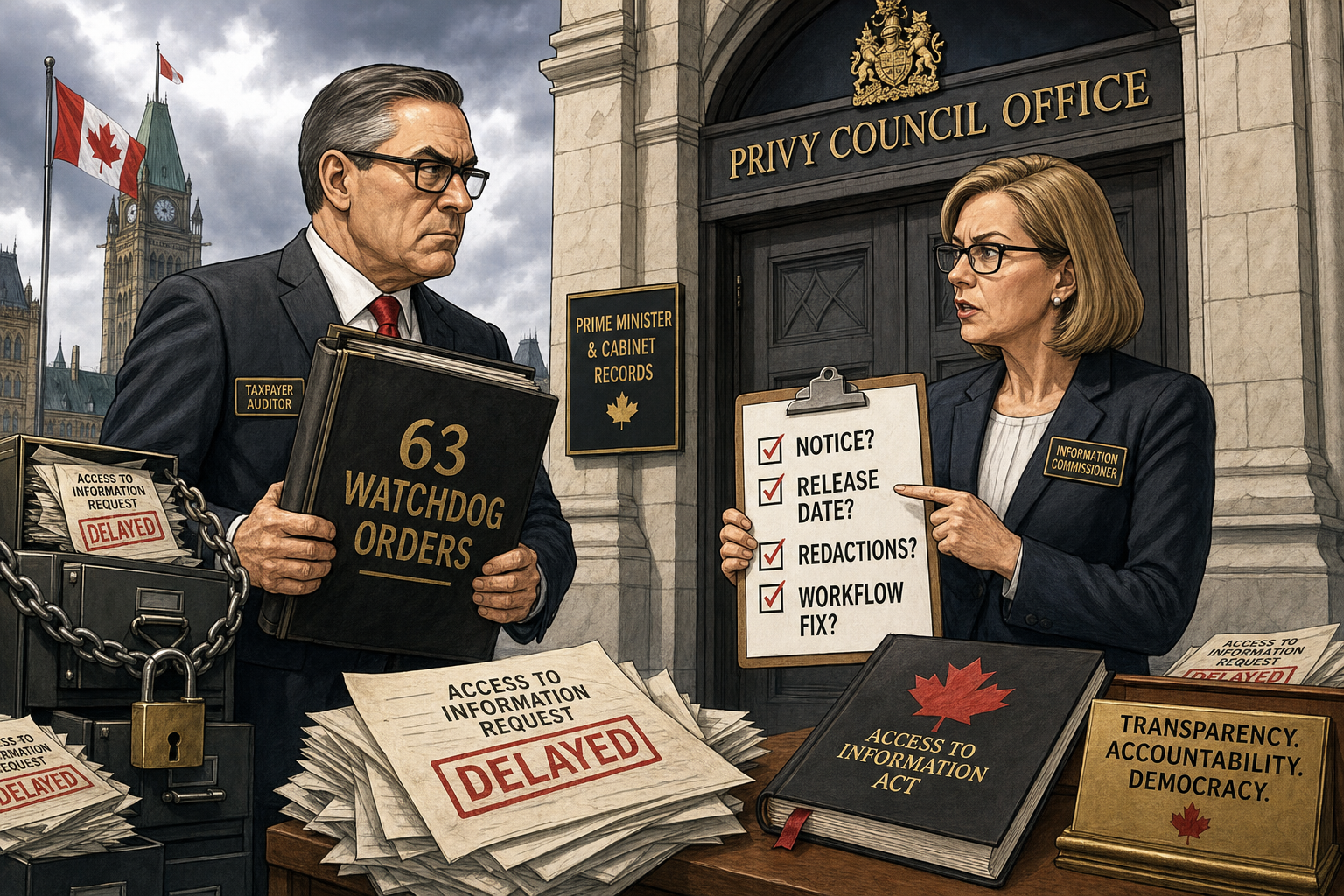
The Privy Council Office is not a back-office agency. It supports the Prime Minister and Cabinet, coordinates the machinery of government and sits close to the records Canadians most need when political narratives require checking. That is why the Information Commissioner’s 2025–26 annual report is not a minor paperwork story. It is a central-government accountability story.
The watchdog reported that PCO had 217 complaints submitted, 225 complaints concluded and 63 orders issued in 2025–26. Those 63 orders were the most ever for the institution. The Commissioner also said those orders came from the well-founded outcome of 28% of concluded PCO complaints, compared with an all-institution average of 8.6%. That is the receipt: the Prime Minister’s own central agency was not merely part of a system-wide delay problem. It stood out.
The compliance issue gets worse. In 10 investigations concluded with orders, the Commissioner said PCO did not provide the required notice indicating whether it intended to implement the orders. For requesters, that notice matters. It tells citizens whether a watchdog order is being honoured, resisted or left in limbo. Without it, transparency becomes a maze where the government centre can force Canadians to chase the next answer.
On November 2, the Commissioner told the House ethics committee that modern government operations must be matched by access-to-information governance. Her warning was blunt: without that alignment, the risk is incomplete responses and the erosion of transparency, accountability and public trust. That warning fits PCO exactly. If cabinet support, digital workflows and politically sensitive files are moving faster than the disclosure rules, Canadians need proof that records are being captured, searched and released on lawful timelines.
The watchdog’s own 2026–27 plan shows why vague assurances are not enough. Refusal complaints assigned to investigators within 120 days reached 50.9% in 2024–25 against an 85% target. The access system is already under strain. PCO should not be adding avoidable opacity at the centre of government.
A conservative accountability standard is simple: publish a PCO access-enforcement ledger. For every complaint and order, list the request date, delay length, exemption claimed, order date, implementation notice, release date, redaction grounds, court challenge status and the management fix ordered by the Clerk. Protect cabinet confidences where the law requires it. But publish the process receipts.
Carney’s government says it values competent management. Competent management starts with obeying the access law and proving it.
- Office of the Information Commissioner of Canada: 2025–2026 Annual Report
- Office of the Information Commissioner of Canada: Information Commissioner’s November 2, 2026 ETHI appearance
- Office of the Information Commissioner of Canada: 2026–2027 Departmental Plan
This article relies on official watchdog documents and argues for disclosure of access-law compliance receipts. It does not allege unlawful conduct by individual public servants.