Canada-China Financial Deal Needs a Market-Access Ledger
Before Ottawa deepens financial integration with Beijing, Canadians should see the signed agreements, access concessions, regulator safeguards and security-screen receipts.
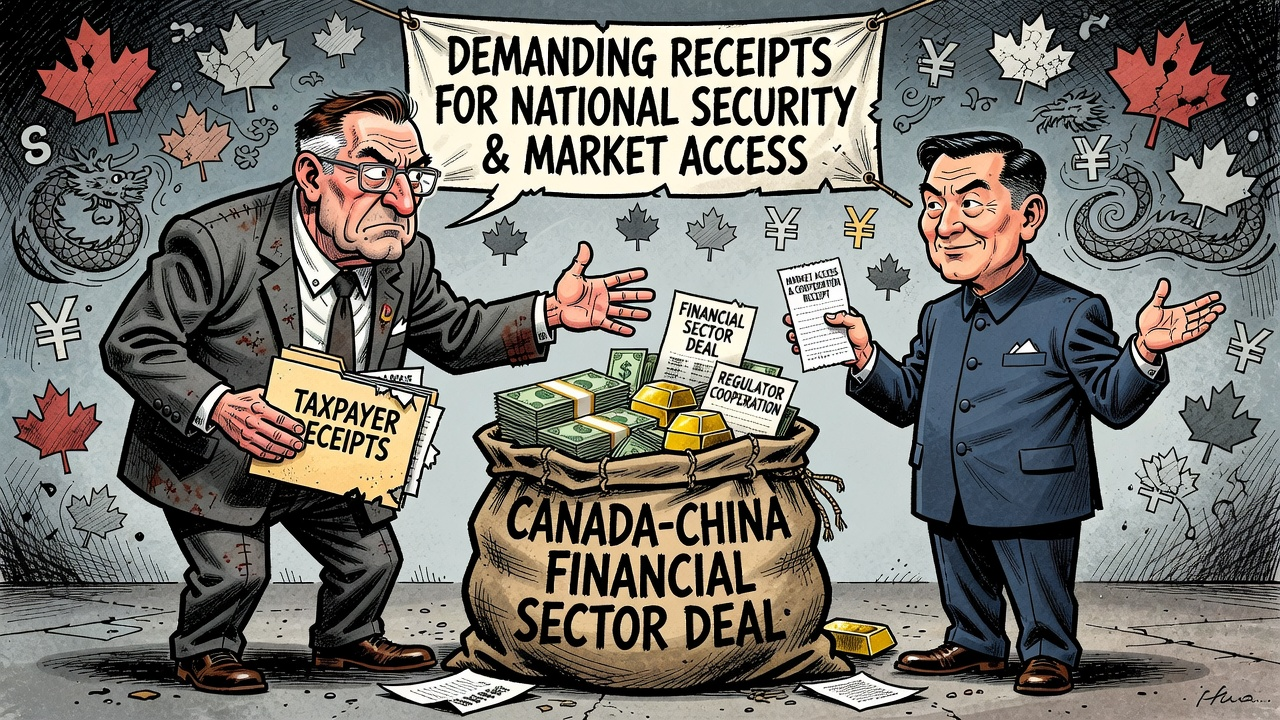
Finance Canada says the Second Canada-China Economic and Financial Strategic Dialogue took place in Vancouver on November 8 and 9, co-chaired by Chinese Vice Premier He Lifeng, Finance Minister François-Philippe Champagne and International Trade Minister Maninder Sidhu. That is not a minor courtesy call. Ottawa says the dialogue produced outcomes meant to strengthen bilateral economic and financial cooperation and advance a renewed strategic partnership.
The core phrase Canadians should not miss is “financial services market access.” The joint factsheet says both sides agreed to enhance financial-sector cooperation, including market access, engagement between capital-market and financial-regulatory authorities, a finance-ministry MOU, an OSFI-NFRA supervisory dialogue, and terms of reference for a financial working group. The Canadian Press summarized it plainly: Canada and China have struck an agreement to deepen collaboration across their financial systems.
Maybe there are legitimate commercial opportunities here. Canadian exporters, banks, pension managers and insurers can all argue that access to a large market matters. But a conservative accountability standard starts with a harder question: what exactly did Canada give, what exactly did Canada get, and what safeguards apply before institutions tied to an authoritarian state are welcomed deeper into Canada’s financial plumbing?
Ottawa’s release says ministers and Vice Premier He also held a business roundtable with industry leaders from both countries. Fine. Publish the guest list. Publish the agenda. Publish which Canadian financial firms, asset managers, pension funds, state-linked entities, law firms and lobbyists attended. Publish whether any participants are seeking licences, exemptions, procurement access, regulatory relief or federal financing. Canadians should not have to guess who was in the room when market-access language was negotiated.
The security ledger matters just as much as the trade ledger. Canada’s financial system is not only a commercial marketplace; it is critical infrastructure, a sanctions channel, a money-laundering target, and a data-rich map of Canadian households and businesses. Any deeper regulator-to-regulator arrangement with Beijing should therefore come with written guardrails: national-security review triggers, anti-money-laundering controls, beneficial-ownership screening, data-localization rules, cyber-risk assessments, sanctions-compliance protocols and foreign-interference reporting obligations.
OSFI should also explain what its new supervisory dialogue can and cannot share. Technical cooperation is one thing. Sensitive supervisory information, bank-risk data or market-integrity intelligence is another. If the agreement contains information-sharing limits, publish them. If it does not, explain why not.
This is not an argument for isolation. It is an argument against blind trust. Before Prime Minister Mark Carney’s next China push is sold as pragmatic diversification, Ottawa should table the actual ledger: signed MOUs, terms of reference, market-access commitments, business-roundtable participants, regulator firewalls, security reviews and measurable Canadian gains. If the deal is as good as ministers suggest, the receipts should make the case.
- Finance Canada: Joint Factsheet: Second Canada-China Economic and Financial Strategic Dialogue
- Finance Canada: Ministers Champagne and Sidhu deepen Canada-China economic ties and cooperation with Vice Premier He Lifeng
- The Canadian Press via CityNews: Canada and China sign deal to deepen financial sector ties
- China MFA: He Lifeng to Chair the Second China-Canada Economic and Financial Strategic Dialogue in Canada
This article argues for public disclosure, security screening and regulator safeguards. It does not allege unlawful conduct by any participant.