Scotia’s $1.999M Major Projects Contract Needs a Sole-Source Ledger
The Major Projects Office can move quickly without turning “extreme urgency” into a blank cheque.
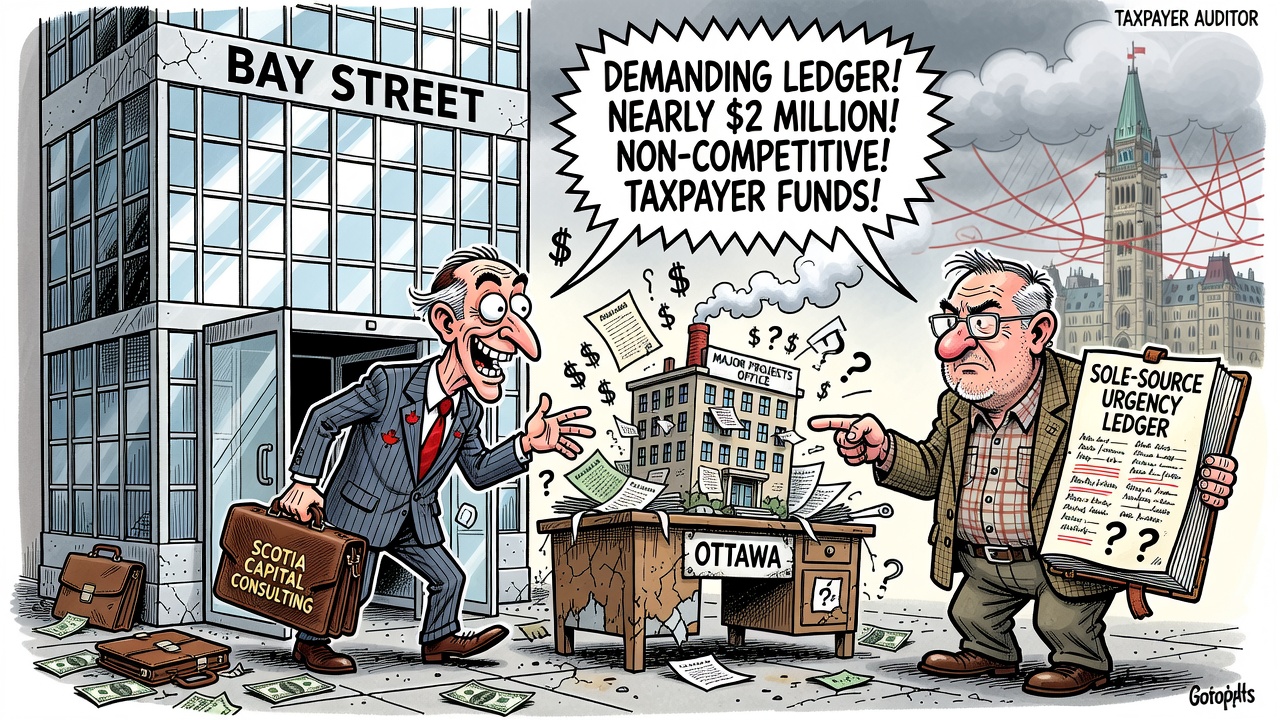
The Major Projects Office was sold as a way to make Canada build again: faster approvals, better co-ordination and the private capital needed to move nationally important projects. That is a defensible goal. But speed does not suspend accountability — especially when a nearly $2 million consulting contract is handed to a Bay Street firm without a competition.
The federal contract record is blunt. The Privy Council Office lists Scotia Capital Inc. as the vendor for “management consulting.” The comments say the contract “was awarded on behalf of the Major Projects Office.” It was dated August 20, 2026, runs to February 20, 2027, and has an original and total value of $1,999,250.
The red flags are in the procurement fields. Solicitation procedure: non-competitive. Limited tendering reason: extreme urgency. Number of bids: one. Article 6 exception: “Only one person is capable of performing the contract.” None of that proves wrongdoing. It does prove that Canadians deserve more than a sparse database entry.
Prime Minister Mark Carney launched the Major Projects Office in August 2025, promising a single point of contact to get nation-building projects built faster. The government said the office would help streamline approvals, reduce timelines for projects of national interest to a maximum of two years, and help structure and co-ordinate financing with private-sector, provincial, territorial and federal partners. Canada’s official MPO page now says the office works on regulatory co-ordination, financial co-ordination and structuring, and possible Building Canada Act listings.
That is exactly why this contract matters. If the office is influencing financing structures, project pipelines, regulatory timing or investor-facing advice, then a sole-source financial-consulting contract is not a routine stationery purchase. It sits near the machinery that decides which projects move, how they are packaged, and what public supports may be considered.
The conservative accountability standard should be simple: build faster, but publish the receipts. Ottawa should release the statement of work, the urgency memo, the legal basis for claiming only one supplier could perform the work, conflict-of-interest screens, deliverables, invoice milestones, project files touched, and whether any other banks or advisory firms were considered. If legitimate commercial sensitivities exist, redact narrow details — not the whole rationale.
Taxpayers are not asking bureaucrats to slow every project into paralysis. They are asking the Carney government to prove that “urgent” has not become a password for insiders, and that “only one person is capable” was tested before it was typed into a contract record.
The Major Projects Office may need specialized financial expertise. Scotia Capital may have relevant expertise. But expertise is not a substitute for competition, and urgency is not a substitute for explanation. When Ottawa builds a fast lane for major projects, Canadians need guardrails on that lane: open procurement where possible, documented exceptions where not, and a public ledger showing who is advising government, on what terms, and around which decisions.
A government that says it can move at private-sector speed should also be able to produce private-sector-grade documentation. Publish the sole-source ledger.
- Government of Canada Open Contracting: Privy Council Office contract record — Scotia Capital Inc.
- Government of Canada: Major Projects Office
- Prime Minister of Canada: Prime Minister launches Major Projects Office
- Treasury Board of Canada Secretariat: Supplementary Estimates (A), 2026–27
- Rebel News: Scotia Capital got a $2 million contract for Carney’s Major Projects Office without a competition
This article relies on the public contract record and argues for disclosure of the procurement rationale. It does not allege illegality or improper conduct by Scotia Capital.