The Deficit Isn’t the Invoice: Budget 2026 Shows a $169B Cash Requirement
Ottawa’s headline deficit is only the first number Canadians see. The cash-financing bill is the number they will pay to carry.
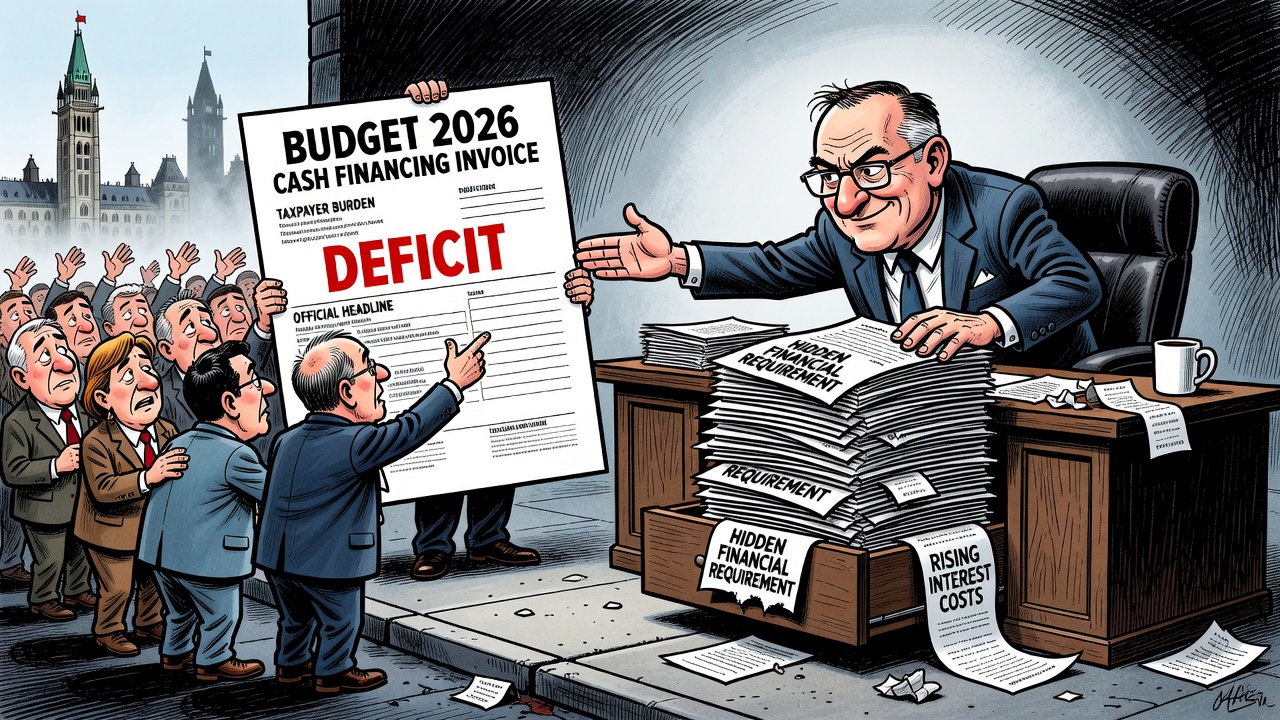
Budget 2026 is being sold as disciplined because the Liberal government says it is protecting fiscal anchors, investing for growth and moving the operating budget toward balance. That may be the message box. It is not the whole invoice.
The government’s own annex shows a budgetary deficit of $62.3 billion in 2026-27, followed by $62.5 billion in 2027-28, $57.6 billion in 2028-29, $53.4 billion in 2029-30 and $52.9 billion in 2030-31. In plain English: there is no balanced budget anywhere in the forecast window. The red ink simply becomes a managed feature of the plan.
But the more important line is the one most press releases skip. Budget 2026’s summary statement of transactions projects a financial requirement of $149.5 billion in 2026-27 and $169.0 billion in 2027-28. That is not the same thing as the deficit. It is the broader cash need after non-budgetary loans, investments, advances and accounts are included. If the deficit is the political headline, the financial requirement is closer to the financing invoice.
That distinction matters because debt service is already consuming real money. Public debt charges are projected at $60.2 billion in 2026-27, then $67.3 billion, $73.8 billion, $78.4 billion and $85.5 billion by 2030-31. The government argues those costs remain manageable as a share of GDP. Conservative accountability should ask a different question: what services, tax relief or debt reduction disappear when interest becomes one of Ottawa’s biggest recurring bills?
Federal debt is also projected to rise from $1.306 trillion in 2025-26 to $1.593 trillion by 2030-31. A falling or stable debt-to-GDP ratio can be useful context, but it does not erase the fact that taxpayers are carrying hundreds of billions more in nominal federal debt while interest costs climb each year.
The government can argue that some borrowing finances productive capital investment. Fine. Then publish a project-by-project receipt ledger: the amount borrowed, the asset built, the expected return, the repayment path, the risk if growth does not arrive and the annual interest cost attached to each envelope. If these are investments, they should survive investment-grade disclosure.
Carney’s budget asks Canadians to trust that today’s borrowing will build tomorrow’s prosperity. Trust is not an accounting method. Parliament should demand the full cash-financing table every time Ottawa cites the deficit, because the deficit is not the invoice. It is only the part of the invoice the government prefers to talk about.
- Finance Canada: Budget 2026 Annex 1 — Details of economic and fiscal projections
- Finance Canada: Budget 2026 Annex 2 — Debt management strategy
- Finance Canada: Budget 2026 Economic and fiscal overview
- Associated Press: Carney unveils budget to strengthen Canada’s economy
This article uses Finance Canada’s official Budget 2026 tables as the primary source for deficit, debt, debt-service and cash-financing figures.