The Places-of-Worship Safety Ledger Parliament Refused to Open
When churches, synagogues, mosques, temples and gurdwaras are threatened, Canadians deserve one public record—not a procedural shrug.
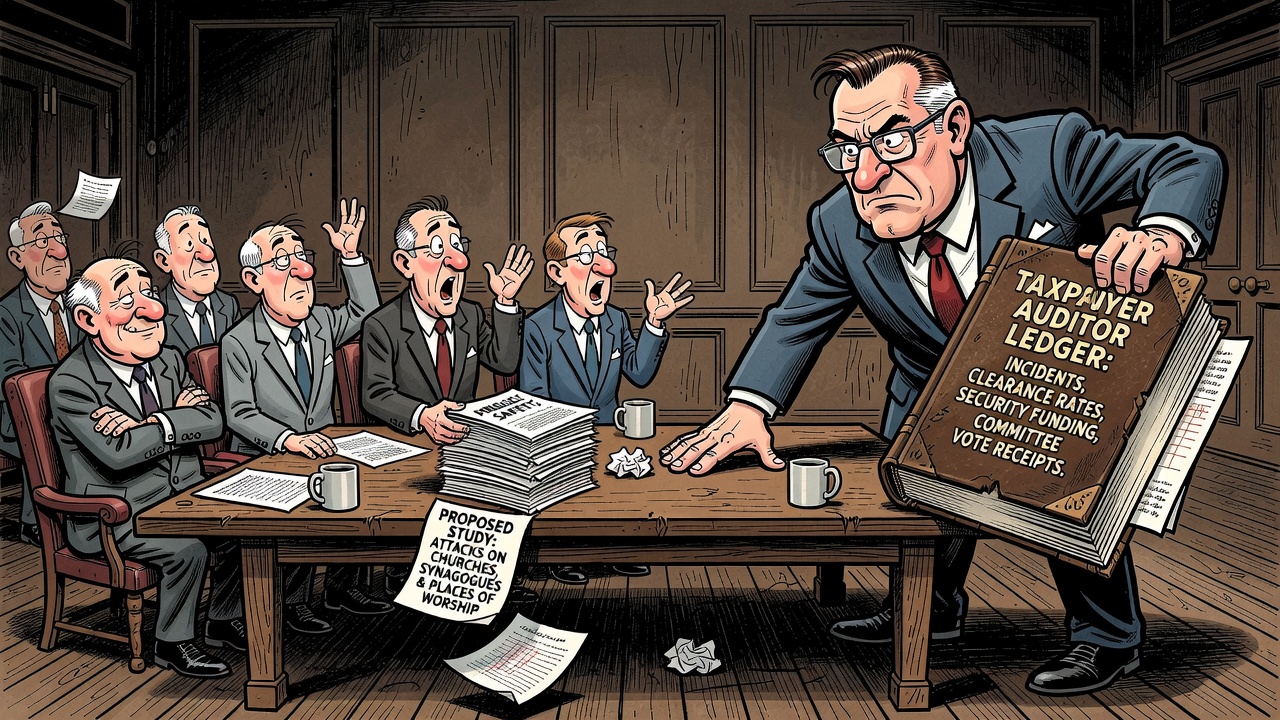
On October 29, Conservative MP Andrew Lawton tried to move the House of Commons Heritage Committee into a study of vandalism, arson, shootings and other criminal attacks against places of worship in Canada. The Democracy Fund says the chair ruled the motion inadmissible as outside the committee’s mandate, and a majority sustained that ruling. Juno News and LifeSiteNews reported the same broad sequence: a proposed study, a mandate objection, and Liberal and Bloc members backing the chair.
This should not be hard. If Ottawa can find parliamentary time for online speech rules, national identity programs and cultural policy, it can find a forum for Canadians whose churches, synagogues, mosques, temples, gurdwaras and other houses of worship have been attacked or threatened. The issue is not sectarian. It is basic public safety and equal citizenship.
Lawton’s proposed study, as reported by LifeSiteNews, cited police-reported hate crimes targeting religion rising from 469 to 1,115 annually since 2015. It also proposed hearing from the Minister of Canadian Identity and Culture, the Minister of Public Safety, the justice minister, Statistics Canada, police services and representatives from Jewish, Christian, Muslim, Hindu, Sikh and other faith communities. That is exactly the kind of witness list a serious Parliament would want: victims, police, data officials and accountable ministers in the same public record.
The strongest response is not outrage for one denomination. It is receipts for every community. Canadians need a places-of-worship safety ledger showing each reported incident by date, location, faith community, offence category, investigation status, clearance status, prosecution status, security funding received, and whether the site had previously requested protection. Where a fire is still undetermined, say so. Where an incident was not hate-motivated, say so. Where the case is unresolved, say that too.
That ledger should also publish the committee record. Which MPs voted to sustain the chair’s ruling? What precise mandate rationale was used? Which committee, if not Heritage, will study the matter? Public safety? Justice? Human rights? Parliament cannot claim the problem belongs somewhere else and then never open the somewhere else.
Conservatives should be clear: religious freedom is not merely the right to hold private beliefs. It includes the practical ability to gather safely, pray safely, mourn safely and maintain community buildings without fear. A government that talks endlessly about inclusion should be willing to count the attacks, publish the outcomes and explain what it is doing to prevent the next one.
Sunlight is the minimum. If Ottawa refuses a committee study, it owes Canadians a better alternative: a national incident table, quarterly clearance-rate updates, transparent security-grant reporting and a public hearing where affected congregations can testify under one roof.
- poliOSINT transcript mirror: House of Commons Heritage Committee meeting 50, October 29, 2026
- The Democracy Fund: Concern after Commons committee declines to study attacks on places of worship
- Juno News: Liberals block study into church burnings and synagogue attacks
- LifeSiteNews: Report on Lawton motion and cited hate-crime/arson figures
This article argues for transparent public-safety reporting across faith communities. It does not prejudge unresolved investigations or claim every incident was hate-motivated.