Low-Wage TFW Reforms Need a Local-Hiring Receipt Ledger
If Ottawa says Canadians remain first in line, it should prove it before low-wage access expands.
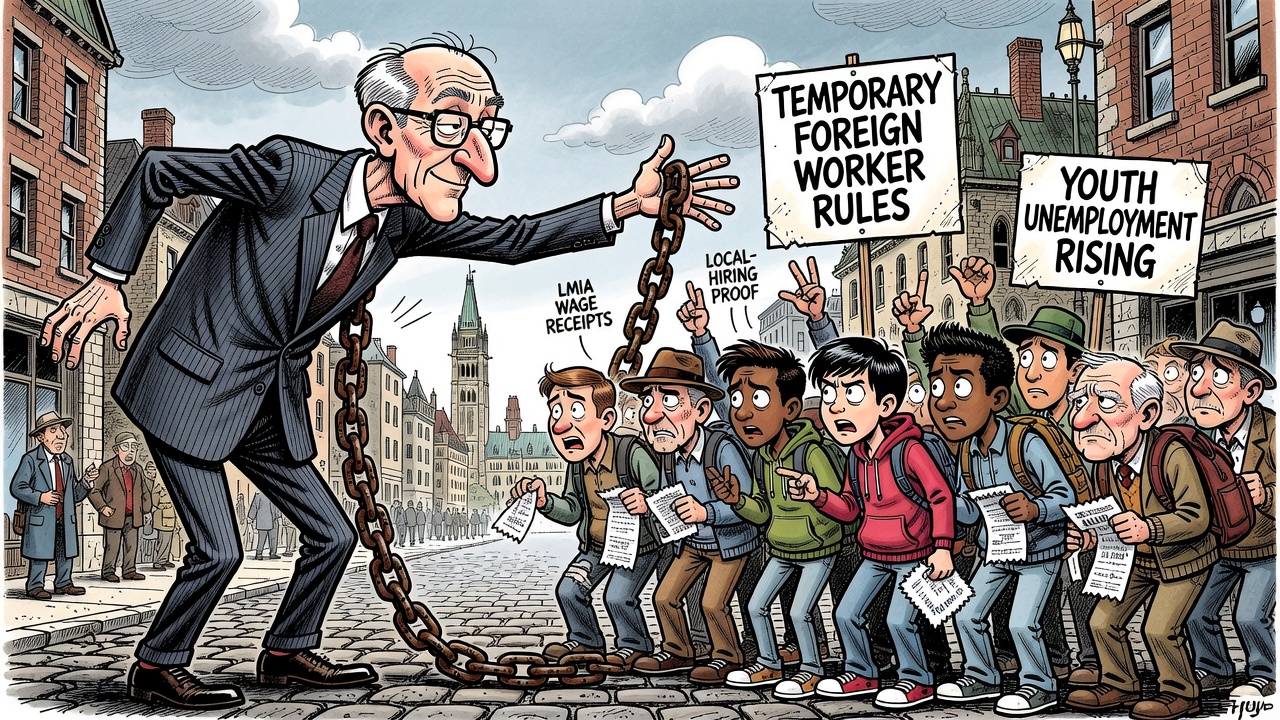
Ottawa’s November 6 Temporary Foreign Worker announcement is being sold as “targeted” and “responsive.” That may be the government’s intention. But after the October jobs report showed national unemployment rising to 6.7% and youth unemployment climbing to 13.7%, the low-wage stream deserves a much harder public test.
Employment and Social Development Canada says Low-Wage Stream LMIA applications submitted on or after November 6 can now have a maximum duration of up to two years, up from one year. The department also added early childhood educators to the exception list for low-wage LMIA processing in Census Metropolitan Areas with unemployment rates of 6% or higher, alongside existing priority sectors such as health care, construction and food processing.
The larger change is scheduled for March 1, 2027, if provinces and territories opt in. Ottawa says employers in identified communities could be allowed to hire temporary foreign workers for up to 15% of their workforce through the Low-Wage Stream, up from the current 10% cap, while priority sectors would remain at 20%. Budget 2026 also proposes $151.5 million over five years for ESDC to implement TFW reforms and $82 million over four years for the Migrant Worker Support Program.
Here is the conservative accountability problem: the government cannot call a program “last resort” while asking Canadians to trust unpublished evidence. If a daycare, farm, plant or rural employer has a real shortage, show the applications, wages offered, training attempts, retention numbers and local unemployment data. If the shortage is sector-specific, publish the occupation code and region. If the employer is asking for a two-year LMIA, show why a one-year approval and renewed local recruitment would not do.
This is not an argument against immigrants or temporary foreign workers. They are often the people most exposed when the rules are loose and enforcement is opaque. The point is that low-wage programs can become a pressure valve for employers who would rather import scarcity than raise wages, improve schedules, train local workers or compete for young Canadians looking for a start.
Ottawa’s own wording says Canadians must remain “first in line.” Good. Put that promise in a public ledger. Before any employer receives expanded low-wage access, Canadians should be able to see the recruitment proof, wage comparison, inspection record, violations history, workforce share, occupation need, provincial sign-off and local unemployment rate.
A serious labour-market policy can survive transparency. A loophole cannot. If the Liberal government wants Canadians to accept longer low-wage approvals and higher regional caps, it should stop asking for faith and start publishing receipts.
- Employment and Social Development Canada: Targeted reforms to the Temporary Foreign Worker Program
- Budget 2026: Chapter 3: workforce, immigration and TFW reform measures
- Statistics Canada: Labour Force Survey, October 2026
- Global News / The Canadian Press: October unemployment report coverage
This article criticizes federal program design, employer-access rules and transparency. It does not blame immigrants, temporary foreign workers or individual employees.