Canada’s Chinese EV Quota Needs a Forced-Labour Import Ledger
Affordable vehicles do not justify importing supply-chain opacity. Ottawa should publish the receipts before the quota fills.
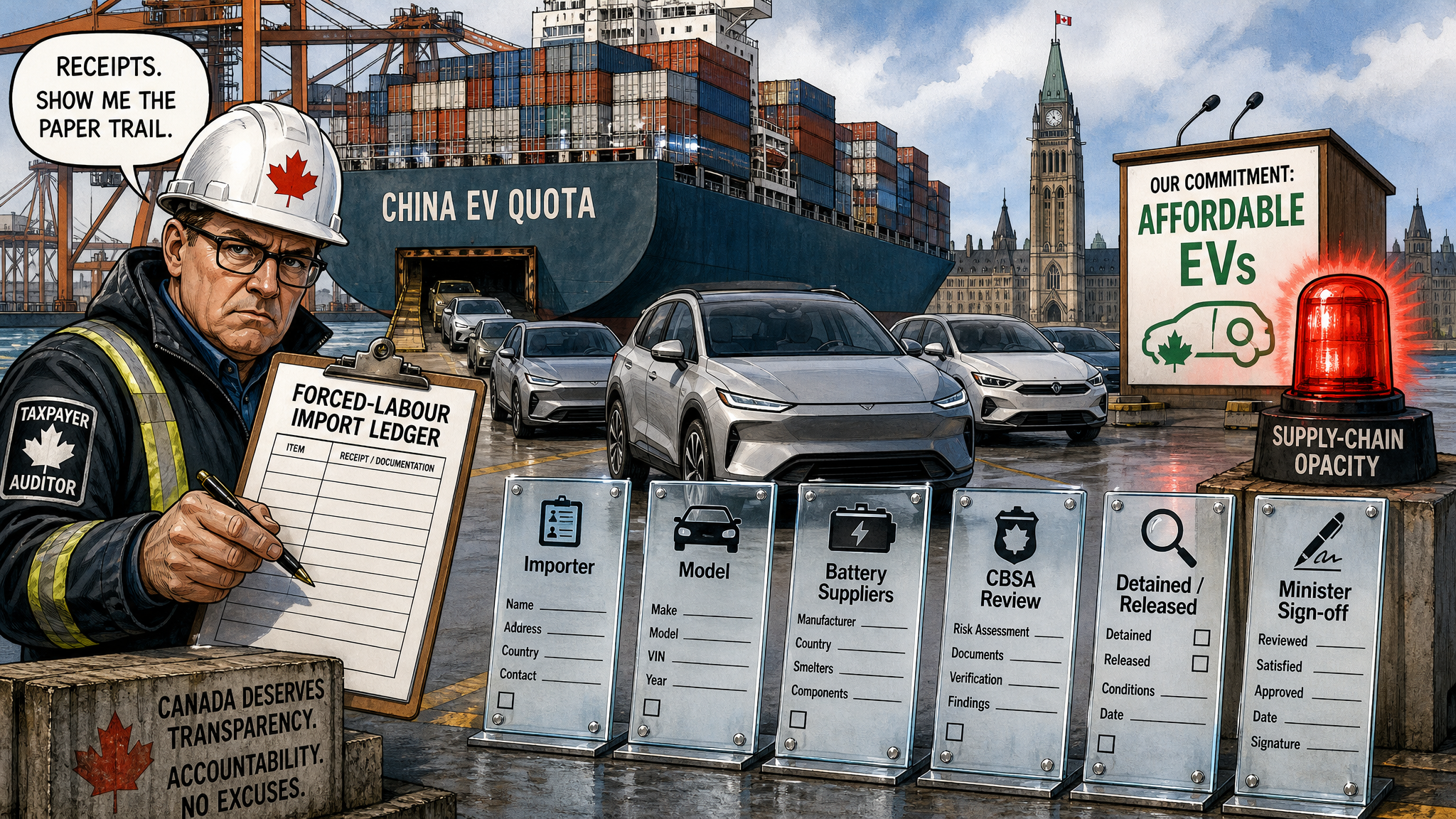
Canada’s China electric-vehicle quota is no longer an abstract trade file. Global Affairs says the January 16, 2026 Canada-China arrangement created an initial country-specific quota of 49,000 Chinese EVs per year at the 6.1% most-favoured-nation tariff rate, implemented March 1.
The Canada Gazette explains the policy trade-off plainly: Canada had applied a 100% surtax on Chinese EVs in 2024; under the 2026 arrangement, the quota would replace that approach for eligible imports, with annual volume starting at 49,000 units and increasing by 6.5% each year. Using rounded annual volumes, that points to 278,989 vehicles over five years: 49,000, 52,185, 55,577, 59,190 and 63,037.
That is a lot of vehicles to move through a system that still owes Canadians a forced-labour proof file. Global Affairs’ August notice says every covered EV import requires a shipment-specific permit and that imports without a permit are prohibited. It also says the second period of quota year one, from September 1, 2026 to February 28, 2027, makes 24,500 vehicles available plus unused volume from the first period.
Parliament has already put the hard question on the record. At the May 4, 2026 Industry committee meeting, Michael Kovrig was asked whether Canada could credibly assure that no Chinese EVs entering the country contain components produced by forced labour. His answer was: not currently. He then warned MPs that forced labour is built directly into parts of the EV supply chain.
The conservative accountability standard is not complicated. If Ottawa wants managed market entry for cheaper EVs, it should prove that market entry is clean, enforceable and transparent. A permit number is not enough. Canadians need a public forced-labour import ledger before quota volumes become routine.
That ledger should list, permit by permit, the importer of record, manufacturer, model, shipment date, port of entry, tariff classification, quota allocation, country-of-origin determination, battery supplier, aluminum and critical-mineral suppliers, due-diligence documents reviewed, CBSA referral status, any detention or release decision, exemptions, corrective action and ministerial sign-off. If confidentiality is claimed, publish the legal basis and a redacted version rather than hiding the whole file.
Ottawa cannot ask Canadians to trust a China trade reset while withholding the basic import receipts. Cheap EVs may help consumers, but affordability is not a licence to outsource ethics enforcement to opaque supply chains. Before the quota fills, publish the ledger.
- Global Affairs Canada: Electric vehicle imports from China
- Global Affairs Canada: Notice to importers — Serial No. 1168
- Canada Gazette: Order Amending the Import Control List (2026-1)
- House of Commons INDU committee: May 4, 2026 evidence on federal EV policies
- House of Commons written question: Q-1233 on Chinese-made EV analysis
This article criticizes federal trade transparency and forced-labour enforcement. It does not allege that a specific importer or vehicle shipment used forced labour.